
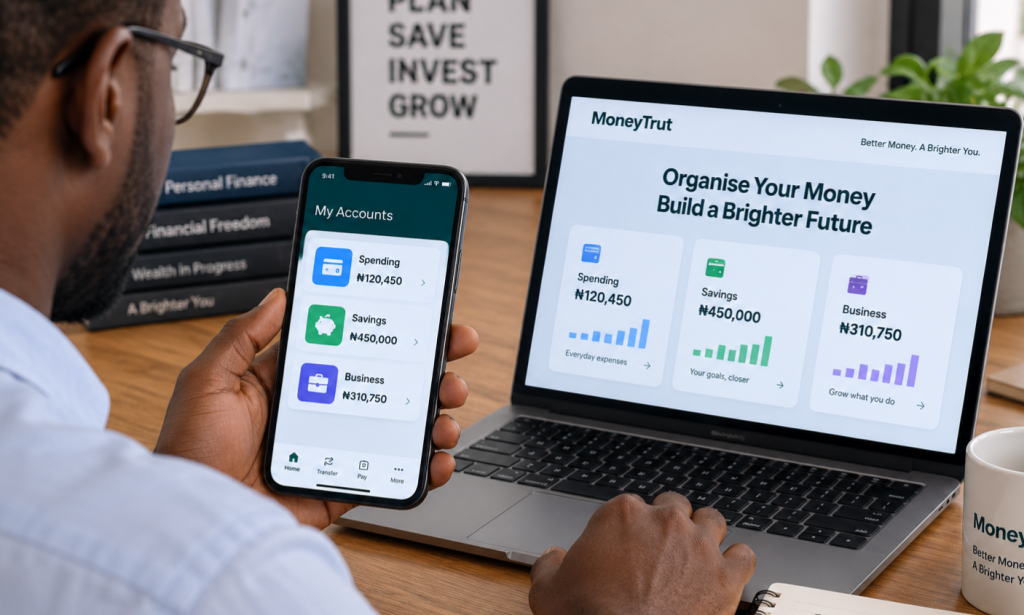
How many bank accounts do you have?
One?
Two?
Three?
Five?
Or perhaps you have lost count because every bank, fintech app or savings platform you have used seems to have created another account for you.
Having multiple accounts is not automatically good or bad.
The real question is:
Does each account have a useful purpose?
For some people, one bank account is perfectly adequate.
For others, separating money into different accounts can make budgeting, saving and managing a business much easier.
The important thing is not to collect bank accounts.
It is to create a system that makes your money easier to manage.
How Many Bank Accounts Do You Actually Need?
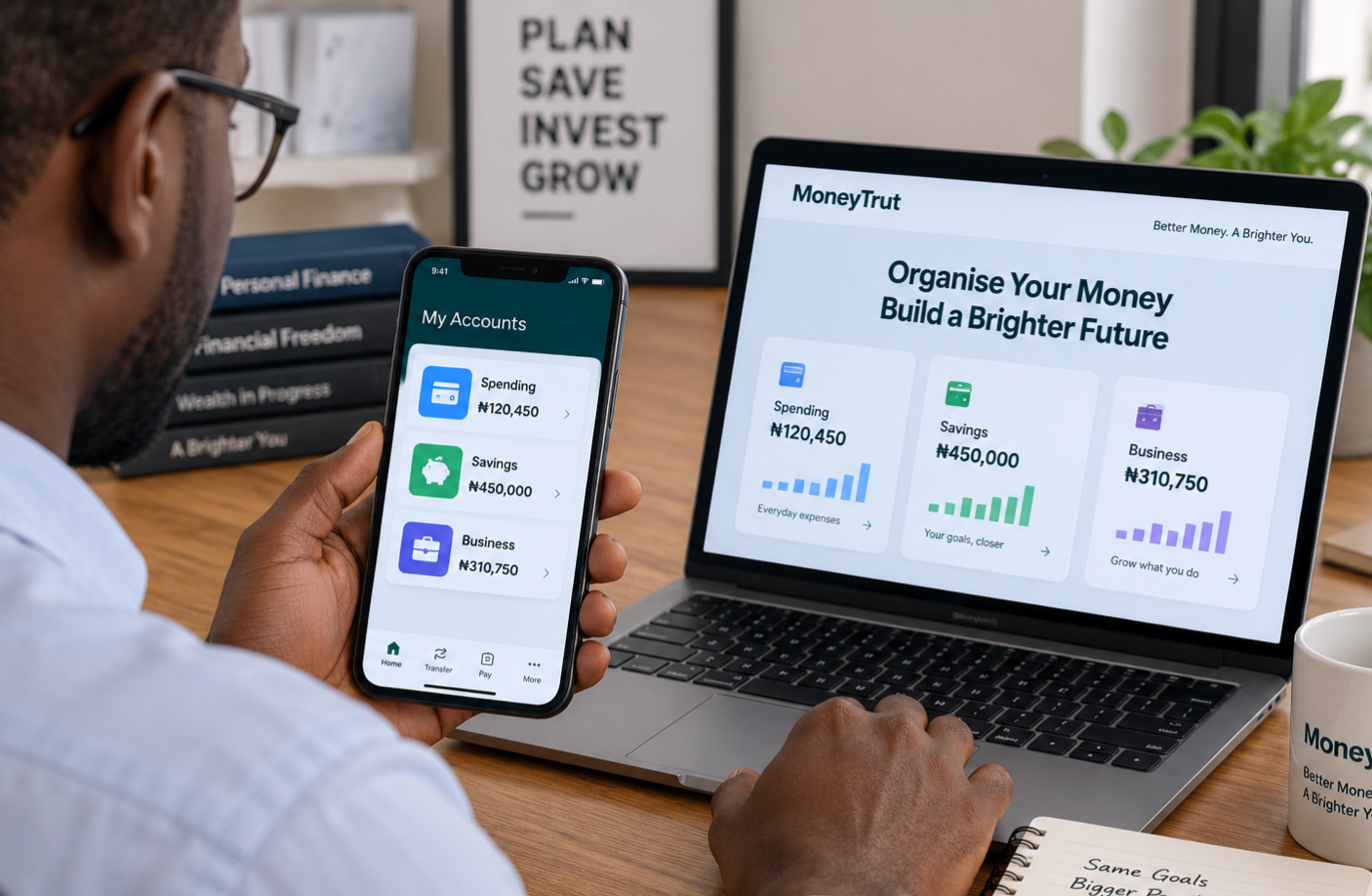
There is no universal number.
A person earning ₦150,000 per month with straightforward expenses may manage perfectly well with one or two accounts.
Someone earning ₦1 million with investments, a side business, multiple income sources and several financial goals may benefit from having more.
A useful way to think about it is:
One account for everyday money.
One account for money you are deliberately keeping.
Then add another account only when there is a clear reason.
For many people, two or three well-organised accounts can be enough.
The exact number depends on your financial situation.
Why Would You Need More Than One Account?
The main reason is separation.
If your salary, rent money, emergency savings, spending money and business income all sit in the same account, everything can look like available money.
Suppose ₦500,000 enters your account.
You know that:
- ₦100,000 is for savings
- ₦80,000 is for rent
- ₦50,000 is for investments
- ₦270,000 is for normal expenses
But your account simply shows:
Available balance: ₦500,000
That can make it psychologically easier to spend money that already has a purpose.
Separate accounts can create a physical or digital boundary between different types of money.
Account 1: Your Everyday Spending Account
This is the account you use for normal expenses.
It may receive your salary or a regular transfer from your main income account.
You can use it for:
- Food
- Transportation
- Airtime and data
- Utilities
- Subscriptions
- Shopping
- Transfers
- Other everyday expenses
For example, suppose you earn ₦500,000 monthly.
You might decide that ₦300,000 is your planned spending amount.
Instead of leaving the entire ₦500,000 in the account you use every day, you could transfer ₦300,000 into your spending account.
The remaining money stays elsewhere for its intended purposes.
Now your spending account itself provides a boundary.
If you see ₦300,000, you know that is the money available for your normal monthly spending.
Account 2: Your Savings Account
A separate savings account can make it easier to avoid spending money meant for a future goal.
You could use it for:
- Emergency savings
- A major purchase
- School fees
- Rent
- Travel
- Equipment
- A business goal
- Other planned expenses
The important thing is to define what the money is for.
For example:
Salary: ₦500,000
Everyday spending: ₦300,000
Savings: ₦100,000
Investing: ₦50,000
Other planned expenses: ₦50,000
The exact figures will vary according to your income and obligations.
The principle is to give your money a purpose before it gets spent.
MoneyTrut's guide on saving from your salary goes into this in more detail:
How Much Should You Save From Your Salary Every Month?
Account 3: Your Emergency Fund
Should your emergency fund have its own account?
It can be useful, particularly if you know you are likely to spend savings that remain too accessible.
An emergency fund exists for unexpected but important expenses.
For example:
- Sudden medical expenses
- Urgent repairs
- Loss of income
- Essential family emergencies
- Unexpected major bills
The point is not to use it for:
- New clothes
- Entertainment
- Weekend outings
- A new phone you simply want
- Impulse purchases
If your emergency fund sits beside your everyday spending money, it may be tempting to treat it as ordinary savings.
Separating it can make its purpose clearer.
MoneyTrut explains emergency funds here:
How Much Should You Have in an Emergency Fund?
And if your income is limited:
How to Build an Emergency Fund With a Low Income
Do You Need a Separate Investment Account?
Not necessarily a separate bank account, but it can be useful to separate money intended for investing from money intended for everyday spending.
Suppose you receive ₦500,000.
If you leave your investment money in your normal spending account, you may gradually spend it.
Instead, you could move the amount you intend to invest into the appropriate investment platform or account.
For example:
₦50,000 → investment
₦300,000 → spending
₦100,000 → savings
₦50,000 → planned expenses
The key is not having another bank account simply for the sake of having another account.
It is keeping investment money from becoming accidental spending money.
The SEC recommends establishing clear investment goals, understanding risk tolerance, researching investments and investing consistently.
What About a Separate Business Account?
If you operate a business or side hustle, separating business money from personal money is particularly useful.
Suppose your salary is:
₦400,000
Your side business generates:
₦200,000
If all ₦600,000 goes into the same account, it becomes difficult to know how much the business actually made.
You might spend business revenue thinking it is personal income.
Instead, you could have:
Personal account: Salary and personal spending
Business account: Customer payments and business expenses
This makes it easier to track:
- Business revenue
- Business expenses
- Profit
- Money reinvested
- Money taken from the business
MoneyTrut previously covered this issue in:
How to Manage Your Money When You Have Multiple Sources of Income
What If You Are a Freelancer?
Freelancers can also benefit from separating personal and work money.
Imagine you earn:
₦300,000 salary
and:
₦150,000 freelance income
If the ₦150,000 is mixed into your salary account, you may gradually spend it without knowing whether your freelance work is actually profitable.
A separate account can help you track the freelance side of your finances.
You can then decide how much of the income should go toward:
- Business expenses
- Taxes where applicable
- Savings
- Investments
- Personal spending
It also gives you a clearer picture of how much your freelance work contributes to your overall finances.
Do You Need a Separate Account for Every Financial Goal?
No.
This is where people can overcomplicate their finances.
Imagine you have:
- Emergency fund
- Rent fund
- School-fee fund
- Vacation fund
- Car fund
- Land fund
- Investment fund
- Clothing fund
- Gadget fund
Opening eight different bank accounts may not make you more financially organised.
It could make your finances harder to track.
You can often group related goals.
For example:
Emergency savings
Planned expenses
Long-term investing
Everyday spending
Four broad purposes may be easier to manage than ten tiny accounts.
What About a Sinking Fund?
A sinking fund is money you gradually set aside for a known future expense.
You do not necessarily need a separate bank account for every sinking fund.
For example, suppose you know you will need:
₦240,000 for annual insurance and other planned expenses.
Instead of waiting until the bill arrives, you could save:
₦20,000 per month × 12 months = ₦240,000
That money can be kept in a broader planned-expenses savings account.
MoneyTrut explains sinking funds here:
What Is a Sinking Fund and How Does It Work?
One Account Can Still Work
There is nothing inherently wrong with having only one bank account.
If your finances are simple, one account may be enough.
For example, imagine someone earning:
₦200,000 per month
Their expenses are predictable.
They have no business.
They have no complicated income sources.
They have a small emergency fund.
They can track their spending and save consistently.
There may be little benefit in opening five accounts.
The problem isn't having one account.
The problem would be using one account without knowing where the money is supposed to go.
The Real Problem Is Usually Not the Number of Accounts
Someone can have seven bank accounts and still be terrible at managing money.
Another person can have one account and manage their finances extremely well.
Financial organisation comes from knowing:
How much comes in.
How much goes out.
What you are saving.
What you owe.
What you are investing.
What each amount is meant to accomplish.
The accounts are simply tools.
A Simple Two-Account System
If your finances are relatively simple, you could start with two accounts.
Account 1: Spending
Use it for:
- Food
- Transport
- Bills
- Shopping
- Transfers
- Everyday expenses
Account 2: Savings
Use it for:
- Emergency fund
- Major planned expenses
- Other savings goals
Suppose you earn:
₦300,000
You could move:
₦60,000 → savings
and leave:
₦240,000 → spending
You now have a simple boundary.
The exact amount should depend on your actual expenses and financial goals.
A Three-Account System
For someone with more complicated finances, three accounts can be useful.
Account 1: Income/Spending
Your salary or regular income comes in here.
Account 2: Savings
Money for emergency funds and planned goals.
Account 3: Business or Investment
Money that has a specific long-term purpose.
For example:
Monthly income: ₦500,000
Spending: ₦300,000
Savings: ₦100,000
Investment/business: ₦100,000
Again, these are examples, not a recommended fixed formula.
What If You Earn ₦1 Million Per Month?
Higher income does not automatically mean you need more accounts.
Suppose you earn ₦1 million.
You could still use three accounts:
Account 1 — Spending: ₦500,000
Account 2 — Savings: ₦200,000
Account 3 — Investment/business: ₦300,000
Or perhaps your actual expenses require a completely different structure.
The important point is that income level alone does not determine the number of accounts you need.
Your financial complexity does.
What If Your Income Changes Every Month?
This is where separate accounts can become especially helpful.
Suppose you are self-employed.
You earn:
January — ₦400,000
February — ₦250,000
March — ₦650,000
April — ₦300,000
Your income isn't predictable.
If every naira stays in one spending account, a good month can make you feel richer than you actually are.
A separate savings or reserve account can help you retain part of the stronger months to support weaker months.
MoneyTrut has a detailed guide on this:
How to Budget When Your Income Changes Every Month
Should Your Salary Go Into Your Spending Account?
It can, but it doesn't have to.
One approach is:
Salary account → distribute money → spending/savings/investment
For example:
Your salary arrives:
₦500,000
You immediately allocate:
₦300,000 → spending
₦100,000 → savings
₦50,000 → investment
₦50,000 → planned expenses
Now your salary account acts as a distribution point rather than the account from which you spend everything.
This can be particularly useful if you are trying to prevent lifestyle creep.
Don't Make Your Savings Account Too Easy to Spend From
A savings account is not very useful as a savings tool if you constantly move money back into your spending account.
Suppose you save ₦100,000.
Three days later:
"Let me just take ₦20,000."
Then:
"Let me take another ₦15,000."
Then:
"I'll replace it next month."
Eventually, the savings account becomes another spending account.
The solution may be to create a stronger boundary.
You could:
- Keep savings separate
- Avoid using the savings account for daily transactions
- Give it a specific purpose
- Automate contributions
- Review it only when necessary
Should You Use Different Banks?
Not necessarily.
You can have multiple accounts within the same bank.
Or you can use different banks.
The choice depends on what you value.
Using the same bank can be convenient because:
- Transfers may be simpler
- You already understand the app
- You have fewer banking relationships to manage
Using different banks can provide:
- Backup access if one bank's systems are unavailable
- Different product features
- Different savings or account options
- A way to separate personal and business banking
But there is no requirement that your accounts must all be with different banks.
Having a Backup Bank Account Can Be Useful
Imagine your primary bank's mobile app is temporarily unavailable when you urgently need to make a payment.
If all your money is in that one account, you may have a problem.
Keeping a modest amount accessible through another bank can provide redundancy.
This does not mean you should keep large amounts of money scattered everywhere.
It simply means you may want a backup option for important transactions.
Don't Spread Your Money So Widely That You Lose Track
There is a downside to having too many accounts.
Suppose you have:
- ₦75,000 in Bank A
- ₦120,000 in Bank B
- ₦50,000 in Bank C
- ₦35,000 in Bank D
- ₦80,000 in a fintech account
You may feel like you have only a little money in each place.
But your total is:
₦360,000
If you don't monitor everything, you may underestimate your actual financial position.
Multiple accounts should make your money easier to manage—not make your financial picture harder to understand.
Keep a Simple Account Map
If you have multiple accounts, create a simple list.
For example:
| Account | Purpose | Target/Use |
|---|---|---|
| Bank A | Spending | Monthly expenses |
| Bank B | Savings | Emergency fund |
| Bank C | Business | Business income/expenses |
| Investment platform | Investing | Long-term wealth |
You don't need to memorise everything.
You simply need to know what each account is for.
What About Fees?
Before opening another account, consider the costs.
Depending on the account and institution, you may encounter:
- Transfer charges
- Card-related charges
- ATM charges
- Account maintenance-related fees where applicable
- Other transaction charges
Don't open another account if its only purpose is to create another place for money to sit while you pay unnecessary charges.
MoneyTrut previously covered ways to reduce unnecessary bank charges:
How to Avoid Unnecessary Bank Charges in Nigeria
The Central Bank of Nigeria also says bank customers have a right to relevant and truthful information about banking products and charges before entering into agreements, as well as a right to an accessible complaints process.
What About Deposit Protection?
If you keep significant amounts of money across different banks, it is worth understanding deposit insurance.
Nigeria's deposit insurance system provides protection for eligible deposits subject to applicable limits and conditions.
This does not mean every financial product is automatically covered simply because it is held through a financial institution.
If you are keeping substantial savings, understand what type of product you are using and what protection applies to it.
Do not assume that a savings account, investment product and other financial products all receive identical protection.
Should You Have a Separate Account for Your Emergency Fund and Savings?
It depends.
Suppose you have:
General savings: ₦200,000
Emergency fund: ₦300,000
You could keep them in one savings account if you can track the amounts accurately.
Or you could separate them if you find it easier psychologically.
The most important distinction is purpose.
If you know:
₦300,000 = emergency fund
you are less likely to treat it as money available for a holiday.
Should Couples Have Separate or Joint Accounts?
There is no universal answer.
Some couples prefer:
One joint account + individual accounts
Others keep their finances completely separate.
Others combine everything.
What matters is agreeing on:
- Household expenses
- Savings goals
- Debt responsibilities
- Major purchases
- Emergency planning
- Financial transparency
A joint account can make shared expenses easier to manage.
Individual accounts can preserve personal financial independence.
Some couples use both.
What About Parents Giving Children Money?
Parents may also choose separate accounts or savings arrangements for children's expenses.
But the appropriate structure depends on the child's age, ownership arrangements, banking rules and the intended purpose of the money.
Don't assume that an account opened for a child works exactly like an ordinary adult account.
Check the institution's current requirements.
When You Probably Don't Need Another Account
Don't open another account simply because:
- A bank is offering a promotion
- You saw someone with ten accounts
- You want to feel financially organised
- You think more accounts automatically mean more savings
- You have forgotten what your existing accounts are for
If your current system works, keep it simple.
When Another Account May Be Worthwhile
Consider adding an account when there is a genuine problem it solves.
For example:
Problem: You keep spending your savings.
Potential solution: Separate savings from spending.
Problem: You can't tell how profitable your side business is.
Potential solution: Separate business money.
Problem: You spend rent money before rent is due.
Potential solution: Separate planned-expense savings.
Problem: You have no backup access to funds.
Potential solution: Maintain a secondary account with a reasonable reserve.
The question should always be:
"What problem will this account solve?"
A Practical Setup for Different Types of People
If You Earn ₦150,000 and Have Simple Finances
You may need only:
1. Spending account
2. Savings account
Keep it simple.
If You Earn ₦300,000 and Are Building Savings
Consider:
1. Spending
2. Savings/emergency fund
3. Investment
If You Earn ₦500,000 and Have a Side Business
Consider:
1. Personal spending
2. Personal savings
3. Business
4. Investment, if necessary
If You Are Self-Employed
You might use:
1. Business income/expenses
2. Personal spending
3. Savings/reserve
4. Investment
Again, these are examples rather than rules.
Don't Confuse More Accounts With More Money
This is the biggest lesson.
Having five bank accounts does not make you wealthier than someone with one.
If you earn ₦300,000 and spend ₦320,000, having six accounts will not fix the problem.
If you earn ₦500,000 and consistently save, invest and manage your expenses well, you can make substantial progress with only a few accounts.
The purpose of account separation is organisation and behaviour, not wealth creation by itself.
The Best Number of Bank Accounts Is the Number You Can Manage
If you have two accounts and understand exactly what each one does, that's good.
If you need four because you run a business, have irregular income and several financial goals, that's also fine.
If you have eight accounts and constantly forget where your money is, you probably have too many.
The right number is:
Enough to separate important financial purposes, but few enough that you can monitor all of them.
A Simple Monthly Routine
At payday, you could use this routine:
Step 1: Receive your income
Salary or business income enters your main account.
Step 2: Allocate savings
Move your planned savings immediately.
Step 3: Fund planned expenses
Set aside money for known future expenses.
Step 4: Fund investments
Move the amount you have decided to invest.
Step 5: Transfer your spending money
Leave or move the amount intended for normal expenses.
Step 6: Track the accounts
Check that the balances correspond with their purposes.
This takes only a few minutes once the system is established.
Bottom Line
You do not need a specific number of bank accounts simply because someone says it is the "right" number.
One account can work.
Two can make saving easier.
Three or four may make sense when you have a business, investments, irregular income or several important financial goals.
But every additional account should have a reason.
The goal is not to create a complicated financial system.
The goal is to make it easier to know where your money is, what it is for and how much you can safely spend.
For many people, a simple structure such as spending + savings + business/investment is enough.
Start there.
Add another account only when it solves a real problem.
And if your current accounts are confusing you, simplifying them may be more useful than opening another one.
Related MoneyTrut Articles
- How to Choose the Right Bank Account in Nigeria
- How Much Should You Save From Your Salary Every Month?
- How Much Should You Have in an Emergency Fund?
- How to Create a Monthly Budget That Actually Works
- How to Manage Your Money When You Have Multiple Sources of Income
- How to Avoid Unnecessary Bank Charges in Nigeria

You must be logged in to post a comment.