
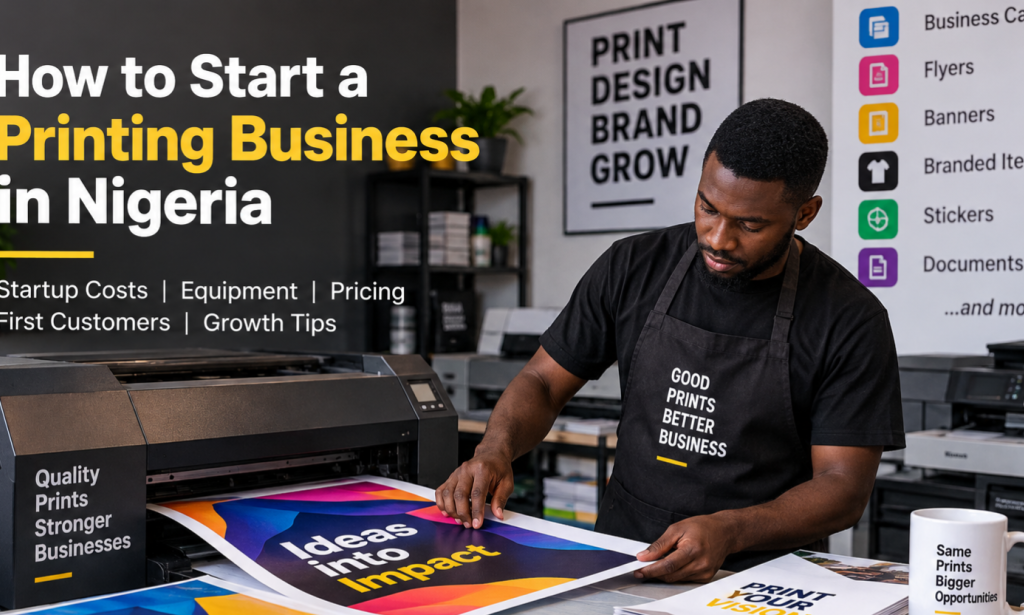
Starting a printing business in Nigeria can range from a small home-based operation producing flyers, business cards and branded materials to a full commercial printing business serving schools, businesses, churches, event planners and corporate organisations.
The mistake many beginners make is thinking that starting a printing business simply means buying a printer.
It does not.
A successful printing business depends on choosing the right printing niche, understanding equipment costs, controlling material waste, pricing jobs correctly, managing power and maintenance costs, and finding customers consistently.
The Nigerian printing market includes digital printing, large-format printing, signage, business stationery, event materials, branded merchandise and other specialised services.
The good news is that you do not necessarily need to own every machine before you start.
You can begin with a focused service, outsource jobs requiring expensive equipment and gradually bring more production in-house as your customer base grows.
The important question is not simply:
“How much does it cost to start a printing business?”
It is:
“What type of printing business do I want to build, who will pay for it, and what will it cost me to produce each job?”
What Is a Printing Business?
A printing business converts digital designs or documents into physical products.
The customer may provide the design, or you may offer design services as part of the package.
For example, a small business might order:
- 500 business cards
- 1,000 flyers
- 100 branded stickers
- 20 promotional T-shirts
A church might order:
- Programmes
- Banners
- Posters
- Invitation cards
An event organiser might need:
- Backdrops
- Directional signs
- Souvenir branding
- Name tags
- Programmes
This means printing is not one single business.
It is a collection of related services that can be combined according to your market.
Choose Your Printing Niche First
Before buying equipment, decide what you want to print.
This is one of the most important decisions you will make.
Digital Document Printing
You can provide:
- Photocopying
- Black-and-white printing
- Colour printing
- Scanning
- Binding
- Laminating
- Typing and document preparation
This model can work near:
- Schools
- Universities
- Government offices
- Business districts
- Courts
- Training centres
The equipment requirements are different from those of a large commercial print operation.
Business Printing
You can target small businesses with:
- Business cards
- Letterheads
- Invoice books
- Receipt books
- Flyers
- Brochures
- Stickers
- Product labels
This can be attractive because businesses may return repeatedly.
Event Printing
You could specialise in:
- Wedding programmes
- Invitation cards
- Birthday banners
- Funeral programmes
- Memorial posters
- Event backdrops
- Table numbers
- Name tags
Nigeria's event industry creates recurring demand for printed materials, although demand varies by location and season.
Large-Format Printing
This includes:
- Banners
- Posters
- Signboards
- Wall graphics
- Outdoor advertising materials
Large-format printing requires more specialised equipment and can involve higher capital requirements.
You do not necessarily need to own the machine initially.
You can outsource production while you concentrate on sales, design, customer service and delivery.
Branding and Promotional Printing
You can also provide:
- Branded T-shirts
- Mugs
- Caps
- Bags
- Stickers
- Corporate gifts
- Promotional materials
Some of these services require specialised equipment, while others can initially be outsourced.
You Do Not Have to Own Every Machine
This is one of the most useful principles for a beginner.
Suppose a customer wants:
- 1,000 flyers
- 5 banners
- 50 branded T-shirts
You may not own equipment for all three.
You could produce the flyers yourself and outsource the banners and T-shirts.
You remain the customer's primary supplier while another printer handles part of the production.
This allows you to test demand before committing large amounts of money to equipment.
How Much Money Do You Need to Start?
There is no universal startup amount.
A small document-printing business can require very different capital from a commercial digital printing operation.
Your capital depends on:
- Type of printing
- Equipment
- Location
- Rent
- Power supply
- Computer
- Design software
- Materials
- Staff
- Working capital
For example, someone starting a small document-printing service from an existing space may spend much less than someone opening a large-format printing shop.
Practical Printing Business Startup-Cost Guide
The following table is a planning guide, not a fixed Nigerian price list. Actual prices vary considerably by equipment brand, condition, capacity, location and whether you buy new or used equipment.
| Startup item | Lean/home-based | Small commercial setup | Larger setup |
|---|---|---|---|
| Computer | ₦150,000–₦300,000 | ₦250,000–₦500,000 | ₦400,000–₦800,000+ |
| Basic printer/digital printer | ₦100,000–₦250,000 | ₦250,000–₦700,000 | ₦700,000–₦2,500,000+ |
| Laminator/binding/finishing | ₦50,000–₦150,000 | ₦100,000–₦300,000 | ₦250,000–₦800,000+ |
| Paper and initial consumables | ₦50,000–₦100,000 | ₦100,000–₦250,000 | ₦250,000–₦600,000+ |
| Design/software/accessories | ₦20,000–₦60,000 | ₦40,000–₦100,000 | ₦80,000–₦200,000+ |
| Power backup/setup | ₦50,000–₦150,000 | ₦100,000–₦300,000 | ₦250,000–₦1,000,000+ |
| Branding/marketing | ₦20,000–₦50,000 | ₦50,000–₦100,000 | ₦100,000–₦250,000+ |
| Rent/shop setup | ₦0–₦150,000 | ₦200,000–₦600,000+ | ₦500,000–₦1,500,000+ |
| Working-capital reserve | ₦50,000–₦150,000 | ₦150,000–₦300,000 | ₦300,000–₦1,000,000+ |
| Approximate starting range | ₦490,000–₦1.36m | ₦1.24m–₦3.15m | ₦2.83m–₦8.65m+ |
These ranges are intended for planning rather than as quotations from equipment suppliers.
There is also an important distinction between buying equipment yourself and starting with outsourcing.
For example, someone with ₦300,000 may be able to start a printing business by handling design, customer acquisition and selected small printing jobs while outsourcing banners, T-shirts and other specialised production.
Someone with ₦3 million may instead decide to bring more production in-house.
The amount of capital you need therefore depends heavily on the business model.
Three Practical Ways to Start
Option 1: Start lean — around ₦200,000–₦500,000
You already have a computer or basic equipment and outsource expensive jobs.
Focus on:
- Design
- Customer acquisition
- Small printing jobs
- Finishing
- Delivery
- Business relationships
Option 2: Small commercial setup — around ₦1 million–₦3 million
You begin purchasing more of your own equipment and consumables.
You may offer:
- Digital printing
- Business cards
- Flyers
- Programmes
- Laminating
- Binding
- Stickers
- Basic branding
You can still outsource large-format or specialised work.
Option 3: Larger production setup — ₦3 million and above
You begin investing in higher-capacity equipment and potentially a commercial workspace.
This could include:
- Higher-capacity digital printers
- Large-format equipment
- Professional finishing equipment
- Multiple computers
- Power backup
- Larger material inventory
At this level, your equipment decisions should be based on proven customer demand rather than assumptions.
A Lean Starting Model
Suppose you have limited capital.
Instead of buying several expensive machines, you could start with:
- Computer
- Basic printer
- Cutting tools
- Laminator
- Binding machine
- Design software
- Paper and consumables
- Internet
- Small working-capital reserve
For specialised jobs, you can outsource production.
This allows you to learn:
- What customers want
- Which products sell
- How much customers are willing to pay
- Which services have better margins
- Which equipment you eventually need
A More Established Printing Setup
A larger operation might eventually add:
- Higher-capacity digital printer
- Colour printer
- Large-format printer
- Paper cutter
- Creasing machine
- Binding equipment
- Laminator
- Heat press
- Screen-printing equipment
- Packaging equipment
But equipment should be added according to demand.
A machine that sits unused is not an asset generating revenue.
It is capital tied up in equipment.
Your Computer Is Part of the Business
Printing is increasingly connected to graphic design and digital workflows.
Your computer may be used for:
- Adobe Illustrator
- Photoshop
- CorelDRAW
- Canva
- PDF preparation
- Customer artwork
- Document formatting
- Print layout
You do not necessarily need the most expensive computer.
Choose one that can comfortably handle the type of design and production work you intend to offer.
Learn Basic Graphic Design
You can run a printing business without being an expert graphic designer if customers regularly provide print-ready artwork.
However, design skills can become an important additional source of revenue.
For example, instead of charging only for printing:
Printing = ₦X
you could provide:
Design + printing = ₦Y
You can create:
- Flyers
- Business cards
- Menus
- Invitations
- Posters
- Social-media graphics
- Brochures
This also makes your business more useful to customers who do not already have a designer.
Understand Print Specifications
A printing business needs more than basic design knowledge.
You should understand concepts such as:
- Resolution
- Bleed
- Crop marks
- Colour modes
- CMYK
- RGB
- Paper sizes
- Paper weight
- Finishing
- Lamination
- Cutting
- Binding
For example, artwork designed for a phone screen is not automatically ready for professional printing.
Learning proper print preparation can reduce expensive production mistakes.
Calculate the Cost of Every Job
Never price a printing job by guessing.
Suppose a customer orders 500 flyers.
Your costs could include:
Paper: ₦20,000
Ink/toner: ₦8,000
Design: ₦5,000
Finishing: ₦4,000
Electricity/fuel: ₦3,000
Labour: ₦5,000
Transport: ₦5,000
Total direct cost:
₦50,000
If you charge ₦75,000:
Revenue:
₦75,000
Direct contribution:
₦75,000 − ₦50,000 = ₦25,000
That ₦25,000 is not automatically your final profit.
You still have to consider:
- Rent
- Equipment maintenance
- Software
- Internet
- Advertising
- Taxes
- Equipment depreciation
- Administrative costs
- Wastage
This is why calculating the full economics of a job matters.
Include Wastage in Your Pricing
Printing materials do not always produce perfect output.
You may have:
- Misprints
- Paper jams
- Incorrect cuts
- Colour problems
- Damaged materials
- Customer design changes
- Machine errors
If you calculate your price based only on the exact number of sheets required, you may underestimate your actual cost.
Build reasonable production wastage into your costing.
Electricity Is a Real Business Cost
Power can significantly affect a printing business.
Your equipment may require reliable electricity for:
- Printing
- Computers
- Design
- Lamination
- Cutting
- Air conditioning
- Lighting
Depending on your location and equipment, you may need to account for:
- Grid electricity
- Generator fuel
- Inverter
- Solar
- UPS
- Maintenance
Do not treat electricity as an afterthought.
Include it in your cost calculations.
Maintain Your Machines
Printing equipment requires maintenance.
Depending on the machine, you may need:
- Cleaning
- Consumable replacement
- Parts replacement
- Calibration
- Servicing
- Technician support
Before buying a machine, find out:
How much does it cost to maintain?
Also ask:
Can I easily get parts and consumables in Nigeria?
A cheap machine that becomes unusable because its parts are difficult to source can become expensive in the long run.
Think About Consumables Before Buying Equipment
A printer may look affordable until you calculate the cost of operating it.
Check:
- Ink
- Toner
- Drum
- Paper
- Maintenance kits
- Print heads
- Replacement parts
The machine purchase price is only one part of the economics.
The real question is:
How much does it cost me to produce one finished unit?
Choose Your Location Carefully
Location can be important, particularly for walk-in printing businesses.
Potential locations include areas near:
- Universities
- Polytechnics
- Schools
- Government offices
- Business districts
- Markets
- Event centres
- Churches
- Courts
- Commercial streets
But a more expensive location is not automatically better.
If most of your customers order through WhatsApp and you deliver, you may not need a premium storefront.
You could operate from a less expensive location and focus on online sales.
Home-Based Printing Can Work
If your equipment and customer volume allow it, you can begin from home.
This can reduce:
- Rent
- Shop setup costs
- Utilities
- Initial overhead
However, consider:
- Space
- Noise
- Power
- Customer access
- Security
- Storage
- Any applicable local requirements
As demand grows, you can decide whether a commercial location is justified.
Create a Clear Price List
Customers should not have to ask you the price of every basic service.
Create a simple price list covering common products.
For example:
- Business cards
- Flyers
- Posters
- Programmes
- Banners
- Stickers
- Brochures
- Lamination
- Binding
- Design
You can still provide customised quotations for larger orders.
A price list makes your business look organised and reduces repetitive conversations.
Do Not Compete Only on Price
Printing can become a race to the bottom if your only selling point is:
“I am cheaper.”
Another printer can always offer a lower price.
Instead, compete through:
- Quality
- Speed
- Reliability
- Convenience
- Design support
- Customer service
- Delivery
- Consistency
A business customer may prefer paying slightly more if you consistently deliver the correct order on time.
Offer Delivery
Delivery can make your printing business more useful.
A customer may not want to travel across town just to collect:
- 1,000 flyers
- Business cards
- Banners
- Programmes
You can charge for delivery or build it into your quotation.
Track delivery costs carefully.
Transport that is not included in your pricing can quietly reduce your margin.
Build Relationships With Businesses
Businesses can become repeat customers.
Target:
- Restaurants
- Schools
- Churches
- Hotels
- Real estate agencies
- Retail shops
- Clinics
- Event planners
- Fashion businesses
- Construction companies
- Small manufacturers
- Professional service firms
A business may need printing repeatedly throughout the year.
That is more valuable than constantly searching for completely new customers.
Work With Event Planners
Event planners can become a strong source of referrals.
They may regularly need:
- Programmes
- Banners
- Invitations
- Backdrops
- Name tags
- Directional signs
- Souvenir branding
You can also develop relationships with:
- Photographers
- Videographers
- Decorators
- Caterers
- DJs
- MCs
These businesses already interact with customers who may require printing.
Use WhatsApp Business
A printing business can operate effectively through WhatsApp.
Use WhatsApp Business to:
- Display your services
- Share your price list
- Receive artwork
- Send quotations
- Confirm payments
- Send production updates
- Share completed work
- Arrange delivery
Create clear communication standards.
For example, when a customer sends artwork, confirm:
Quantity + size + material + finishing + deadline + price
before beginning production.
Build a Digital Portfolio
Photographs of completed jobs can become your sales tool.
Show examples of:
- Business cards
- Flyers
- Banners
- Programmes
- Stickers
- Packaging
- Signage
- Branded merchandise
If possible, photograph the finished products properly rather than simply uploading screenshots of designs.
Customers want to see what the final physical product looks like.
How to Get Your First 10 Printing Customers
Getting the first customers is often harder than buying the equipment.
Instead of waiting for people to discover your new printing business, create a simple customer-acquisition process.
Your first objective should not be 1,000 customers.
It should be your first 10 paying customers and several repeat customers.
1. Start With Businesses Around You
Make a list of at least 30 businesses within your area.
Look for:
- Restaurants
- Barbing salons
- Beauty salons
- Fashion stores
- Real estate agents
- Schools
- Churches
- Clinics
- Hotels
- Supermarkets
- Small offices
- Event planners
- Construction companies
Many of these businesses regularly need printed materials.
For example, a restaurant may need:
- Menus
- Flyers
- Stickers
- Promotional posters
- Branded packaging
A real estate agent may need:
- Business cards
- Property flyers
- Signage
- Inspection forms
A school may need:
- Brochures
- Admission materials
- Certificates
- Letterheads
- Event programmes
Do not approach every business with the same offer.
Identify something they are likely to need and make a specific offer.
2. Create a Simple Introductory Offer
Your first offer should be easy to understand.
For example:
“We provide business cards, flyers, stickers, banners and other branded materials with design and delivery available.”
You can offer a small introductory package to your first customers.
For example:
Business Starter Package
- Business card design
- 500 business cards
- Flyer design
- 100 flyers
The exact price should be based on your actual production cost.
Do not make the mistake of offering extremely low prices simply to get customers.
The objective is to demonstrate value and obtain your first paying customers—not to train customers to expect unsustainable prices.
3. Use WhatsApp for Direct Outreach
Create a professional WhatsApp Business profile.
Add:
- Business name
- Logo
- Services
- Location
- Working hours
- Portfolio
- Price guide
Then contact potential customers individually.
Avoid sending the same spam message to hundreds of people.
A better message is short and specific.
For example:
Hello, I'm [Name] from [Business Name]. We provide printing and branding services for businesses, including flyers, business cards, stickers, menus and banners. I noticed your business and thought some of our printing services may be useful for your marketing. I can send you our sample work and price list if you're interested.
The goal is to start a conversation.
Do not immediately send a long catalogue of 30 products.
4. Visit Nearby Businesses
For a local printing business, physical outreach can still be useful.
Prepare a small portfolio containing examples of:
- Business cards
- Flyers
- Stickers
- Menus
- Programmes
- Banners
- Brochures
Visit businesses in your target area.
Introduce yourself briefly.
Ask who handles their printing.
Then leave your contact information and portfolio.
You do not need to convince everyone.
If you visit 30 businesses and several become customers, you have started building a local customer base.
5. Target Businesses That Already Spend Money on Marketing
Some businesses are more obvious prospects than others.
Look for businesses that are already:
- Running promotions
- Opening new branches
- Advertising online
- Hosting events
- Launching products
- Rebranding
- Moving to a new location
These businesses already have a reason to need promotional materials.
For example, a new restaurant may need:
- Menu cards
- Flyers
- Stickers
- Branded packaging
- Outdoor signage
Instead of selling printing generally, offer the specific materials needed for the launch.
6. Build Referral Relationships
You do not have to find every customer yourself.
Build relationships with businesses that already serve your potential customers.
Useful referral partners include:
- Graphic designers
- Photographers
- Videographers
- Event planners
- Caterers
- Decorators
- Social-media managers
- Web designers
- Signage companies
For example, a graphic designer may create a flyer but not provide printing.
You can become the printing partner.
A photographer covering a wedding may know that the couple also needs programmes and invitation cards.
An event planner may regularly need banners, programmes and name tags.
The objective is to become the person they call when their customers need printing.
7. Offer a Referral Incentive
You can create a simple referral system.
For example:
“Refer a customer who completes an order and receive a discount on your next order.”
The exact incentive should make financial sense for your business.
You could also offer referral commissions to professional partners where appropriate.
Keep the system simple and track who referred each customer.
8. Use Your Existing Network
Your first customers may already know you.
Tell people in your network that you have started the business.
Contact:
- Friends
- Former colleagues
- Family members
- Professional contacts
- Church members
- Community contacts
- Business owners you already know
Do not simply say:
“I have started a printing business.”
Tell them exactly what you provide.
For example:
“I now provide business printing and branding services, including flyers, business cards, stickers, programmes and banners. I also handle design and delivery.”
People are more likely to remember a specific service than a general announcement.
9. Post Useful Samples on Social Media
Your social-media pages should function as a portfolio.
Instead of posting only:
“We print. Contact us.”
show actual work.
Post:
- Before-and-after designs
- Finished business cards
- Restaurant menus
- Stickers
- Flyers
- Banners
- Packaging
- Short videos of the printing process
Add a simple call to action:
“Send your artwork on WhatsApp for a quotation.”
This gives interested customers a clear next step.
10. Follow Up
Many potential customers will not order immediately.
Someone may say:
“I will get back to you.”
Do not assume that means no.
Follow up after a few days.
For example:
Hello, just following up on the printing services we discussed. If you have any upcoming flyers, business cards, banners or other materials, I can prepare a quotation for you.
Keep the follow-up professional.
Do not repeatedly message people who have clearly declined.
A Simple First-10-Customer Plan
You can turn the strategy into a measurable target.
Days 1–3: Prepare
Create:
- WhatsApp Business profile
- Digital portfolio
- Basic price list
- Business introduction
- Three to five sample products
Days 4–7: Contact Your Network
Contact at least 20 people or businesses you already know.
Tell them exactly what you offer.
Ask for referrals.
Week 2: Local Business Outreach
Identify 30 nearby businesses.
Contact or visit them.
Focus on businesses with obvious printing needs.
Week 3: Build Partnerships
Approach:
- 5 graphic designers
- 5 event planners
- 5 photographers/videographers
- 5 social-media managers
Explain how you can handle printing for their customers.
Week 4: Follow Up
Follow up with everyone who showed interest.
Track:
| Metric | Target |
|---|---|
| Businesses contacted | 50+ |
| Portfolio/sample presentations | 20+ |
| Quotations sent | 10+ |
| First-time customers | 5–10 |
| Referral partners | 5+ |
| Repeat orders | 2–3 |
These are activity targets, not guaranteed results.
The purpose is to create a measurable sales process rather than simply waiting for customers.
What to Do After the First 10 Customers
Once you have your first customers, pay attention to where they came from.
For example:
| Customer source | Customers | Revenue |
|---|---|---|
| WhatsApp outreach | 3 | ₦120,000 |
| Walk-in/local outreach | 2 | ₦75,000 |
| Referral | 3 | ₦180,000 |
| Social media | 1 | ₦40,000 |
| Existing network | 1 | ₦35,000 |
These figures are illustrative.
The important point is to measure your own results.
If referrals consistently produce better customers than social media, spend more time developing referral partnerships.
If local businesses respond well to direct outreach, build a larger local prospect list.
Your first customers should therefore do more than generate revenue.
They should teach you where your best customers come from.
Offer Design and Printing Together
This can make your business more convenient.
For example, a customer needs a restaurant menu.
You could provide:
- Design
- Printing
- Lamination
- Delivery
Instead of sending the customer to four different suppliers, you provide the complete service.
That convenience can justify a higher overall project value.
Consider Outsourcing Before Buying
Suppose customers frequently ask for banners but you do not own a large-format printer.
You could find a reliable wholesale printer.
Your workflow becomes:
Customer → Your business → Production partner → You → Customer
You handle:
- Customer acquisition
- Design
- Quotation
- Quality control
- Delivery
Once banner orders become sufficiently frequent, you can calculate whether buying your own equipment makes economic sense.
How to Find Reliable Suppliers
Your suppliers can affect your margins significantly.
Compare suppliers based on:
- Price
- Quality
- Availability
- Delivery time
- Payment terms
- Consistency
Do not choose a supplier only because they are the cheapest.
If their paper quality changes or they regularly delay orders, your customers may blame your business.
Keep Samples
Maintain physical samples of your work.
Create a sample book containing:
- Paper types
- Card thickness
- Finishes
- Lamination
- Sticker materials
- Different print qualities
This can help customers make decisions.
It also allows you to explain the difference between cheaper and premium options.
Take Deposits for Large Orders
Large printing orders can require significant upfront spending.
For example, you may need to purchase:
- Special paper
- Ink
- Packaging
- Branded materials
Do not automatically finance a large customer order from your own pocket.
For significant jobs, establish:
- Total price
- Deposit
- Balance
- Quantity
- Specification
- Delivery date
- Approval of artwork
Get customer approval before production.
Confirm Artwork Before Printing
One of the most expensive mistakes in printing is producing the wrong artwork.
Before printing a large order, confirm:
- Spelling
- Phone numbers
- Addresses
- Prices
- Dates
- Names
- Logos
- Colours
- Quantity
- Size
For important jobs, get the customer's approval in writing.
A simple:
“Approved for printing”
can prevent arguments later about whether the customer approved the artwork.
Keep Business Records
Record every job.
Track:
- Customer
- Product
- Quantity
- Material
- Production cost
- Outsourcing cost
- Transport
- Amount charged
- Deposit
- Balance
- Delivery date
- Final margin
After several months, you can identify which services are actually making money.
You may discover that:
- Business cards have low margins but high volume.
- Banners have better margins but require outsourcing.
- Corporate stationery produces repeat business.
- Event printing generates seasonal demand.
- Design services provide high-margin revenue.
Your records help you make equipment and marketing decisions based on evidence.
Manage Cash Flow
Printing businesses can have substantial revenue while still experiencing cash-flow problems.
Imagine you receive a ₦500,000 order.
You may need to spend ₦350,000 producing it.
If the customer has not paid a sufficient deposit, your business may have to finance the project.
This is why customer deposits, supplier terms and working capital matter.
MoneyTrut's guide on How to Manage Cash Flow in a Small Business in Nigeria explains the difference between business sales and available cash.
Registering the Business
If you are operating the printing business as a formal commercial enterprise, you can consider registering it with the Corporate Affairs Commission.
The Corporate Affairs Commission (CAC) provides registration for business names and companies through its official registration system.
The appropriate structure depends on your circumstances.
A small sole-proprietor operation may use a business name, while a larger operation with partners or more complex ownership may consider a company structure.
Do not choose a structure simply because another printer uses it.
Consider your ownership, contracts, growth plans and other business requirements.
How to Start With ₦200,000
Suppose you already have access to a computer and some basic equipment.
A lean model could allocate:
- ₦50,000 — paper and initial consumables
- ₦30,000 — basic finishing tools
- ₦25,000 — design/printing accessories
- ₦25,000 — transport
- ₦20,000 — marketing
- ₦50,000 — working capital
Total:
₦200,000
This model assumes you outsource expensive production.
The objective is to start selling before committing large amounts of capital to machines.
How to Start With ₦500,000
With ₦500,000, you could build a stronger small-scale operation if you already have some equipment or workspace.
An illustrative allocation might include:
- Basic printing equipment
- Finishing equipment
- Paper and consumables
- Computer upgrades
- Branding
- Marketing
- Transport
- Working capital
Do not spend the entire ₦500,000 on equipment.
A printing business needs money to keep operating after the initial purchase.
How to Start With ₦1 Million
With around ₦1 million, you may have more flexibility, but the same principle applies.
You could consider:
- Better digital printing equipment
- Finishing equipment
- Computer
- Initial consumables
- Generator or power backup
- Branding
- Workspace
- Working capital
Whether ₦1 million is enough depends heavily on the type of printing you want to provide.
A small digital-printing operation and a commercial large-format printing press are completely different capital projects.
Common Printing Business Mistakes
Buying equipment before finding customers
You may end up with expensive machines that are rarely used.
Competing only on price
Low prices can destroy your margins.
Ignoring electricity costs
Power can materially affect production costs.
Using poor-quality materials
Customers may blame you for the finished product.
Not confirming artwork
One spelling mistake across 2,000 printed copies can become expensive.
Accepting large orders without deposits
You may end up financing someone else's project.
Mixing personal and business money
This makes it difficult to measure actual profitability.
Failing to maintain equipment
Small maintenance problems can become expensive breakdowns.
Depending on one supplier
A supplier problem can disrupt your entire operation.
Offering everything immediately
Too many services can create unnecessary complexity.
A Practical 30-Day Plan
Week 1: Choose Your Niche
Decide what you will initially focus on.
For example:
- Business printing
- Event printing
- Document services
- Stickers and labels
- Digital printing
- Large-format printing
Week 2: Research Suppliers and Competitors
Identify:
- Equipment suppliers
- Paper suppliers
- Ink/toner suppliers
- Outsourcing partners
- Local competitors
Compare prices and quality.
Week 3: Create Samples and Start Marketing
Produce sample work.
Create:
- WhatsApp Business profile
- Digital portfolio
- Price list
- Social-media page
Start approaching potential customers.
Week 4: Take Small Orders and Measure
Track:
- Revenue
- Material cost
- Transport
- Labour
- Outsourcing
- Time
- Customer feedback
- Actual margin
Then decide what to improve.
Do not rush into major equipment purchases before you understand what customers are actually buying.
How to Scale a Printing Business
Once demand becomes consistent, you can scale through:
More customers → higher order volume → better supplier terms → more in-house production → additional equipment → larger business contracts
You could eventually specialise in:
- Corporate printing
- Packaging
- Signage
- Event printing
- Labels
- Promotional products
- Commercial digital printing
You can also build a production network where specialised jobs are outsourced while your business manages the customer relationship.
Build Recurring Business
The most useful customers may not be those who place one large order.
A business that orders small quantities every month can create more predictable revenue.
Consider targeting businesses that regularly need:
- Receipts
- Invoices
- Flyers
- Menus
- Labels
- Stickers
- Business cards
- Promotional materials
A customer who returns every month can be more valuable than someone who places one large order and never returns.
Final Checklist Before Starting
Before investing heavily, ask yourself:
Market
- Who are my target customers?
- What do they regularly print?
- Who are my competitors?
Services
- What will I produce myself?
- What will I outsource?
- What is my initial niche?
Equipment
- What equipment do I actually need?
- What does it cost to maintain?
- Are spare parts and consumables available?
Money
- What does each job cost?
- What is my selling price?
- What is my gross margin?
- How much working capital do I need?
Operations
- How will I manage electricity?
- Where will I store materials?
- How will I handle deliveries?
Sales
- How will I get my first customers?
- Can I build relationships with businesses?
- Can I use WhatsApp Business?
Quality
- How will customers approve artwork?
- How will I control wastage?
- How will I handle mistakes?
If you cannot answer these questions, spend more time planning before buying expensive equipment.
Bottom Line
A printing business in Nigeria does not have to begin with a large commercial printing press.
You can start with a focused service, outsource specialised jobs and gradually bring more production in-house as customer demand becomes consistent.
The important thing is to understand the economics before buying equipment.
Know your material costs.
Know your production costs.
Account for electricity, transport and wastage.
Confirm customer artwork before printing.
Take deposits for substantial orders.
Maintain your machines.
Keep business records.
And build relationships with customers who need printing repeatedly.
The goal is not simply to own printing machines.
The goal is to build a business where equipment, customers, pricing, production capacity and cash flow work together.
Related Articles
- How to Start a Small Business in Nigeria With Little Money
- How to Choose a Small Business to Start in Nigeria: A Practical Guide
- How to Price Your Products and Services in Nigeria Without Losing Money
- How to Get Customers for a Small Business in Nigeria: Practical Ways That Work
- How to Manage Cash Flow in a Small Business in Nigeria

You must be logged in to post a comment.