

Budgeting is relatively straightforward when you receive the same salary every month.
You know roughly how much is coming in, so you can decide how much goes toward rent, food, transportation, savings, debt and everything else.
But what happens when your income changes every month?
Maybe you earn ₦250,000 one month, ₦450,000 the next and ₦700,000 the month after.
Perhaps you are a freelancer, salesperson, business owner, contractor or someone who earns commissions.
The problem isn't necessarily that your income is too low.
The problem is that your income is unpredictable while your expenses are not.
Your rent still has to be paid.
Food still costs money.
Bills still arrive.
Debt payments still have due dates.
The solution is not to pretend your income is fixed.
Instead, you need a budgeting system that works with the income you actually receive.
The Basic Rule: Don't Build Your Lifestyle Around Your Best Month
This is one of the most important rules for anyone with irregular income.
Suppose your income over four months looks like this:
| Month | Income |
|---|---|
| January | ₦300,000 |
| February | ₦450,000 |
| March | ₦700,000 |
| April | ₦350,000 |
It would be dangerous to treat ₦700,000 as your normal income simply because you earned it once.
Your next month could be much lower.
A safer approach is to establish a baseline income that your essential budget can survive on.
MoneyHelper similarly recommends that people with variable income consider budgeting around their lowest monthly income, or using an average of income over a longer period, rather than assuming every month will be a good month.
The exact method depends on how predictable your income is, but the principle is simple:
Build your essential lifestyle around income you can reasonably depend on—not income you hope to receive.
What Counts as Irregular Income?
Irregular income doesn't necessarily mean you are unemployed or financially unstable.
It simply means your income varies.
You might receive:
- Freelance payments
- Business profits
- Sales commissions
- Overtime
- Contract payments
- Consulting fees
- Online income
- Seasonal income
- Performance bonuses
- Multiple income streams
- Part-time income
For example, a freelancer might earn ₦180,000 in one month and ₦600,000 the next.
A salesperson might earn a modest basic salary but receive large commissions occasionally.
A small business owner might have strong sales during one period and weak sales during another.
The budgeting problem is similar in all three cases.
Step 1: Find Your Minimum Reliable Income
Start by looking at your actual income history.
If possible, review the last six to twelve months.
For example:
| Month | Income |
|---|---|
| January | ₦280,000 |
| February | ₦350,000 |
| March | ₦420,000 |
| April | ₦250,000 |
| May | ₦500,000 |
| June | ₦310,000 |
You can then look for a realistic baseline.
The lowest month was ₦250,000.
The average was higher.
But if ₦250,000 was unusually low because of a one-off problem, using exactly ₦250,000 may be unnecessarily restrictive.
The goal isn't to find a magical number.
The goal is to find a conservative income level that your essential expenses can realistically fit inside.
Step 2: Calculate Your Essential Monthly Expenses
Next, work out how much you actually need to maintain your basic financial obligations.
For example:
| Expense | Monthly amount |
|---|---|
| Housing | ₦80,000 |
| Food | ₦60,000 |
| Transportation | ₦30,000 |
| Utilities | ₦20,000 |
| Communication | ₦10,000 |
| Debt payment | ₦20,000 |
| Family obligations | ₦20,000 |
| Total | ₦240,000 |
Your essential monthly expenses are therefore approximately:
₦240,000
If your conservative income baseline is ₦300,000, you have:
₦300,000 − ₦240,000 = ₦60,000
of potential breathing room.
That is a much more useful number than simply saying:
"I usually earn around ₦400,000."
Step 3: Separate Your Essential Expenses From Everything Else
When income is irregular, this becomes particularly important.
Separate your spending into three broad groups.
Essential expenses
These are expenses you generally need to keep paying.
Examples include:
- Housing
- Basic food
- Transportation
- Utilities
- Healthcare
- Minimum debt payments
- Essential family obligations
Important but adjustable expenses
These matter but may be reduced when income falls.
Examples might include:
- Better-quality groceries
- Entertainment
- Certain subscriptions
- Clothing
- Dining out
- Non-essential transportation
Optional spending
These are expenses you can postpone or eliminate if necessary.
For example:
- Impulse purchases
- Luxury items
- Expensive entertainment
- Unplanned trips
- Lifestyle upgrades
The categories will differ from person to person.
The important thing is knowing which expenses you can cut when your income falls.
Step 4: Create a "Minimum Month" Budget
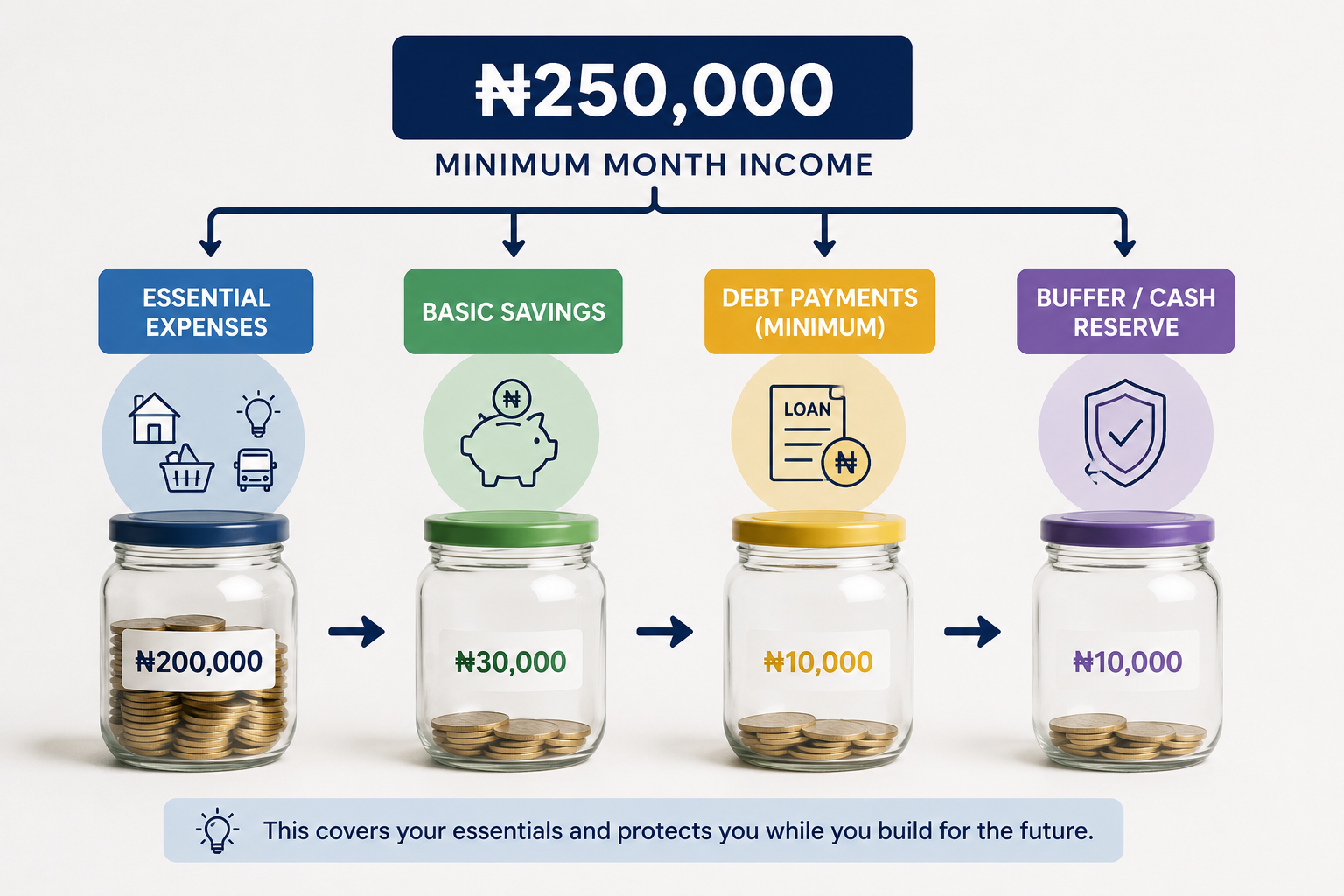
This is the budget that keeps your life running when income is weak.
Suppose your income varies between:
₦250,000 and ₦700,000
A minimum-month budget might look like:
| Category | Amount |
|---|---|
| Housing | ₦80,000 |
| Food | ₦60,000 |
| Transport | ₦30,000 |
| Utilities | ₦20,000 |
| Debt | ₦20,000 |
| Family obligations | ₦20,000 |
| Basic savings | ₦10,000 |
| Buffer | ₦10,000 |
| Total | ₦250,000 |
Now imagine you earn ₦250,000.
You already know what the money needs to accomplish.
But what happens when you earn ₦500,000?
You don't automatically increase your lifestyle to ₦500,000.
That brings us to the next step.
Step 5: Give Your Extra Income a Job
Suppose your minimum budget is:
₦250,000
and you earn:
₦500,000
You have:
₦250,000
above your baseline.
That money should have a purpose.
For example:
₦100,000 → emergency savings
₦75,000 → debt repayment
₦50,000 → future planned expense
₦25,000 → discretionary spending
The exact numbers aren't universal.
The principle is what matters.
A high-income month should strengthen your financial position instead of immediately increasing your lifestyle.
Step 6: Build a Cash Buffer for Low-Income Months
This is one of the biggest advantages of having a financial buffer when your income changes.
Imagine:
January income: ₦600,000
February income: ₦300,000
March income: ₦250,000
If you spend almost everything you earn during January, February and March can become difficult.
But if you keep part of the stronger month's income aside, you can use that buffer when income falls.
For example, suppose you earn ₦600,000.
Your normal baseline expenses are ₦300,000.
Instead of immediately spending the remaining ₦300,000, you could direct some of it toward your financial buffer.
Over time, the buffer can help smooth the difference between good months and bad months.
This is different from an emergency fund, although the two can overlap depending on your circumstances.
An emergency fund is intended for unexpected financial shocks, while a cash-flow buffer can help you handle normal fluctuations in income.
Step 7: Build Your Emergency Fund Separately
If your income is irregular, an emergency fund can be particularly valuable.
You may face two different problems:
Problem 1: Your income is lower than usual.
Problem 2: Something unexpected happens.
For example, your income falls from ₦500,000 to ₦250,000 while your car suddenly requires a major repair.
Without savings, you may have to borrow.
With savings, you have more options.
MoneyTrut already covers this in:
How to Build an Emergency Fund With a Low Income
and:
How Much Should You Have in an Emergency Fund?
The right target depends on your expenses, income stability and circumstances rather than one universal number.
Step 8: Don't Treat Every Large Payment as Spendable Income
This is a common problem for freelancers and business owners.
Suppose you receive:
₦800,000
for completing a project.
It can feel like you suddenly have ₦800,000 available.
But some of that money may already have a job.
Depending on your circumstances, you may need to account for:
- Business expenses
- Taxes where applicable
- Future operating costs
- Debt
- Emergency savings
- Planned expenses
- Personal living expenses
If you immediately spend the entire ₦800,000, your next month may become difficult.
A large payment is not necessarily the same thing as disposable income.
Step 9: Create Sinking Funds for Predictable Expenses
Irregular income makes predictable expenses even more important to plan for.
Suppose you know that you will need:
₦600,000
for an expense in six months.
You could calculate:
₦600,000 ÷ 6 = ₦100,000 per month
But if your income changes every month, you don't necessarily need to contribute exactly ₦100,000 every month.
Instead, you could contribute more during stronger months.
For example:
Month 1: ₦50,000
Month 2: ₦150,000
Month 3: ₦100,000
Month 4: ₦50,000
Month 5: ₦150,000
Month 6: ₦100,000
Total:
₦600,000
This is one reason sinking funds can work particularly well for people with variable income.
If you want to understand the concept in more detail, see What Is a Sinking Fund and How Does It Work?.
Step 10: Budget for Your Annual Expenses
Some expenses don't appear every month.
That doesn't mean they aren't part of your financial reality.
Examples include:
- Annual rent
- School fees
- Insurance
- Vehicle registration
- Professional fees
- Equipment replacement
- Annual subscriptions
- Planned travel
- Major maintenance
Suppose an expense will cost:
₦1,200,000
over the next year.
The annual target can be divided into:
₦1,200,000 ÷ 12 = ₦100,000 per month
You don't necessarily need to transfer exactly ₦100,000 every month.
But you should recognize that the expense exists.
This is particularly important when your income fluctuates because a large expense can arrive during one of your weaker months.
Step 11: Use Your Good Months Strategically
Let's say your normal income range is:
₦250,000–₦500,000
Then one month you receive:
₦800,000
That is a good month.
But don't immediately conclude that you can now afford a permanent increase in your lifestyle.
Instead, consider using the extra income to improve your financial position.
For example:
₦250,000 → normal living costs
₦150,000 → emergency savings
₦150,000 → debt repayment
₦100,000 → sinking funds
₦100,000 → investment or long-term savings
₦50,000 → personal spending
This is only an illustration.
Your priorities may be different.
The important idea is that good months should help fund future stability.
Step 12: Avoid Lifestyle Inflation
Lifestyle inflation happens when your spending rises whenever your income rises.
For example:
Income increases from:
₦300,000 → ₦500,000
Then:
Rent increases.
Eating out increases.
Subscriptions increase.
Transportation becomes more expensive.
Shopping increases.
Before long, the extra ₦200,000 has disappeared.
Then your income falls back to ₦300,000.
Your lifestyle, however, may still be built around ₦500,000.
That is where irregular income becomes dangerous.
If your income is unpredictable, lifestyle inflation can make the low-income months much harder.
Step 13: Pay Yourself a Consistent Amount
This strategy can be particularly useful for business owners.
Suppose your business generates:
January: ₦900,000
February: ₦400,000
March: ₦1,100,000
April: ₦500,000
Instead of treating every business payment as personal spending money, you may choose to establish a consistent personal amount.
For example:
₦400,000 per month
could become your personal household income target.
The remaining business cash stays available for:
- Business expenses
- Tax obligations
- Working capital
- Future investments
- Slow months
- Equipment
- Growth
This creates separation between business cash flow and personal spending.
The exact amount should depend on the actual profitability and cash requirements of the business.
Step 14: If You're Self-Employed, Don't Forget Taxes
If you earn income independently, tax obligations may not be handled in the same way as they are for an employee whose employer withholds certain taxes.
Your specific obligations depend on where you live, your business structure and the type of income you receive.
The important budgeting principle is:
Don't treat money that may be owed to the government as personal spending money.
Set aside appropriate amounts and confirm your obligations under the relevant tax rules.
For Nigerian readers, this is an area where MoneyTrut should eventually publish country-specific tax guides rather than making broad assumptions that apply to everyone.
Step 15: Use a Separate Account or Money Bucket
You don't necessarily need multiple bank accounts.
But separating money can make variable income easier to manage.
You might have:
Income account
Money comes in here.
↓
Bills/living account
Money needed for normal expenses.
↓
Savings
Emergency fund and long-term savings.
↓
Sinking funds
Money for predictable future expenses.
For business owners:
Business account
should ideally remain separate from personal spending.
The purpose is not to create unnecessary complexity.
It's to make it harder to accidentally spend money that already has another purpose.
A Practical Example: Income Between ₦100,000 and ₦1 Million
Let's look at several income levels.
If you earn around ₦100,000
Your first priority may be keeping essential expenses manageable and building a small financial cushion.
If you can consistently save:
₦5,000 per month
that's:
₦60,000 per year
before considering any interest or investment returns.
Don't create a budget that assumes you can save ₦30,000 if your basic expenses already consume most of your income.
The goal is sustainability.
If you earn around ₦300,000
Suppose your essential expenses are:
₦220,000
That leaves:
₦80,000
before other financial goals.
You might use part of that for:
- Emergency savings
- Debt repayment
- Sinking funds
- Investing
- Personal spending
The exact allocation depends on your circumstances.
If you earn around ₦500,000
Suppose your baseline expenses are:
₦300,000
You have:
₦200,000
of potential financial breathing room.
That doesn't mean you should automatically spend the ₦200,000.
You could use part of it to strengthen savings, reduce debt or prepare for known future expenses.
MoneyTrut's How Much Should You Save From a ₦500,000 Salary? goes deeper into this specific income level.
If you earn around ₦1 million
The biggest risk may no longer be simply making enough money.
It may be failing to keep enough of it.
If your essential expenses are ₦500,000, you have significant room to build:
- Emergency savings
- Investments
- Business capital
- Retirement savings
- Future-expense funds
- Debt reduction
Higher income creates an opportunity to build financial resilience.
It doesn't guarantee it.
What Should You Do When You Have a Bad Month?
Suppose you normally earn:
₦500,000
but this month you only receive:
₦250,000.
Don't panic immediately.
First ask:
What absolutely has to be paid?
Then:
What can be postponed?
What can be reduced?
What savings can appropriately be used?
What income is expected soon?
What spending can stop temporarily?
This is where having a minimum-month budget becomes valuable.
If your essential expenses are ₦240,000, then a ₦250,000 month is tight but potentially manageable.
If your lifestyle requires ₦450,000 every month, the same income drop becomes a much bigger problem.
The goal of the budgeting system is therefore to keep your minimum required lifestyle below your normal income floor.
What Should You Do When You Have an Excellent Month?
Don't celebrate by immediately creating permanent new expenses.
If you receive:
₦900,000
instead of your normal ₦400,000, the additional:
₦500,000
could dramatically improve your finances if used carefully.
You might:
- Increase your emergency fund
- Pay down expensive debt
- Fund upcoming annual expenses
- Invest
- Build business reserves
- Save toward a major financial goal
- Allow yourself some controlled spending
You don't have to save every naira.
Enjoying some of your extra income is reasonable.
The important thing is avoiding a permanent lifestyle increase based on temporary income.
How to Calculate Your Average Income
If your income is highly variable, you can calculate an average.
Suppose your last six months were:
₦300,000
₦450,000
₦350,000
₦600,000
₦400,000
₦500,000
Total:
₦2,600,000
Divide by six:
₦433,333
Your average monthly income was approximately:
₦433,333
That number can be useful for planning.
But don't automatically assume you can spend ₦433,333 every month.
An average can hide the fact that some months are much lower.
For essential budgeting, a conservative baseline may still be safer.
Average Income vs Lowest Income
Which should you use?
It depends on how variable your income is.
If your income is:
₦390,000
₦410,000
₦420,000
₦400,000
₦430,000
then the average is reasonably representative.
But if your income is:
₦150,000
₦700,000
₦250,000
₦900,000
₦200,000
then the average can be misleading.
You may need a much more conservative baseline.
This is why budgeting for irregular income isn't about finding one magic formula.
It's about understanding the pattern of your income and building enough flexibility around it.
What If You Are Living Paycheck to Paycheck?
Irregular income can make this particularly difficult.
But low financial breathing room isn't always caused by irresponsible spending.
You may simply have:
- High housing costs
- Large debt payments
- Several dependants
- High transportation costs
- Unstable income
- Insufficient income
If you regularly reach payday with nothing left, read How to Stop Living From Paycheck to Paycheck.
The solution may involve reducing expenses, increasing income, restructuring debt or some combination of these.
A Simple System for Variable Income
If you want to keep things simple, use this five-part system.
1. Establish your minimum income
Know the lowest realistic income you can expect.
2. Build your minimum-month budget
Cover the expenses that absolutely need to be paid.
3. Save during strong months
Don't spend every naira above your baseline.
4. Prepare for predictable expenses
Use sinking funds for major future costs.
5. Build an emergency fund
Protect yourself against genuinely unexpected financial problems.
This system doesn't require a complicated spreadsheet.
It requires discipline and a willingness to let strong months support weak months.
The Bottom Line
Budgeting with an irregular income requires a different mindset from budgeting around a fixed salary.
You cannot assume every month will be good.
Instead, build your essential lifestyle around a conservative income level, understand your minimum expenses and use stronger months to create financial breathing room.
When income is higher than expected, don't automatically increase your lifestyle.
Use some of the extra money to strengthen your savings, prepare for predictable expenses, reduce debt or build long-term wealth.
When income falls, your budget should already have a plan for it.
The goal isn't to make every month financially identical.
The goal is to make your finances stable even when your income isn't.

You must be logged in to post a comment.