
You have probably heard the advice before: save three to six months of expenses for emergencies.
It is useful advice, but it leaves out an important question:
Three to six months of what?
And what if you currently have nothing saved?
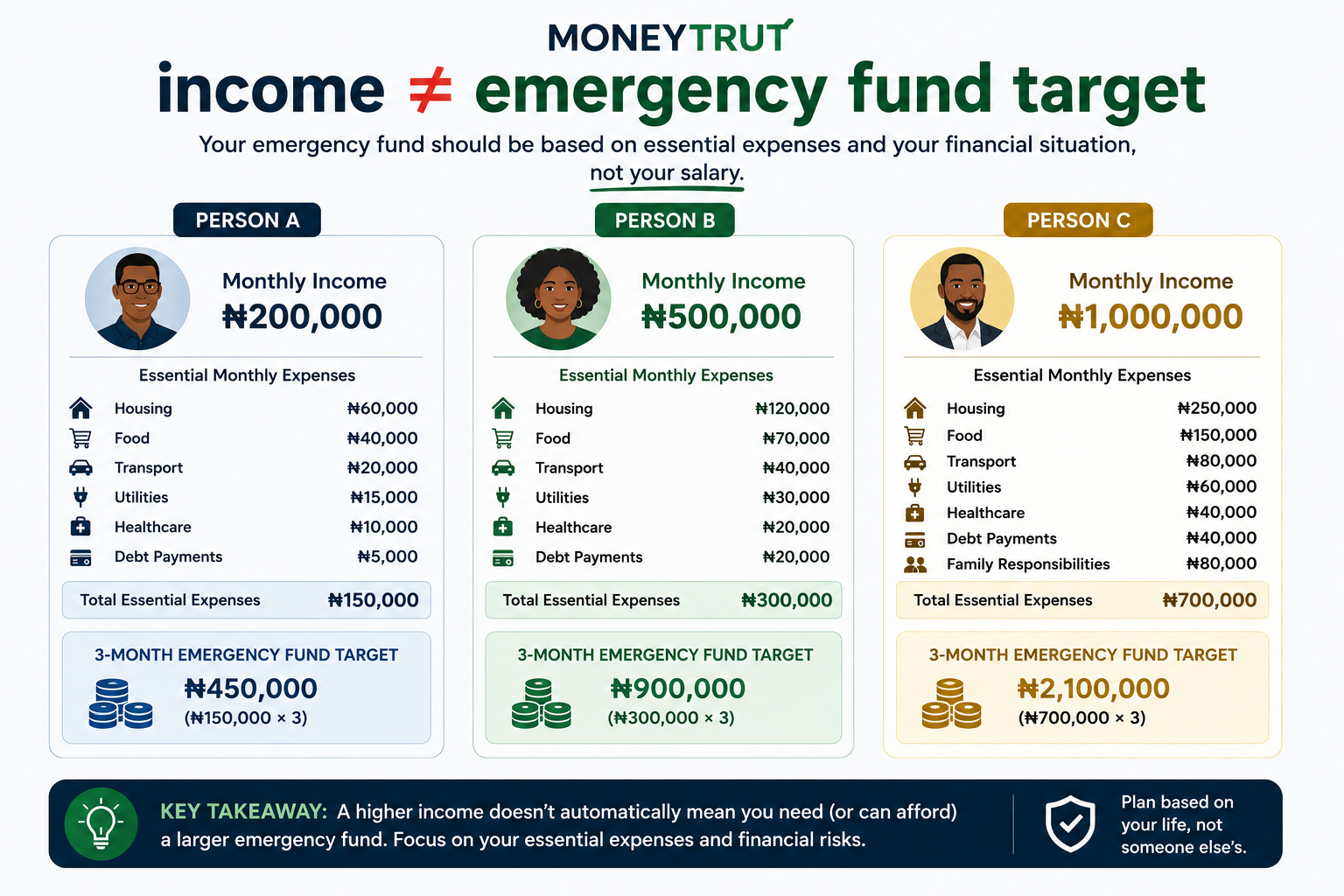
Someone earning ₦200,000 a month with relatively low expenses does not necessarily need the same emergency fund as someone earning ₦1 million but supporting a large family and carrying heavy monthly commitments.
There is no single emergency-fund number that works for everyone. The amount you need depends on your essential expenses, income stability, family responsibilities, debt and how quickly you could recover from a financial setback. The Consumer Financial Protection Bureau (CFPB) specifically notes that the amount needed depends on your situation and that even a small amount can provide some financial security.
So instead of asking, “How much money should everyone have saved?”, a better question is:
“How much money would I need to stay financially stable if something unexpected happened?”
What Is an Emergency Fund Supposed to Cover?
An emergency fund is money reserved for unexpected and necessary expenses or a sudden loss of income.
That could include:
- an unexpected medical expense
- urgent home repairs
- necessary vehicle repairs
- a sudden loss of income
- emergency travel
- an essential expense that you did not reasonably expect
It is not normally intended for predictable expenses such as rent, school fees you have planned for, holidays or a new phone.
The purpose is to give you a financial buffer when something goes wrong so that one unexpected bill does not immediately become expensive debt. The CFPB warns that without savings, even a financial shock can push people toward borrowing or using other savings.
So, How Much Should You Have?
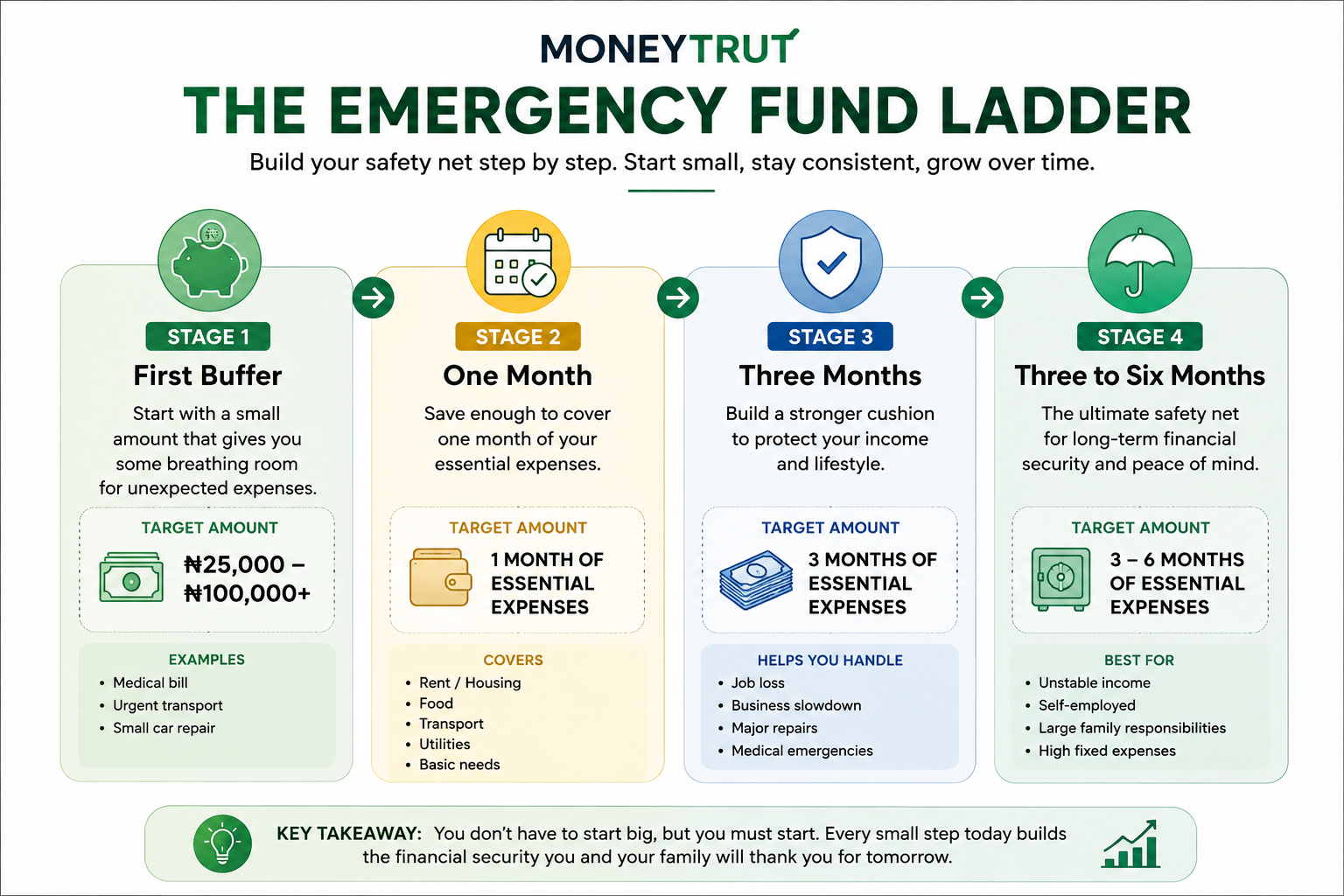
A useful way to think about your emergency fund is in stages.
Stage 1: Your first financial buffer
If you currently have ₦0 saved, your first target does not have to be three months of expenses.
Your first goal is simply to build a meaningful cash buffer.
Depending on your circumstances, that could be:
₦25,000 → ₦50,000 → ₦100,000 → ₦250,000
There is nothing magical about these numbers.
The purpose is to move from having no emergency savings to having money available when something unexpected happens.
The CFPB specifically recognizes that people living paycheck to paycheck may find saving difficult, but that even a small amount can provide some financial security.
Stage 2: One month of essential expenses
Your next target can be one month of essential expenses.
This is where your emergency fund becomes more meaningful.
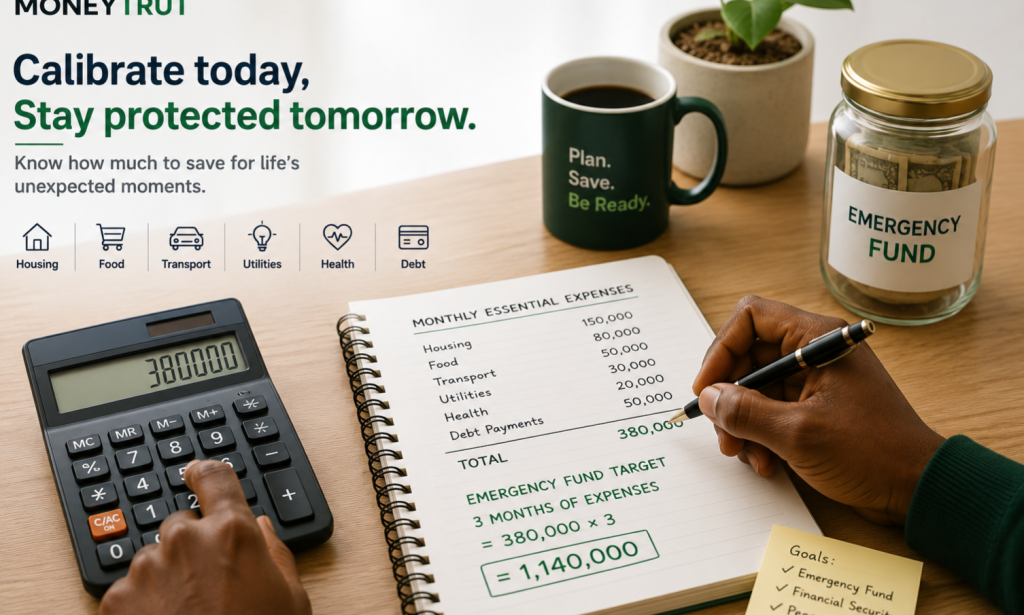
Suppose your monthly income is ₦500,000.
You might spend:
- Housing: ₦150,000
- Food: ₦100,000
- Transportation: ₦50,000
- Utilities: ₦40,000
- Medication and healthcare: ₦20,000
- Minimum debt payments: ₦20,000
Your essential monthly expenses would be ₦380,000.
That means ₦380,000 is more useful as an emergency-fund milestone than simply saying:
“I earn ₦500,000, so I need ₦500,000 saved.”
Your emergency fund is about protecting your essential needs, not matching your salary.
Stage 3: Three months of essential expenses
Once you have built a one-month reserve, a three-month target becomes a useful benchmark.
If your essential expenses are ₦380,000 per month:
₦380,000 × 3 = ₦1.14 million
That would give you approximately three months of essential expenses.
The Federal Reserve uses having enough savings to cover three months of expenses as one measure of financial resilience. In its 2025 household survey, 55% of U.S. adults said they had savings set aside to cover three months of expenses.
That statistic is U.S.-specific and should not be interpreted as representing Nigerian households. But it illustrates why a three-month reserve is a useful benchmark for financial resilience.
Stage 4: Three to six months or more
For some households, three months may not provide enough protection.
A larger emergency fund may make sense if:
- you are self-employed
- your income changes significantly from month to month
- you are the only income earner
- you support several dependants
- your job is relatively uncertain
- your essential monthly expenses are high
- finding another source of income could take several months
The FDIC has used three to six months of essential expenses as a general emergency-savings benchmark, while CFPB guidance emphasizes that the appropriate amount depends on the individual's circumstances.
So three to six months should be treated as a useful target range, not a universal law.
Calculate Your Emergency Fund Based on Expenses, Not Salary
This is probably the most important calculation in the article.
Start with your essential monthly expenses.
Do not simply use your total monthly spending.
For example, imagine three people:
| Person | Monthly income | Essential expenses | 3-month target |
|---|---|---|---|
| A | ₦200,000 | ₦150,000 | ₦450,000 |
| B | ₦500,000 | ₦300,000 | ₦900,000 |
| C | ₦1,000,000 | ₦700,000 | ₦2.1 million |
These are hypothetical examples.
Notice something important:
The person earning ₦1 million does not automatically have a more comfortable financial position.
If ₦700,000 of that income is committed to essential expenses, losing that income could create a much larger financial problem.
This is why expenses and financial responsibilities matter more than salary alone when calculating an emergency-fund target.
What Counts as an Essential Expense?
This is where many people make the calculation too complicated—or too generous.
Essential expenses are generally the costs you would need to keep paying if your income suddenly dropped.
Depending on your situation, these could include:
Housing
- rent or mortgage
- essential housing costs
Food
- basic groceries
- essential household food expenses
Transportation
- transport to work
- essential vehicle expenses
Utilities
- electricity
- water
- basic communication services
Healthcare
- necessary medication
- essential medical expenses
- insurance premiums where applicable
Debt obligations
- minimum required debt payments
Family responsibilities
If you are responsible for children, parents or other dependants, necessary support may need to be included.
The exact list will differ between households.
The point is to calculate what you genuinely need—not what you normally spend when everything is going well.
Should You Save Three Months or Six Months?
The answer depends on your financial situation.
Three months may be a reasonable milestone if:
- your income is relatively stable
- you have manageable expenses
- you have another household income
- you have relatively few dependants
- you could find another source of income reasonably quickly
Six months or more may make more sense if:
- you are self-employed
- your income is irregular
- you are the sole provider
- you have several dependants
- you work in an industry with significant job uncertainty
- you have high fixed expenses
For someone with very unstable income, even six months may not be enough.
For someone with very stable income, low expenses and other financial resources, six months may be more than they need to keep immediately accessible.
There is no magic number.
What If I Can't Afford Three Months?
This is where financial advice often becomes unrealistic.
If you earn ₦150,000 a month and have ₦140,000 in essential expenses, telling you to immediately save three months of expenses may not be helpful.
Your three-month target would be:
₦140,000 × 3 = ₦420,000
That is a worthwhile long-term target.
But it does not mean you should wait until you have ₦420,000 before considering yourself financially better prepared.
Start smaller.
For example:
First target: ₦25,000
Then:
₦50,000
Then:
₦100,000
Then:
One month of essential expenses
Then:
Three months
The CFPB recommends starting with what you can afford and notes that even small emergency savings can provide some financial security.
The important thing is to keep moving.
What If I Earn ₦100,000 a Month?
Let's make this practical.
Suppose you earn ₦100,000 and your essential expenses are ₦85,000.
You have only ₦15,000 of potential monthly breathing room before considering other spending.
Trying to save ₦30,000 every month may simply create another problem.
Instead, you might start with ₦5,000 or ₦10,000.
If you saved ₦10,000 every month:
₦10,000 × 12 = ₦120,000
That would give you more protection than starting with nothing.
You could then increase your contributions when your income rises or when you find ways to reduce your essential and discretionary expenses.
What If I Earn ₦500,000 a Month?
Suppose your essential expenses are ₦300,000.
A reasonable progression could be:
First buffer: ₦50,000–₦100,000
One-month target: ₦300,000
Three-month target: ₦900,000
Six-month target: ₦1.8 million
These are not universal recommendations.
If you have unstable income, dependants or significant debt, your target may need to be different.
The important part is that the calculation is based on your actual financial situation.
What If I Earn ₦1 Million a Month?
A higher salary does not automatically mean you need to keep millions of naira sitting in cash.
Suppose your essential expenses are ₦600,000.
Your targets could look like:
One month: ₦600,000
Three months: ₦1.8 million
Six months: ₦3.6 million
But if your expenses are only ₦350,000, the calculation changes dramatically.
That is why the question:
“How much should someone earning ₦1 million save?”
is less useful than:
“How much are your essential expenses, and how financially secure is your income?”
Should You Count Investments as Part of Your Emergency Fund?
Be careful.
Your emergency fund and your long-term investments serve different purposes.
Money that you may need urgently should generally be kept somewhere that is safe and accessible.
The CFPB recommends keeping emergency savings somewhere safe and accessible, and where you are less tempted to spend it on non-emergencies.
If you put your emergency money into an investment whose value can fall significantly, you could be forced to sell when the market is down.
For example, imagine you need ₦500,000 urgently but the investment holding that money has fallen by 25%.
Your ₦500,000 could now be worth only ₦375,000.
That is not the kind of risk you generally want for money whose primary purpose is financial protection.
Your emergency fund is about stability.
Your investments are about long-term growth.
Keep those purposes separate.
What If I Have Debt?
Having debt does not necessarily mean you should have no emergency savings.
Consider someone with ₦0 saved and a high-interest loan.
If an unexpected ₦150,000 expense occurs, they may have to borrow again.
A small emergency cushion can reduce the chance that every financial shock creates another debt.
At the same time, expensive debt can grow rapidly, so it may not make sense to build an enormous cash reserve while ignoring high-interest debt.
The right balance depends on:
- the interest rate
- the type of debt
- your income stability
- your essential expenses
- whether you have any existing savings
The CFPB's research on savings and debt also suggests that the trade-off is not simply “save everything” or “pay off everything”; people can preserve a savings cushion while reducing debt.
What If You Already Have Six Months Saved?
If you already have six months of essential expenses saved, you can now consider other goals such as:
- paying down expensive debt
- investing for long-term goals
- retirement planning
- saving for a home
- education
- business capital
- other major financial objectives
You may also decide to increase your emergency reserve if your circumstances have changed.
For example, having a child, becoming self-employed or becoming the sole income earner could justify a larger cash reserve.
A Simple Emergency-Fund Formula
If you want a straightforward starting point, use this:
Monthly essential expenses × number of months of protection = emergency-fund target
For example:
₦250,000 × 3 = ₦750,000
or
₦400,000 × 6 = ₦2.4 million
Start with three months as a useful benchmark.
Then consider whether your personal circumstances justify moving toward six months or more.
Don't Let the Perfect Target Stop You From Saving
The biggest mistake is turning an emergency-fund target into an excuse not to start.
If your eventual goal is ₦1 million but you currently have ₦0, the first ₦50,000 still matters.
If your long-term target is ₦2 million but you currently have ₦200,000, you are not failing because you have not reached ₦2 million.
You have already reduced your financial vulnerability compared with having nothing saved.
Build the fund gradually.
When your income rises, increase your contributions.
When your expenses fall, consider directing some of the difference toward savings.
When you use the fund for a genuine emergency, rebuild it.
The CFPB similarly recommends rebuilding emergency savings after using it.
How to Build an Emergency Fund With a Low Income
The Bottom Line
There is no universal emergency-fund number.
For many people, three months of essential expenses is a useful milestone, while three to six months can be a reasonable longer-term target depending on income stability, dependants, debt and other risks.
But if you are starting from zero, don't let a three- or six-month target discourage you.
Start with what you can.
Build your first financial buffer.
Then work toward one month of essential expenses.
From there, build toward three months and eventually consider whether three to six months—or more—is appropriate for your situation.
The right emergency fund is not the one that looks impressive on paper.
It is the amount that gives you enough financial breathing room to handle a serious setback without immediately turning to debt or sacrificing another important financial goal.

You must be logged in to post a comment.