
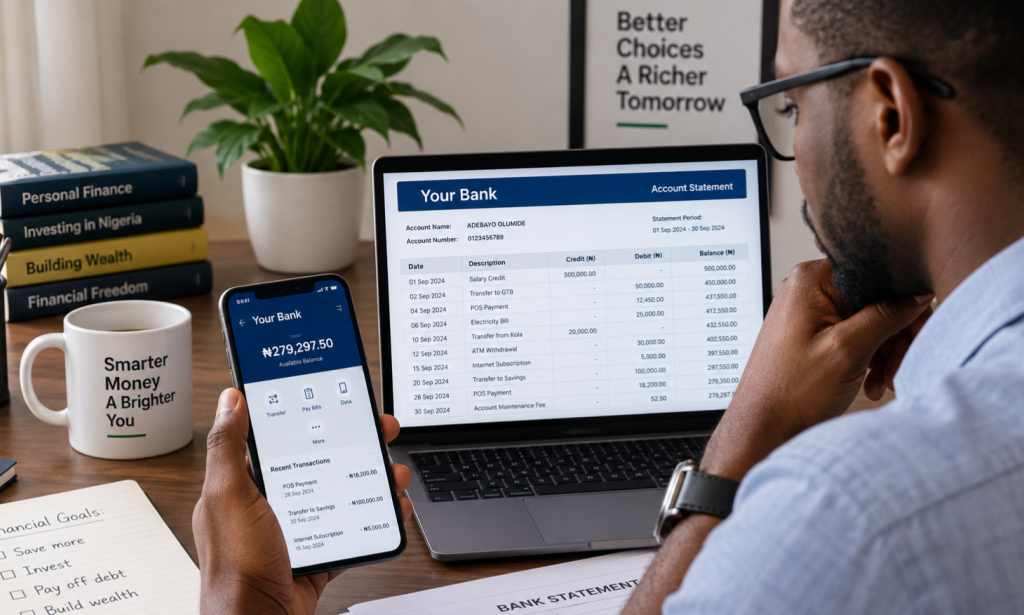
Getting a bank statement in Nigeria is usually straightforward. Depending on your bank and account, you may be able to download one through mobile banking, internet banking, request it through customer service or obtain it from a branch.
The important part is knowing what type of statement you need, what information it should contain and how to check it for errors before submitting it.
What Is a Bank Statement?
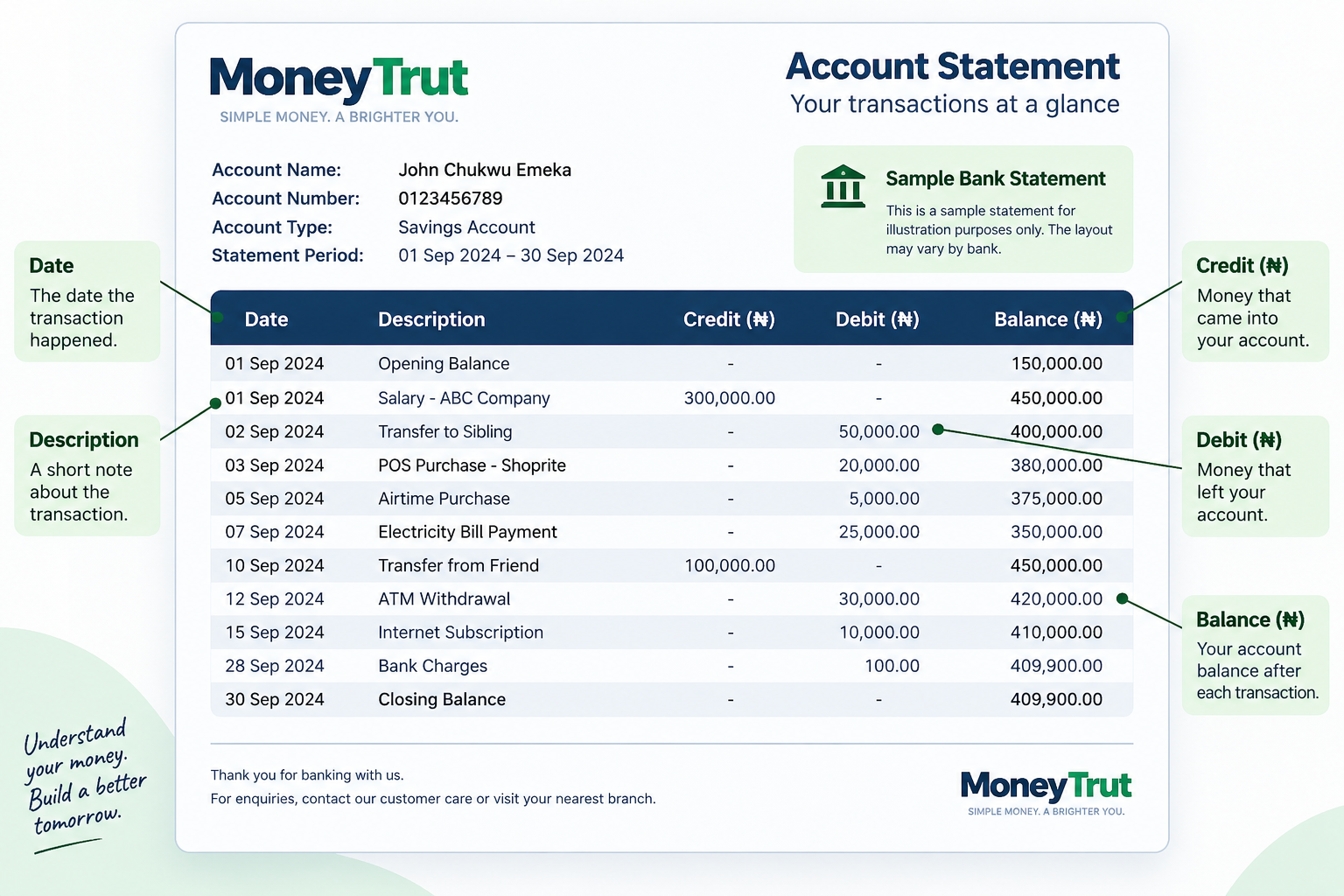
A bank statement is a record of activity on your bank account for a particular period.
For example, you could request a statement covering:
- January 1 to January 31
- The previous six months
- The previous 12 months
- The period since an account was opened
A typical statement can show:
- Account holder's name
- Account number or masked account number
- Statement period
- Opening balance
- Deposits
- Withdrawals
- Transfers
- Payments
- Bank charges
- Interest where applicable
- Closing balance
- Transaction dates
- Transaction descriptions
The exact information and layout depend on the bank.
What Is a Bank Statement Used For?
People often associate bank statements with visa applications, but they have many other uses.
You may need one for:
Visa Applications
Embassies and visa-processing authorities may request financial evidence showing how you fund a trip and whether your financial circumstances support the application.
The exact requirements depend on the country and visa category.
A bank statement by itself does not guarantee that a visa application will succeed.
Loan Applications
A bank, fintech lender or other financial institution may request transaction history to assess your income, spending and ability to repay.
Mortgage or Property Applications
A lender may request statements as part of assessing your finances.
Rental Applications
A landlord or property manager may ask for evidence that you can afford rent.
Scholarships and School Applications
Some institutions may request financial documents as part of an application.
Business Transactions
A company may need statements for accounting, financial reviews or verification.
Personal Financial Planning
This is one of the most useful reasons to review your own statements.
A statement can show you where your money actually went instead of where you think it went.
You may discover that:
- Small transfers add up to a large amount
- You spend more on food than expected
- Bank charges are accumulating
- You make frequent ATM withdrawals
- Subscriptions are being forgotten
- Transfers to other accounts are larger than expected
This can make your budget much more realistic.
MoneyTrut's guide on how to create a monthly budget that actually works explains why your budget should be based on your actual spending rather than an idealised version of your finances.
How to Get a Bank Statement in Nigeria
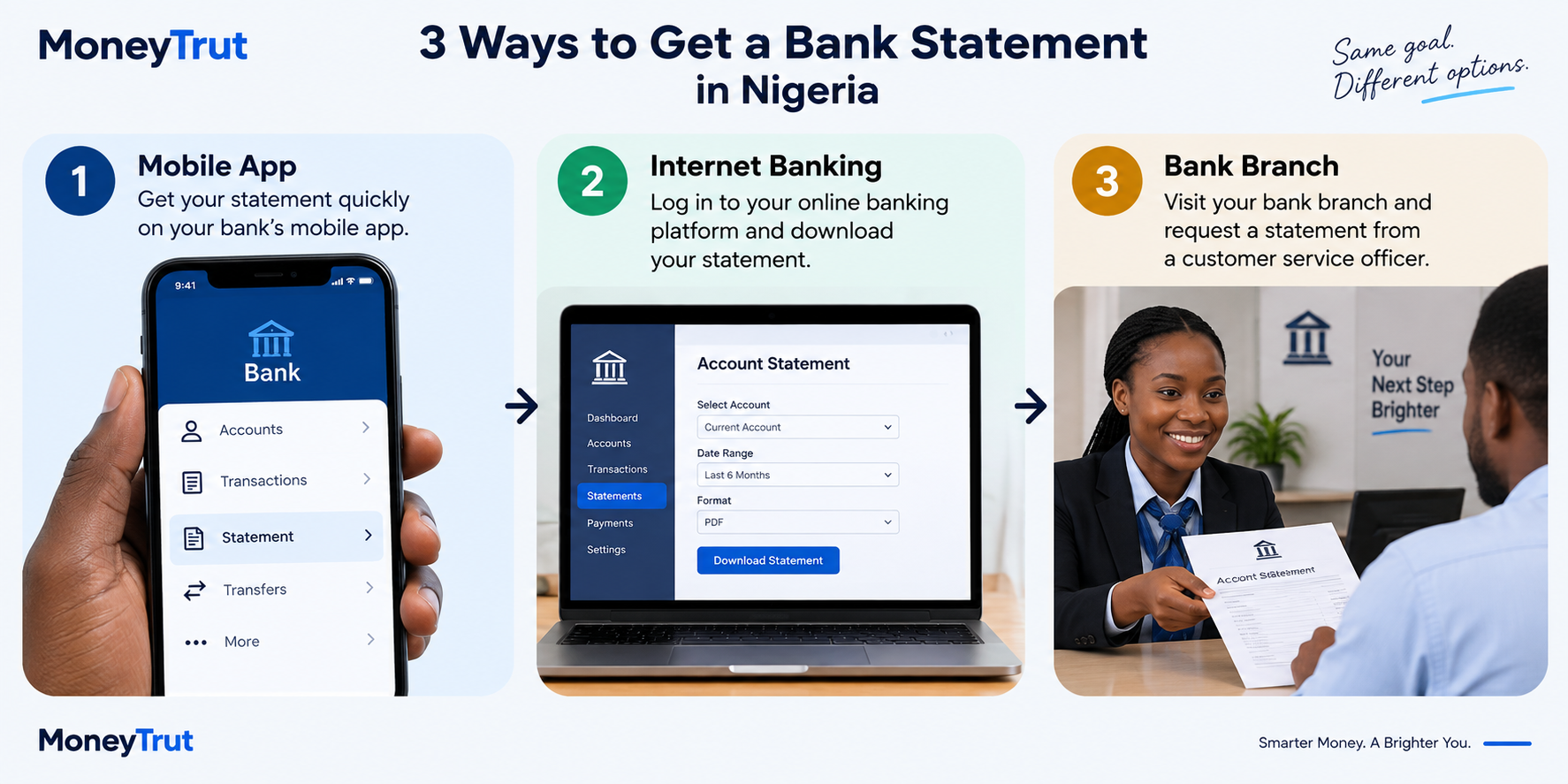
The exact process depends on your bank, but there are several common methods.
1. Download It Through Your Bank's Mobile App
Many Nigerian banks provide electronic statements through their mobile banking applications.
The process commonly involves:
- Log into your banking app.
- Find your account or transaction history.
- Look for an option such as "Statement," "Account Statement" or "Download Statement."
- Select the required period.
- Choose the available format.
- Download or request the statement.
The names and options can vary between banks.
If you cannot find the statement option, check the bank's current app instructions or contact customer service.
2. Use Internet Banking
Some banks allow customers to access statements through their online banking platform.
You may be able to select:
- Account
- Date range
- Statement type
- Download format
The statement may then be downloaded or sent to your registered email address.
3. Request It Through Customer Service
If you cannot access the statement digitally, you can contact your bank's customer service.
Depending on the bank, you may be asked to verify your identity before the statement is provided.
4. Visit a Bank Branch
You can also visit your bank branch and request a statement.
You may need:
- Identification
- Account details
- The period you want covered
- A clear explanation of what you need
If you need a statement for an official application, tell the bank exactly what the receiving organisation has requested.
Do You Need a Printed Bank Statement?
Not necessarily.
Many organisations accept electronic statements, but this depends entirely on the organisation requesting the document.
Before requesting one, find out whether they require:
- PDF statement
- Printed statement
- Stamped statement
- Certified statement
- Statement sent directly by the bank
- A specific number of months
There is little point in obtaining a six-month electronic statement if the organisation specifically requires a 12-month stamped statement.
What Is a Stamped Bank Statement?
A stamped bank statement is a statement that has been authenticated by the bank, typically with an official bank stamp or other verification method.
Some organisations may specifically request a stamped statement because they want additional evidence that the document originated from the bank.
However, not every application requires one.
If the organisation's instructions don't mention a stamp, don't assume you automatically need to pay for or obtain one.
How Many Months of Bank Statements Do You Need?
There is no universal answer.
It depends on why the statement is being requested.
For example, an organisation might request:
- Three months
- Six months
- Twelve months
- A specific period
If the request says "last six months," provide the requested six-month period rather than choosing a shorter period yourself.
For visa applications, always follow the current requirements of the relevant embassy, consulate or visa authority.
What Does a Bank Statement Show?
Understanding the information on your statement can help you identify mistakes.
A typical transaction may contain:
Date → Description → Debit/Credit → Balance
For example:
| Date | Description | Credit | Debit | Balance |
|---|---|---|---|---|
| Sept. 1 | Salary | ₦300,000 | — | ₦350,000 |
| Sept. 2 | Transfer | — | ₦50,000 | ₦300,000 |
| Sept. 3 | POS payment | — | ₦20,000 | ₦280,000 |
The exact layout varies by bank.
Credit
A credit generally means money came into the account.
Examples include:
- Salary
- Transfer received
- Cash deposit
- Refund
- Interest
Debit
A debit generally means money left the account.
Examples include:
- Transfers
- ATM withdrawals
- POS payments
- Bills
- Bank charges
Closing Balance
This is the balance at the end of the statement period.
It should correspond with the transactions recorded, subject to the bank's accounting and statement conventions.
What Is the Difference Between a Bank Statement and Transaction History?
They are related but not always identical.
A transaction history is usually a list of recent account transactions available through your banking app or online banking.
A formal bank statement is generally a structured document covering a specified period and identifying the account and its transactions.
If an organisation specifically asks for a bank statement, don't assume a screenshot of your transaction history will be accepted.
Ask what format they require.
Can You Get a Bank Statement From Another Bank?
Normally, you request a statement from the bank where the account is held.
If you have accounts with:
- Access Bank
- FirstBank
- GTBank
- UBA
- Zenith Bank
- Fidelity Bank
- Stanbic IBTC
- FCMB
- Union Bank
- Or another Nigerian financial institution
you generally request the relevant statement from that institution.
The available methods and charges can differ.
Can You Get a Bank Statement Online?
In many cases, yes.
Many banks provide electronic access to account statements through their digital banking services.
However, don't assume that every type of statement can be obtained entirely online.
A particular application may require a branch-issued or authenticated document.
If you're applying for something important, confirm the required format before relying on an electronic download.
Can a Bank Statement Be Used as Proof of Income?
Sometimes, but it depends on the circumstances.
A bank statement can show salary or other regular deposits entering your account.
For example, if your employer pays ₦500,000 into your account every month, your statement may show those salary credits.
But a bank statement does not automatically prove that every deposit represents salary or legitimate income.
A large transfer into an account could be:
- A loan
- Money borrowed from someone
- Business revenue
- A transfer between your own accounts
- A gift
- Proceeds from an asset sale
The organisation reviewing the statement may therefore request additional evidence.
For employment income, they may also request:
- Payslips
- Employment letter
- Tax documents
- Employer confirmation
The requirements depend on the purpose.
Don't Deposit Large Amounts Just to Make Your Statement Look Better
This is particularly important when a bank statement is being used for an application.
Suppose you normally have ₦100,000–₦200,000 moving through your account and suddenly deposit ₦5 million shortly before submitting a financial application.
The balance may look impressive.
But the transaction itself may raise questions about where the money came from.
A bank statement is not simply about the final balance.
Transaction patterns can matter too.
If the money is legitimate, keep evidence explaining its source.
For example, if you sold an asset, you might retain:
- Sale agreement
- Transfer evidence
- Relevant receipts
- Other documentation showing the source of funds
Never manufacture financial activity simply to make an application appear stronger.
What If Your Bank Statement Contains Errors?
Check the statement carefully.
Look for:
- Transactions you don't recognise
- Incorrect amounts
- Duplicate transactions
- Unexpected charges
- Incorrect dates
- Missing transactions
- Incorrect balances
If something looks wrong, contact your bank promptly.
The Central Bank of Nigeria provides consumer-protection and complaint channels for banking customers, including information on complaints and consumer rights.
What If You See a Transaction You Don't Recognise?
Don't ignore it.
First check whether:
- A family member used your card or account
- The transaction is a recurring subscription
- The description differs from the merchant's familiar name
- The transaction is a transfer you made earlier
- The transaction was reversed or subsequently corrected
If you still don't recognise it, contact your bank through an official channel.
Do not give an unknown caller your:
- PIN
- Password
- OTP
- Full card security information
A bank employee should not require you to disclose sensitive authentication credentials simply because you're reporting a transaction.
How Long Should You Keep Your Bank Statements?
There is no single period that is appropriate for every person.
Keep important financial records for as long as they may reasonably be needed for:
- Tax matters
- Loans
- Property transactions
- Visa applications
- Business records
- Legal matters
- Major purchases
- Financial disputes
For ordinary personal records, digital storage can make long-term retention easier.
For important documents, consider keeping copies in more than one secure location.
Bank Statements and Privacy
Your bank statement contains sensitive financial information.
It may reveal:
- Your income
- Spending habits
- Account number
- Names of people or businesses you transact with
- Financial relationships
- Regular payments
- Account balances
Don't casually send your full statement to strangers.
Before submitting it, make sure you know:
- Who is requesting it
- Why they need it
- What period they need
- How they will store it
- Whether they require the full statement
If an organisation legitimately needs the document, submit it through an appropriate secure channel.
Should You Send a Bank Statement Through WhatsApp?
It depends on who is receiving it and why.
WhatsApp can be convenient, but a bank statement is sensitive financial information.
If an employer, agent or legitimate organisation requests it through WhatsApp, verify that you're communicating with the genuine recipient and that the number belongs to the organisation or authorised representative.
For highly sensitive applications, an official upload portal or secure email may be preferable when available.
Never send your banking password, PIN or OTP along with the statement.
What If You Have Multiple Bank Accounts?
You may need statements from more than one bank.
For example, someone might have:
- Salary account
- Savings account
- Business account
- Domiciliary account
- Investment-related account
If an organisation requests your financial history across all accounts, providing only the account with the highest balance may give an incomplete picture.
On the other hand, don't provide unnecessary documents simply because you have them.
Follow the exact requirements of the organisation requesting the information.
MoneyTrut's guide on how to choose the right bank account in Nigeria explains why different accounts can serve different purposes.
Your Bank Statement Can Help You Improve Your Budget
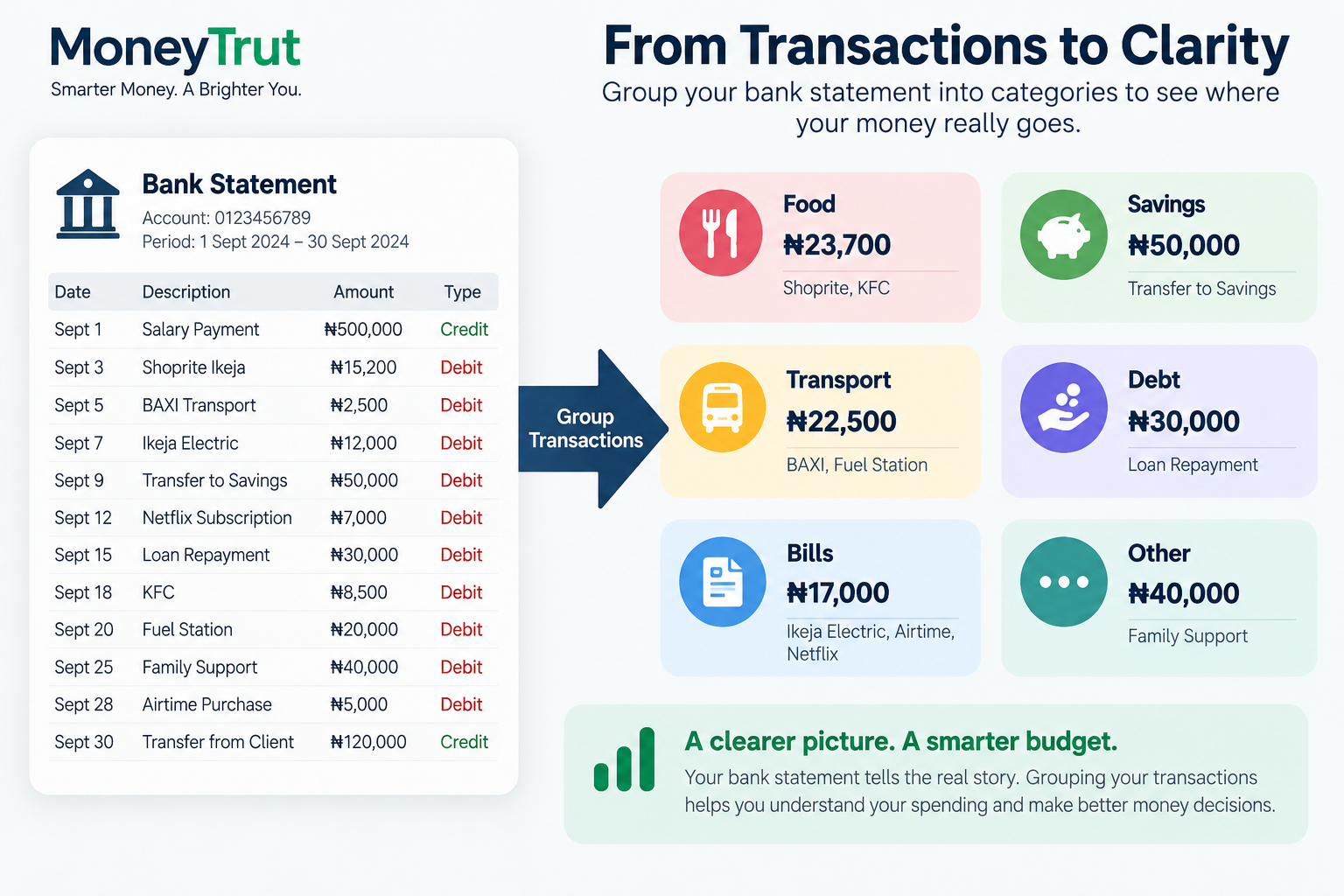
A bank statement isn't only something you submit to an embassy or lender.
It can be one of the best tools for understanding your spending.
Take one month of transactions and group them into:
- Housing
- Food
- Transportation
- Family support
- Debt
- Bills
- Shopping
- Entertainment
- Bank charges
- Savings
- Investments
- Business expenses
Then add each category.
You might discover that the problem isn't one large expense.
It may be dozens of smaller expenses.
For example:
₦2,000 here.
₦3,500 there.
₦5,000 somewhere else.
Repeated throughout the month, they can become significant.
This is exactly why reviewing actual transactions can produce a better budget than simply estimating what you think you spend.
Bank Statement vs Account Balance
Your current account balance tells you approximately how much money is in the account at a point in time.
Your bank statement shows the activity that produced that balance over a selected period.
Both are useful, but they answer different questions.
Balance: How much is in the account now?
Statement: What happened to the money during this period?
If you're trying to understand your financial behaviour, the second question is often more useful.
What If Your Income Is Irregular?
Bank statements can also help people with variable income understand their finances.
Suppose your monthly deposits over six months were:
- ₦250,000
- ₦420,000
- ₦180,000
- ₦350,000
- ₦500,000
- ₦220,000
Instead of assuming you earn ₦500,000 because that was your best month, you can examine the full history and calculate a more realistic average.
This can help when building a budget.
Our article on how to manage your money when you have multiple sources of income explains how to handle salary, freelance income, business income and other variable earnings.
Don't Confuse a Bank Statement With a Bank Reference Letter
They are different documents.
A bank statement records account activity.
A bank reference letter is a letter from the bank confirming certain information about the customer or account, depending on the bank's service and the purpose of the request.
If an organisation specifically asks for a bank reference letter, a statement may not be an acceptable substitute.
Always check the exact wording of the request.
How to Make Sure Your Bank Statement Is Genuine
If a statement is being submitted for an important application, use the document provided by the bank.
Do not edit:
- Account balances
- Transaction amounts
- Dates
- Names
- Descriptions
- Bank logos
- Other financial information
Editing a financial document to create a different impression can have serious consequences.
If something is incorrect, ask the bank to correct or explain it.
What If You Need an Older Bank Statement?
If the period you need is not available in your mobile app, contact your bank.
Older statements may require a branch request or another process depending on the institution.
Don't assume that because you cannot see a transaction in your app's current history, the bank no longer has the record.
Tell the bank the exact period you need.
For example:
"I need a statement covering January 1, 2024 to December 31, 2024."
Being specific makes the request easier.
A Simple Checklist Before Submitting Your Bank Statement
Before sending a statement to an organisation, check:
- Is the correct account included?
- Is the requested period covered?
- Is your name correct?
- Is the statement complete?
- Are all pages included?
- Are the transactions readable?
- Is the required stamp or certification included?
- Does the organisation require a PDF or printed copy?
- Are you sending it through a secure channel?
- Have you confirmed who is receiving it?
These simple checks can prevent unnecessary delays.
Bottom Line
A bank statement is more than a list of transactions.
It is a record of how money has moved through your account during a particular period, and it can be useful for financial planning, loan applications, visa applications, business records and many other purposes.
In Nigeria, you may be able to obtain a statement through your bank's mobile app, internet banking, customer service or branch, depending on the institution and the type of statement you need.
Before requesting one, find out exactly what the organisation requesting it requires.
And don't forget its personal-finance value.
Reviewing your own bank statements regularly can reveal spending patterns, unnecessary charges and financial habits that are difficult to see when you simply look at your account balance.
Your balance tells you where your money is.
Your statement helps explain where it went.

You must be logged in to post a comment.