

If you want to start a business in Nigeria, one of the first questions you may encounter is:
Should I register a business name or a company?
For a small business owner, the difference may initially seem unimportant.
You may simply want to sell products, provide services, receive payments and operate under a professional business name.
But the structure you choose can affect how your business is organised, how ownership works and how you approach future growth.
The Corporate Affairs Commission (CAC) provides separate registration processes for business names and companies.
So before spending money on registration, it is worth understanding what you are actually registering.
Business Name vs Company: The Basic Difference
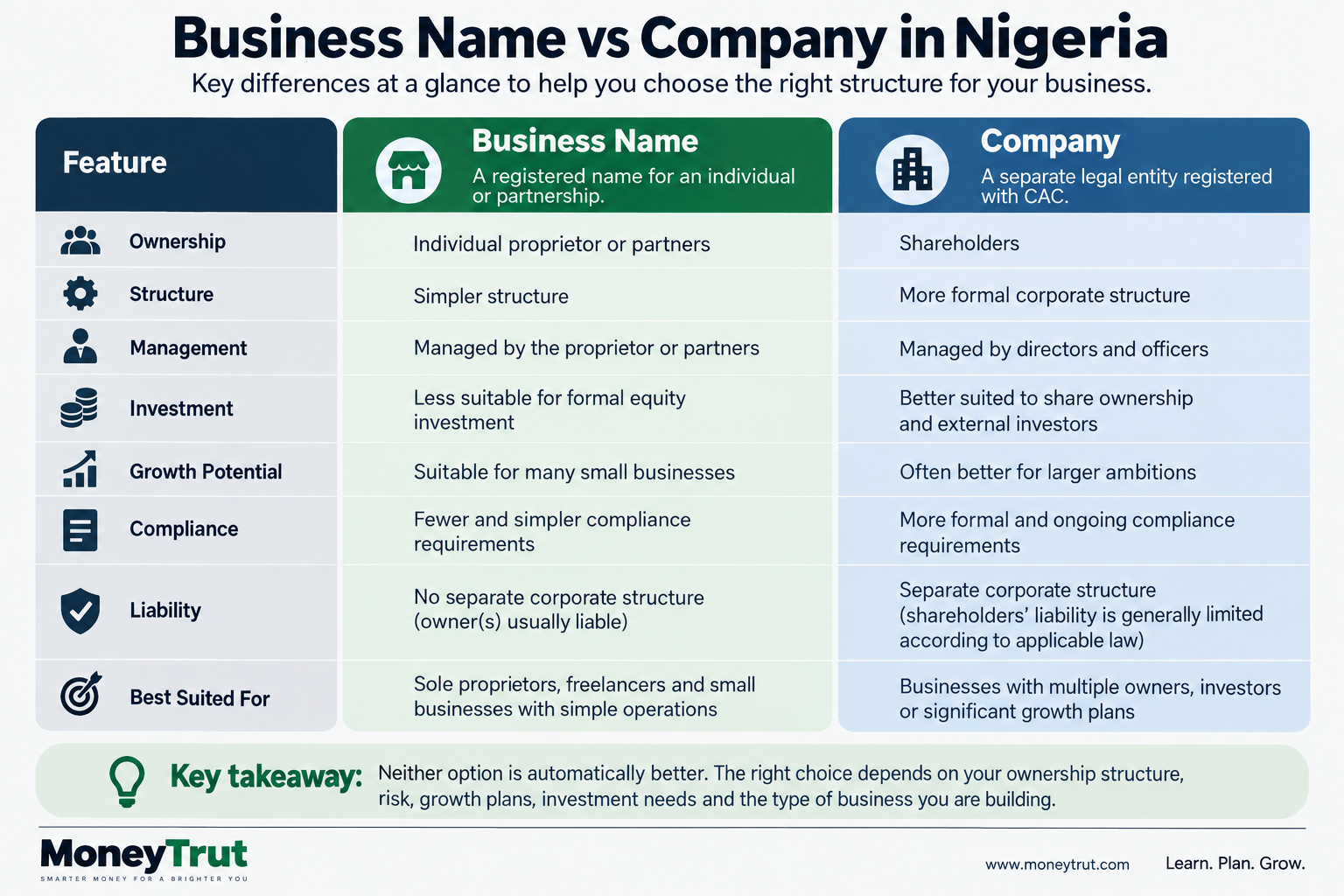
In simple terms:
Business name: A registered name under which an individual or partners operate a business.
Company: A separate corporate structure registered with CAC, such as a private company limited by shares.
A business name can be appropriate for a person running a relatively straightforward business.
A company can be more appropriate where the business has multiple owners, requires a more formal corporate structure or is being built for larger-scale growth.
Neither option is automatically better.
The right choice depends on the type of business you are building.
What Is a Business Name in Nigeria?
A business name is the name under which an individual or partnership carries on business.
For example, imagine someone named Daniel Okafor starts a phone accessories business.
He could operate under a registered business name such as:
Daniel Tech Hub
The registration identifies the business and its proprietor or partners.
CAC currently states that individuals and proprietors can register business names without using a lawyer, chartered accountant or chartered secretary. The process is handled through the CAC Company Registration Portal (CRP), with electronic registration documents issued after approval.
This makes a business name a relatively straightforward structure for many small operators.
What Is a Company?
A company is a more formal corporate structure.
One common option for a growing Nigerian business is a private company limited by shares.
Instead of the business simply being operated under an individual's business name, the company has its own corporate identity.
For example:
Daniel Tech Hub Limited
The company has shareholders and directors and operates under the requirements applicable to its corporate structure.
CAC's company registration process involves name availability, name reservation, completion of the digital pre-registration application, submission of supporting documents and payment of applicable filing and statutory stamp-duty fees.
The Key Differences
Here is the simplest way to compare them:
| Feature | Business Name | Company |
|---|---|---|
| Suitable for | Many small businesses and sole proprietors | Businesses requiring a corporate structure |
| Ownership | Individual proprietor or partners | Shareholders |
| Management | Proprietor/partners | Directors and officers |
| Structure | Simpler | More formal |
| Investors | Less suitable for formal equity investment | Better suited to share ownership |
| Growth | Suitable for many small businesses | Often better for larger ambitions |
| Registration | CAC business-name registration | CAC company registration |
| Compliance | Ongoing requirements apply | More formal corporate compliance |
| Separate corporate structure | No company structure | Yes |
| Best for | Simple business operations | Businesses planning a more formal structure |
The table is a simplification. The actual legal and tax consequences depend on the structure, activities and circumstances of the business.
1. Choose a Business Name If You Are Starting Small
A business name can make sense when you are starting a relatively small operation and want a straightforward structure.
For example:
- A fashion reseller
- A freelance designer
- A small catering business
- A photographer
- A cleaning service
- A home-based food business
- A small retail operation
- A personal consulting service
- A small online store
Imagine you earn ₦250,000 from your job and want to start selling perfumes on weekends.
You don't necessarily need to create a complicated corporate structure on day one.
If the business is small and you are the sole operator, a business name may be a practical starting point.
That does not mean you can never move to a company later.
Your business can evolve.
2. A Company May Make More Sense When You Have Multiple Owners
Suppose three people want to start a logistics business together.
They will contribute:
Person A: ₦2 million
Person B: ₦1 million
Person C: ₦1 million
They also intend to expand the business, hire employees and acquire vehicles.
This is different from one person selling products independently.
When multiple people are putting money into a business, ownership, decision-making and rights become much more important.
A company structure may therefore be more appropriate than simply operating a business name.
3. A Company Can Be More Appropriate for Investors
Suppose you start a technology company with your own ₦2 million.
After two years, the business has grown and an investor wants to put ₦20 million into the business in exchange for an ownership interest.
A company structure can provide a formal framework for shareholders and share ownership.
This is one reason entrepreneurs planning to raise equity investment often think about company structure early.
But don't register a company simply because you like the word "Limited."
Choose a structure because it serves the actual needs of the business.
4. A Business Name Can Be Enough for Many Small Businesses
There is sometimes a misconception that every serious business must be registered as a limited company.
That is not necessarily true.
A registered business name can be perfectly reasonable for many small businesses.
For example, imagine someone running a small baking business.
She makes cakes from home and earns:
₦300,000 revenue per month
Her costs are:
₦210,000
Her gross profit before other applicable expenses is:
₦90,000
She has no employees and no outside investors.
Her main objective is to build a customer base and increase sales.
There may be no immediate reason to create a more complex structure simply to appear bigger.
The appropriate structure should follow the business rather than the owner's desire to look corporate.
5. Think About Where You Want the Business to Be in Three Years
This is one of the best questions to ask before registering.
Don't only think about what the business looks like today.

Ask:
Where do I want it to be in three years?
Scenario A
You want to sell clothes online.
You expect to remain a small operation.
You are the only owner.
You will purchase inventory and sell directly to customers.
A business name may be sufficient for your intended structure.
Scenario B
You want to build a logistics company.
You expect to have several shareholders.
You want to raise capital.
You plan to employ staff and acquire vehicles.
You expect contracts with larger organisations.
A company may make more sense.
The second business has a different growth model.
6. A Business Name Does Not Automatically Mean "Small"
This is another important point.
The word "business name" should not make you think the business cannot grow.
A registered business name can operate legitimately and can develop a substantial customer base.
The issue is not whether the business is "serious."
The issue is whether the structure fits what you are trying to build.
A business name may be suitable at one stage and a company may become more appropriate later.
7. A Company Does Not Automatically Make a Business Profitable
Registering a company does not create customers.
It does not automatically increase sales.
It does not guarantee access to funding.
It does not turn a weak business idea into a strong one.
Imagine two businesses.
Business A
Registered as a company.
Monthly revenue: ₦300,000
Monthly expenses: ₦350,000
Result: Loss
Business B
Registered as a business name.
Monthly revenue: ₦800,000
Monthly expenses: ₦550,000
Result: ₦250,000 before other applicable expenses and taxes.
The second business is generating more money despite having the simpler structure.
The lesson is straightforward:
Registration structure is not the same thing as business success.
8. Consider Your Customers
Your customers can also influence how formal your business needs to become.
If you sell directly to individual consumers, a business name may be sufficient for your intended operation.
But if your target customers are:
- Large corporations
- Government agencies
- International organisations
- Major contractors
- Banks
- Institutional clients
you may encounter requirements that make a formal company structure more useful or necessary for particular contracts.
That does not mean every corporate customer requires a limited company.
It means you should understand the requirements of the market you want to serve before choosing your structure.
9. Consider Your Business Partners
If you are starting alone, your decision may be relatively straightforward.
But suppose you have two friends who want to start a business with you.
Before putting money together, decide:
- Who owns what?
- Who contributes how much?
- Who makes decisions?
- Who can withdraw money?
- Who handles daily operations?
- What happens if someone wants to leave?
- What happens if someone dies?
- What happens if the business needs more capital?
These questions become increasingly important as the amount of money involved grows.
A formal company structure can provide a clearer framework for ownership and governance.
But you should also have proper agreements and professional advice where necessary.
Registration alone does not solve every partnership problem.
10. Think About Liability
This is one of the most important differences to understand.
A private company limited by shares is designed as a separate corporate structure, and shareholders' liability is generally limited according to the applicable legal framework and their obligations.
That does not mean:
"If I register a company, I can never be personally liable for anything."
That would be an oversimplification.
Directors and other individuals can still have personal obligations and liabilities in particular circumstances.
Business owners should therefore avoid treating incorporation as unlimited personal protection.
If your business involves significant financial, contractual, regulatory or operational risks, professional legal advice may be worthwhile.
11. Consider the Cost and Compliance Burden
A company is not simply a business name with the word "Limited" added to it.
The corporate structure comes with additional governance and compliance considerations.
This matters because you should not choose a structure that you cannot properly maintain.
If your business is generating ₦150,000 per month and you have very simple operations, you need to consider whether a more formal structure is actually necessary.
On the other hand, if your business is generating ₦10 million per month and you have several shareholders, employees, contracts and expansion plans, the answer may be very different.
The bigger and more complex the business becomes, the more important proper corporate administration becomes.
12. Don't Choose Based Only on Registration Cost
One common mistake is asking:
"Which one is cheaper to register?"
That is relevant, but it should not be the only consideration.
The real question is:
"Which structure is appropriate for the business I am building?"
Suppose a company costs more to establish and maintain than a business name.
That additional cost may still make sense if the company structure supports your intended ownership, investment and growth plans.
Likewise, paying for a company structure you don't need can create unnecessary complexity.
13. What Does CAC Say About Registration?
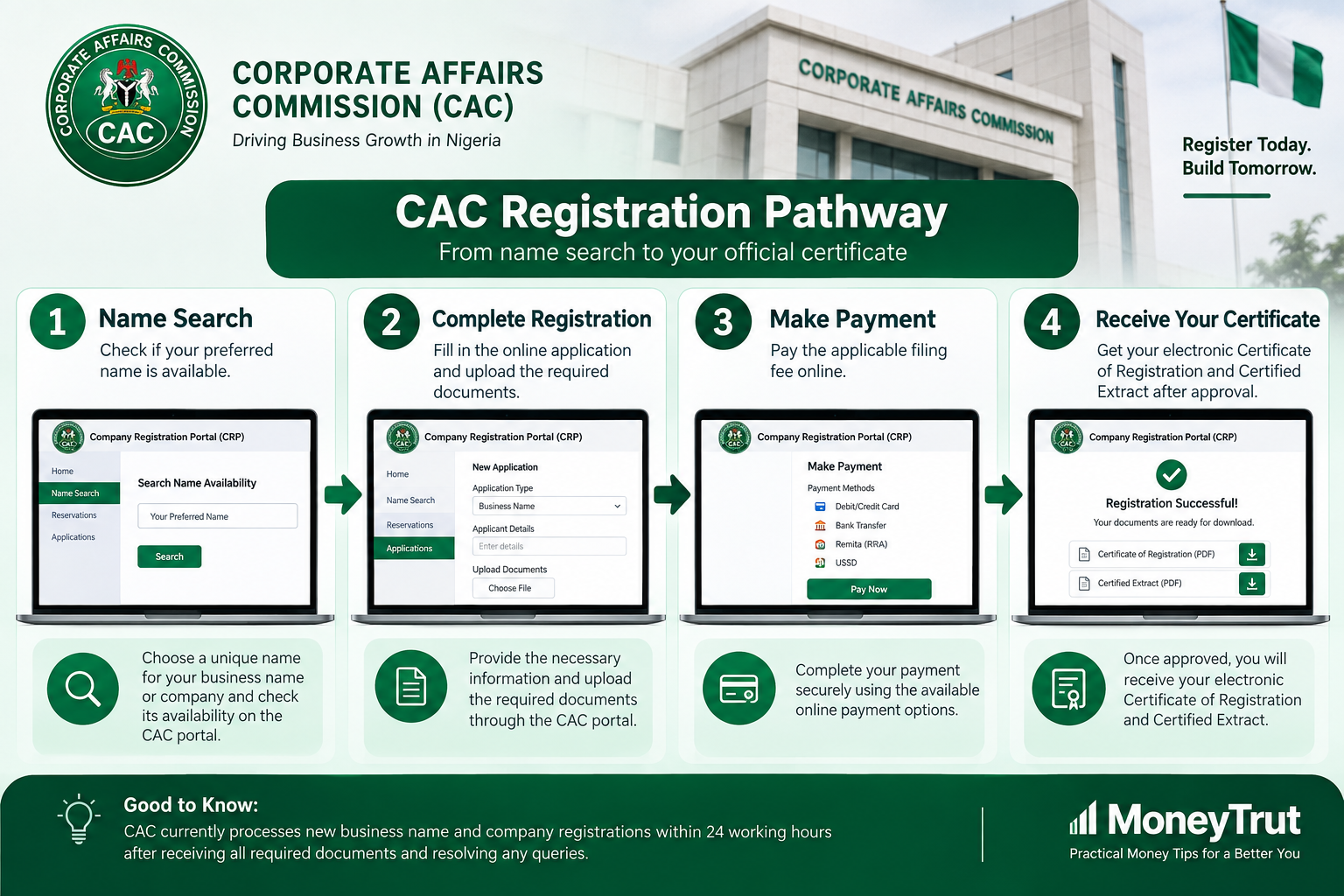
CAC currently provides separate registration procedures for business names and companies.
For a business name, CAC lists the process as:
- Check the availability of the business name.
- Complete the pre-registration form.
- Upload the relevant registration documents.
- Pay the applicable filing fee.
- Receive the electronic Certificate of Registration and Certified Extract after completion.
For company registration, CAC requires a name availability search, formal name reservation, completion of the digital pre-registration process, supporting documentation and payment of applicable filing and statutory stamp-duty fees.
CAC's current published service timelines list 24 working hours for new company and business-name registrations once the relevant documents are received and any queries have been complied with. These are service timelines, not a guarantee that every application will be completed within that period.
14. You Can Register Online
CAC's current system handles registration through its Company Registration Portal.
The official CAC portal allows users to create an account and register or manage business names and companies.
CAC's current guidance also states that business-name registration is end-to-end through the portal and that electronic registration documents are issued.
That means you do not necessarily need to visit a CAC office simply to begin the registration process.
However, if your situation is complicated, using an accredited professional may still be useful.
15. You Don't Always Need an Agent to Register a Business Name
This is particularly useful for small entrepreneurs.
CAC explicitly states that individuals and proprietors can register business names without the services of a legal practitioner, chartered accountant or chartered secretary.
So if someone tells you:
"You must pay me to register your business name because nobody can do it themselves,"
that is not consistent with CAC's current guidance.
You can use the official CAC system yourself.
However, professional assistance may still be worthwhile if you have a complicated ownership structure or are unsure about the legal implications of your proposed structure.
16. Be Careful With Registration Agents
Some entrepreneurs prefer using agents because they don't want to deal with the registration process themselves.
That's a legitimate choice.
But understand what you are paying for.
Ask:
- What is CAC's official fee?
- What is the agent's service charge?
- What documents will I receive?
- Will the registration be under my correct details?
- Will I receive access to the official documents?
- Is the agent accredited where required?
- What happens if CAC raises a query?
Don't simply hand over money because someone says:
"I'll register everything for you."
Your business registration is important enough to verify.
17. Check the Business After Registration
Registration is not the end of the process.
CAC maintains a public registry and provides a company-search service through which registration status and other company information can be checked.
Keep your registration documents safely.
You may need them later when:
- Opening accounts
- Applying for business opportunities
- Signing contracts
- Verifying your business
- Working with partners
- Applying for financing
- Completing other regulatory processes
CAC itself notes that registration can support corporate bank accounts, official contracts and access to government or financial services.
Business Name or Company? Use This Simple Test
Ask yourself these seven questions.
1. Am I the only owner?
If yes, a business name may be sufficient for a straightforward operation.
If no, consider whether a company structure would better organise ownership.
2. Do I expect outside investors?
If yes, think seriously about the structure you will need.
3. Will the business remain relatively small?
If yes, a business name may be practical.
4. Do I want to build a larger corporate business?
If yes, a company may make more sense.
5. Will I have multiple shareholders?
If yes, consider a company structure.
6. Will my business take on significant contractual or financial risks?
If yes, get appropriate professional advice about structure and liability.
7. What do my major customers require?
If your target market has specific registration requirements, factor those into the decision.
Examples of Businesses That May Start With a Business Name
These are examples, not rules.
Example 1: Freelance Designer
Chika works full-time but designs logos and social media graphics after work.
She earns:
Salary: ₦350,000
Freelance income: ₦100,000–₦200,000
She works alone and does not have investors.
A business name may be a practical structure for her business at this stage.
Example 2: Small Online Fashion Store
David buys clothes from suppliers and sells them through Instagram, WhatsApp and a website.
He has no shareholders.
He has two part-time assistants.
His business is growing but remains relatively simple.
A business name may still suit his current structure, depending on his circumstances and future plans.
Example 3: Growing Logistics Company
Three founders want to build a logistics company.
They plan to raise capital, employ drivers, purchase vehicles and work with corporate clients.
This is a much more formal operation.
A company structure may be more appropriate.
Example 4: Technology Startup
Two developers create an application.
They expect to raise investment and potentially bring additional shareholders into the business.
A company structure may be more suitable for their plans.
What If You Already Registered a Business Name?
Don't panic.
You are not necessarily stuck with that decision forever.
As your business grows, your structure can potentially change.
The important thing is to monitor whether your current structure still fits your business.
If your business changes significantly—for example, you add partners, seek investors or expand into a more complex operation—review the structure rather than assuming the original registration will always be sufficient.
Should You Register a Business Name or Company Before Starting to Sell?
This depends on the nature of your business and the requirements that apply to it.
If you are still testing whether people will buy your product, you may first want to validate the business idea.
For example, suppose you want to sell a product that costs ₦200,000 to stock.
Before committing ₦2 million to inventory, you might test demand with a smaller quantity.
Once you establish that customers actually want the product, formalise and expand the operation appropriately.
But some sectors have specific regulatory requirements, licences or approvals.
Do not assume that CAC registration alone gives you permission to operate every type of business.
For example, regulated products and industries can have additional requirements.
SMEDAN's One-Stop Shop highlights that different businesses may need to deal with bodies such as NAFDAC, SON, NEPC, BOI and other agencies depending on the nature of the business.
Registration Is Only One Part of Building a Business
Registering with CAC is important.
But a registered business can still fail.
You still need:
- Customers
- Good products or services
- Proper pricing
- Cash-flow management
- Marketing
- Record keeping
- Reliable suppliers
- Customer service
- Financial discipline
MoneyTrut previously covered the basics of starting a business in:
How to Start a Small Business in Nigeria With Little Money
And pricing is particularly important once you start selling:
How to Price Your Products and Services in Nigeria Without Losing Money
What Should a New Entrepreneur Choose?
For many people starting a simple, owner-operated business, a business name may be a reasonable starting point.
For people building a business with multiple owners, shareholders, outside investment or a more formal growth plan, a company may be more appropriate.
But don't choose based on what sounds more impressive.
Choose based on:
Ownership + Risk + Growth + Investment + Customers + Compliance
If those factors point toward a business name, use one.
If they point toward a company, consider incorporation.
And if your situation involves significant money, multiple investors, complicated ownership or substantial legal risk, professional legal/accounting advice can be worth the cost.
Bottom Line
A business name and a company are not simply two different labels for the same thing.
They represent different business structures.
A business name can be practical for many sole proprietors, freelancers, traders and small businesses.
A company can make more sense when the business has multiple shareholders, plans to raise investment, needs a more formal corporate structure or is being built for larger-scale growth.
The most important thing is not to register the structure that sounds more impressive.
Register the structure that makes sense for the business you are actually building.
And remember that CAC registration is only the beginning. A successful business still needs customers, sensible pricing, good cash-flow management and disciplined financial records.

You must be logged in to post a comment.