

A business can make ₦500,000 in sales in a month and still lose money.
That may sound surprising, but sales are not the same thing as profit. A business must first cover the costs of producing its goods or delivering its services before the owner can know how much money was actually made.
This is why knowing your break-even point is important.
Your break-even point tells you how much you need to sell before your business has covered its costs. At that point, the business is neither making a profit nor a loss.
For a Nigerian small-business owner, this can answer practical questions such as:
- How many products do I need to sell each month?
- Is my current selling price enough?
- How much do I need to sell before I start making a profit?
- Can my business survive if costs increase?
- What sales target should I set each month?
- Is this business idea financially realistic?
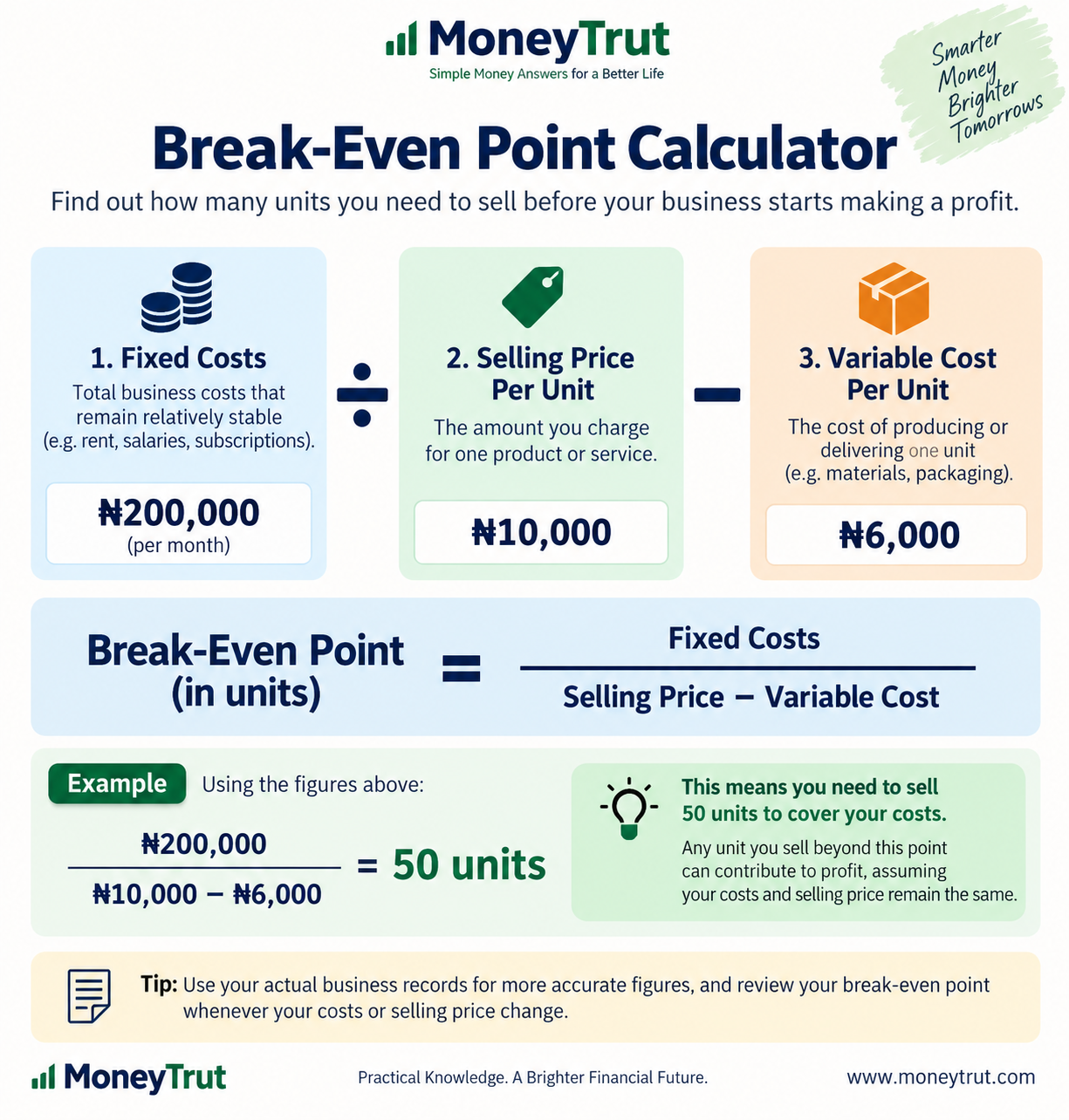
The basic break-even formula is:
Break-Even Point in Units = Fixed Costs ÷ (Selling Price per Unit − Variable Cost per Unit)
Let's break down what that means and how you can use it.
What Is a Break-Even Point?
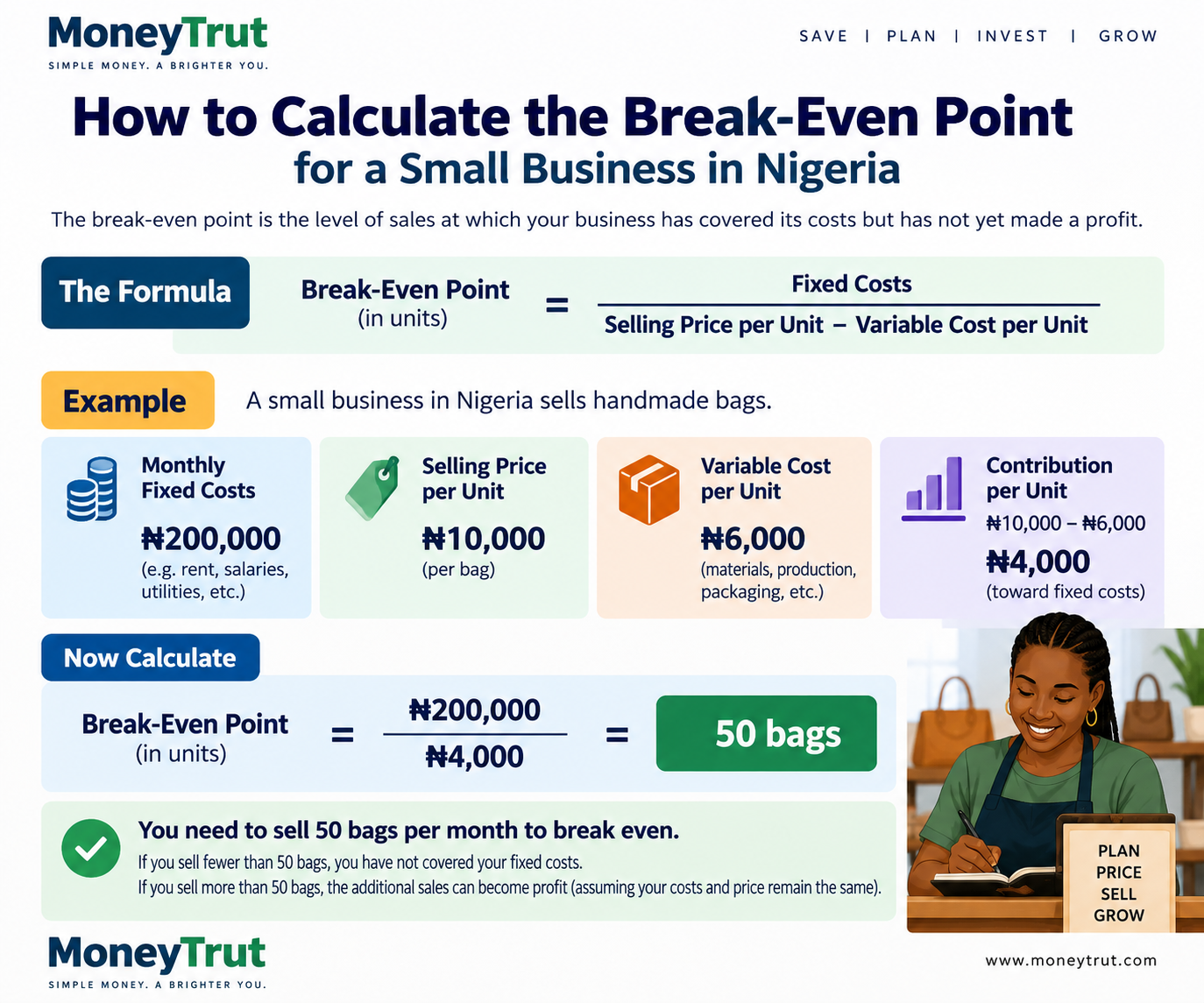
The break-even point is where your business's total revenue is equal to its total costs.
In simple terms:
Revenue = Costs
You are not losing money, but you are not making a profit either.
For example, suppose you run a small business selling bags.
You sell each bag for ₦10,000.
It costs you ₦6,000 in materials, production and packaging to make each bag.
That leaves:
₦10,000 − ₦6,000 = ₦4,000
The ₦4,000 is the amount each bag contributes toward covering your fixed business costs.
If your monthly fixed costs are ₦200,000, you need:
₦200,000 ÷ ₦4,000 = 50 bags
So your monthly break-even point is 50 bags.
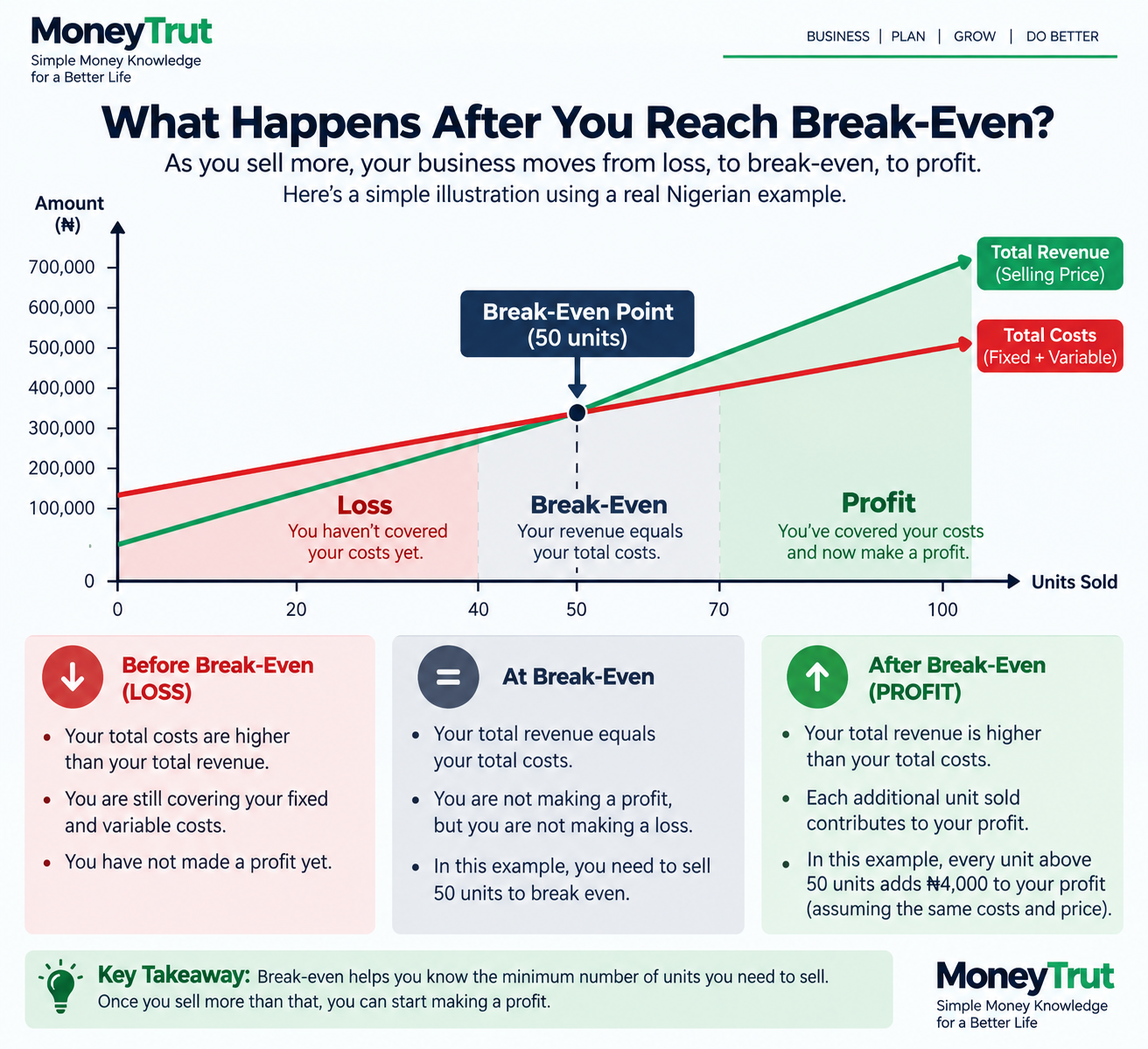
If you sell fewer than 50 bags, you have not covered your fixed costs.
If you sell exactly 50, you have reached break-even.
If you sell more than 50, the additional contribution can become operating profit, assuming your costs and selling price remain as estimated.
Why Break-Even Analysis Matters
Many small-business owners set sales targets without knowing what those targets actually mean financially.
Someone may say:
"I want to sell ₦1 million this month."
But is ₦1 million enough?
That depends on the costs of the business.
If the business spends ₦850,000 to generate those sales, the owner is left with much less than the ₦1 million sales figure suggests.
SMEDAN explains that profit is what remains after the relevant costs are deducted from sales, and distinguishes between gross profit, operating profit and net profit.
Break-even analysis takes this idea one step further by showing how much you need to sell before the business begins moving beyond its costs.
The Three Numbers You Need
To calculate a basic break-even point, you need three main figures.
1. Fixed Costs
Fixed costs are costs that generally remain relatively stable within a particular period, regardless of how many units you sell.
Examples may include:
- Shop rent
- Salaries
- Insurance
- Some subscriptions
- Certain administrative costs
- Equipment-related costs
Suppose your shop rent is ₦600,000 per year.
For a monthly calculation, you could treat that as:
₦600,000 ÷ 12 = ₦50,000 per month
The SBA similarly recommends converting annual fixed costs into monthly amounts when conducting a monthly break-even analysis.
2. Selling Price Per Unit
This is the amount you charge for one unit of your product or service.
For example:
Selling price = ₦10,000
3. Variable Cost Per Unit
Variable costs are costs that generally increase as you produce or sell more.
Depending on the business, these might include:
- Raw materials
- Ingredients
- Packaging
- Production costs
- Per-order delivery costs
- Transaction-related costs
Suppose your product sells for ₦10,000 and the variable cost is ₦6,000.
Your contribution per unit is:
₦10,000 − ₦6,000 = ₦4,000
This ₦4,000 is what each sale contributes toward your fixed costs and eventually your profit.
The Break-Even Formula
The basic formula is:
Break-Even Point in Units = Fixed Costs ÷ (Selling Price − Variable Cost Per Unit)
Let's use a simple Nigerian example.
Suppose you sell handmade bags.
Monthly fixed costs: ₦120,000
Selling price: ₦8,000 per bag
Variable cost: ₦5,000 per bag
First calculate your contribution:
₦8,000 − ₦5,000 = ₦3,000
Then calculate your break-even point:
₦120,000 ÷ ₦3,000 = 40 bags
You therefore need to sell 40 bags per month to break even.
What Happens After You Reach Break-Even?
Suppose you sell 50 bags instead of 40.
You have sold:
50 − 40 = 10 additional bags
Each bag contributes ₦3,000.
So:
10 × ₦3,000 = ₦30,000
Under the assumptions in this example, those additional sales generate ₦30,000 above the break-even level.
This is why a break-even target is more useful than simply saying, "I want more sales."
You can establish a minimum target and then set a higher profit target.
Example: A Small Food Business
Suppose you sell meals for ₦3,000 each.
Your estimated variable cost per meal is ₦1,800.
Your monthly fixed costs are ₦180,000.
First calculate your contribution:
₦3,000 − ₦1,800 = ₦1,200
Then:
₦180,000 ÷ ₦1,200 = 150 meals
You need to sell approximately 150 meals per month to break even.
Now suppose you operate 25 days each month.
150 ÷ 25 = 6 meals per day
So you need to sell approximately 6 meals per day to reach your monthly break-even point.
That makes the number much easier to use as a daily business target.
Example: A Fashion Business
Suppose you sell a dress for ₦25,000.
Your costs directly associated with producing each dress are:
- Fabric and materials: ₦10,000
- Sewing: ₦4,000
- Packaging: ₦1,000
Total variable cost:
₦15,000
Your contribution per dress is:
₦25,000 − ₦15,000 = ₦10,000
Suppose your monthly fixed costs are ₦200,000.
Your break-even point is:
₦200,000 ÷ ₦10,000 = 20 dresses
You therefore need to sell approximately 20 dresses per month to break even.
If you sell 25 dresses, the five additional dresses contribute:
5 × ₦10,000 = ₦50,000
Again, this assumes the original cost and pricing assumptions remain valid.
Example: A Service Business
Break-even analysis is not just for businesses that sell physical products.
Imagine you are a freelance graphic designer.
You charge ₦50,000 per project.
Your average variable cost per project is ₦10,000.
Your contribution is:
₦50,000 − ₦10,000 = ₦40,000
Suppose your monthly fixed business costs are ₦160,000.
Your break-even point is:
₦160,000 ÷ ₦40,000 = 4 projects
You therefore need approximately four projects per month to cover the costs included in the calculation.
This can be particularly useful for freelancers because your capacity may limit how many projects you can realistically complete.
Fixed Costs and Variable Costs Are Not Always Perfectly Clear
Real businesses are sometimes more complicated than the formula suggests.
For example, electricity may have a relatively stable monthly component but also increase when production increases.
The same can happen with:
- Fuel
- Data
- Delivery
- Repairs
- Overtime
- Labour
- Packaging
Some expenses can therefore behave partly as fixed costs and partly as variable costs.
For a simple calculation, you can make a reasonable classification based on how your business operates.
But if the calculation will be used for an important investment or financing decision, it is worth examining the costs more carefully.
How Your Business Records Help
This is where our previous MoneyTrut article on how to keep business records in Nigeria becomes useful.
Your sales and expense records give you real numbers instead of guesses.
You can use them to determine:
Fixed costs: What does the business have to pay regularly?
Variable costs: What does each additional product or service cost?
Selling price: How much are customers actually paying?
Sales volume: How many units are you currently selling?
The more accurate your records are, the more useful your break-even calculation becomes.
Break-Even Revenue
You can also calculate your break-even point in terms of sales revenue rather than the number of units.
Suppose:
Selling price = ₦10,000
Variable cost = ₦6,000
Contribution per unit:
₦4,000
Contribution margin:
₦4,000 ÷ ₦10,000 = 40%
If your fixed costs are ₦200,000:
₦200,000 ÷ 40% = ₦500,000
Your break-even revenue is therefore approximately ₦500,000.
At ₦500,000 in sales, the business would have covered its costs under these assumptions.
What Happens When Your Costs Increase?
Break-even analysis can show you why rising costs can put pressure on a business.
Suppose you sell a product for ₦10,000.
Variable cost:
₦6,000
Contribution:
₦4,000
Fixed costs:
₦200,000
Break-even:
₦200,000 ÷ ₦4,000 = 50 units
Now suppose the variable cost rises from ₦6,000 to ₦7,000.
Your new contribution becomes:
₦10,000 − ₦7,000 = ₦3,000
Your new break-even point becomes:
₦200,000 ÷ ₦3,000 = 66.67
You would need to sell approximately 67 units to break even.
Your selling price did not change.
But your costs increased, so you now need to sell more.
What Happens If You Reduce Your Price?
Suppose your product sells for ₦10,000 and your variable cost is ₦6,000.
Your contribution is:
₦4,000
With fixed costs of ₦200,000:
₦200,000 ÷ ₦4,000 = 50 units
Now imagine you reduce the selling price to ₦9,000.
Your contribution becomes:
₦9,000 − ₦6,000 = ₦3,000
Your new break-even point is:
₦200,000 ÷ ₦3,000 = 66.67
You now need approximately 67 units instead of 50.
This is why lowering prices can sometimes require a significant increase in sales volume to produce the same financial result.
Our earlier guide on how to price your products and services in Nigeria without losing money covers the pricing side of this decision in more detail.
Break-Even Does Not Mean Profit
This is one of the most important things to understand.
If your break-even point is 50 units, selling 50 units does not mean you made a profit.
It means you have covered the costs included in the calculation.
Profit begins after that point, assuming the underlying assumptions remain valid.
For example:
Break-even: 50 units
Actual sales: 70 units
Units above break-even: 20
If each additional unit contributes ₦4,000:
20 × ₦4,000 = ₦80,000
That ₦80,000 represents the contribution above the break-even level before accounting for any costs or changes that were not included in the original calculation.
Use Break-Even to Test a Business Idea
Break-even analysis can be particularly useful before starting a business.
Suppose you want to start a small business.
You estimate:
Monthly fixed costs: ₦100,000
Selling price: ₦5,000
Variable cost: ₦3,500
Contribution:
₦5,000 − ₦3,500 = ₦1,500
Break-even:
₦100,000 ÷ ₦1,500 = 66.67
You therefore need approximately 67 sales per month to break even.
Now ask yourself:
Can I realistically sell 67 units every month?
If your research suggests that you can sell only 30, the business model may need to change.
You could consider:
- Reducing costs
- Increasing the selling price
- Improving the product
- Increasing sales volume
- Changing the target market
- Offering another product
- Reducing fixed expenses
This turns a business idea into something you can test with numbers.
What If You Sell Several Products?
Many Nigerian businesses sell several products rather than one.
A fashion retailer might sell:
- Shirts
- Trousers
- Dresses
- Shoes
- Bags
Each product may have a different selling price and variable cost.
In this situation, there is no single simple unit calculation unless you make assumptions about your sales mix.
One practical approach is to calculate the contribution margin of your major products and identify which products contribute most toward covering your fixed costs.
For a business with many products, more detailed accounting may be appropriate.
How Many Units Do You Need to Make a Specific Profit?
Break-even analysis can also be used to calculate a profit target.
Suppose:
Fixed costs = ₦200,000
Selling price = ₦10,000
Variable cost = ₦6,000
Contribution per unit:
₦4,000
Break-even:
₦200,000 ÷ ₦4,000 = 50 units
Now suppose you want to make ₦100,000 in operating profit.
You need to cover:
₦200,000 fixed costs + ₦100,000 target profit = ₦300,000
Then:
₦300,000 ÷ ₦4,000 = 75 units
So you need to sell approximately 75 units to cover the fixed costs and generate ₦100,000 in operating profit under these assumptions.
This is often more useful than setting an arbitrary sales target.
Don't Forget Costs
One of the easiest ways to produce a misleading break-even figure is to leave out costs.
For example, a small business owner may remember:
- Stock
- Rent
- Salaries
But forget:
- Packaging
- Delivery
- Bank charges
- Advertising
- Data
- Repairs
- Electricity
- Waste
- Equipment maintenance
If important costs are missing, the calculated break-even point may be too low.
Your business records should therefore be as complete as possible.
Review Your Break-Even Point Regularly
Your break-even point is not a permanent number.
It can change when:
- Rent increases
- Supplier prices increase
- Your selling price changes
- Salaries increase
- You hire more workers
- You introduce new products
- You reduce expenses
- Your production process changes
For example, if your product cost rises from ₦6,000 to ₦7,000, your contribution falls even if your selling price remains ₦10,000.
That can significantly increase the number of units you need to sell.
Review your calculation whenever there is a meaningful change in your business.
A Simple Break-Even Worksheet
You can calculate your break-even point using this simple worksheet:
Monthly fixed costs: ₦________
Selling price per unit: ₦________
Variable cost per unit: ₦________
Contribution per unit: ₦________
Break-even units: ________
Then ask:
Current monthly sales: ________ units
Break-even sales: ________ units
Target profit: ₦________
Units required for target profit: ________
This gives you a basic financial target for your business.
Five Common Break-Even Mistakes
1. Treating sales as profit
₦1 million in sales does not mean ₦1 million in profit.
2. Forgetting smaller expenses
Small expenses can become significant when added together.
3. Using unrealistic costs
Your calculation should be based on actual or reasonably estimated costs.
4. Assuming your break-even point will never change
Costs and prices change, so your calculation should change too.
5. Setting a sales target without checking capacity
A business may technically need 100 sales per month to make its target profit, but can it realistically produce and sell 100 units?
Your sales target needs to make sense operationally as well as financially.
How Break-Even Fits Into Business Planning
Break-even analysis should not be used on its own.
You should also consider:
- Customer demand
- Competition
- Cash flow
- Profit margin
- Working capital
- Inventory
- Debt
- Available capital
- Production capacity
A business can have a manageable break-even point and still experience cash-flow problems.
Similarly, high sales do not automatically mean strong profitability.
SMEDAN's guidance on calculating business profit reinforces the importance of looking beyond sales and considering the different costs involved in running a business.
SMEDAN also provides business-development resources and support for Nigerian MSMEs, including access to guidance, resources, training and other support programmes.
Bottom Line
Knowing your break-even point helps you answer a basic but important business question:
How much do I need to sell before my business starts making money?
The formula is:
Break-Even Point in Units = Fixed Costs ÷ (Selling Price − Variable Cost Per Unit)
If your fixed costs are ₦200,000, your product sells for ₦10,000 and your variable cost is ₦6,000, you need to sell 50 units to break even.
But the calculation is only as good as the numbers you put into it.
Use your actual business records, review your costs regularly and make sure your sales target is realistic.
Once you know your break-even point, you can move beyond simply asking, "How much did I sell?"
You can start asking better questions:
Did I sell enough to cover my costs?
How many more units do I need to sell to reach my profit target?
What happens if my costs increase?
Can my current price support the business?
Those are the numbers that can help you make better business decisions.
Related Articles
- How to Keep Business Records in Nigeria: A Simple System for Small Businesses
- How to Price Your Products and Services in Nigeria Without Losing Money
- How to Start a Small Business in Nigeria With Little Money
- Business Name vs Company in Nigeria: Which Should You Register?
- How to Make Money From Your Skills in Nigeria: A Practical Guide

You must be logged in to post a comment.