
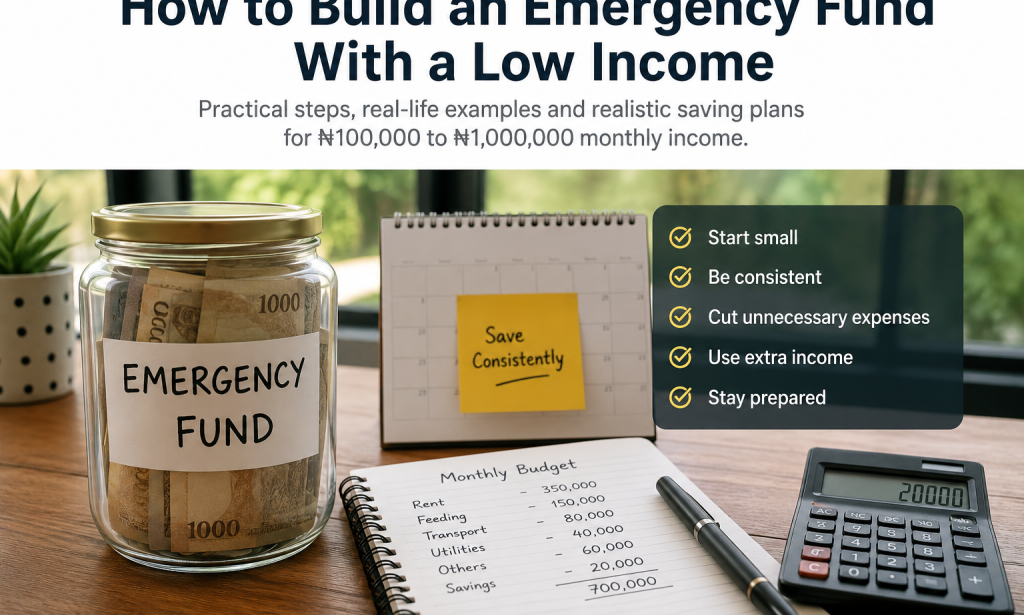
If most of your income is already committed to rent, food, transportation, bills, family responsibilities and debt, being told to “save three to six months of expenses” can sound almost impossible.
You may know you need emergency savings, but knowing that and actually building one are two different things.
The good news is that you do not need to have a large salary or thousands of dollars sitting in your account before you can start.
You can begin with what you can realistically afford, build a small financial buffer, and increase it over time.
An emergency fund is money set aside specifically for unexpected expenses or financial shocks, such as an urgent medical bill, necessary repair, sudden loss of income or another expense that was not part of your normal monthly budget. The Consumer Financial Protection Bureau (CFPB) notes that even a small amount of emergency savings can provide some financial security.
The key is to stop thinking about an emergency fund as one huge number you must reach immediately.
Think of it as a financial safety net that you build in stages.
What Is an Emergency Fund?
An emergency fund is a dedicated pool of money reserved for unexpected and necessary expenses.
It is different from money you are saving for a planned purchase.
For example:
Emergency fund: Your car suddenly needs an expensive repair that you cannot postpone.
Regular savings: You are putting money aside for a new phone you plan to buy in six months.
Emergency fund: You lose your main source of income and need money to cover essential expenses while you look for another source of income.
Regular savings: You are saving for a holiday next year.
The purpose of an emergency fund is simple: when something goes wrong financially, you have another option besides immediately borrowing money, selling important assets or using money meant for another purpose.
Without emergency savings, even a relatively small financial shock can turn into debt.
How Much Should You Have in an Emergency Fund?
There is no single amount that is right for everyone.
You will often hear that an emergency fund should cover three to six months of expenses. That can be a useful long-term target, and financial education materials from U.S. regulators commonly use that range as a general benchmark.
But there is a problem with treating six months as the starting point.
If you currently have nothing saved, being told to accumulate six months of expenses can make the goal feel so far away that you never start.
A better approach is to build your emergency fund in stages.
Stage 1: Build your first financial buffer
Your first goal is simply to have some money available for an unexpected expense.
It could be ₦20,000, ₦50,000, ₦100,000 or another amount that makes sense for your circumstances.
There is nothing magical about any of those figures.
The point is to move from having nothing available to having something available.
Stage 2: Work toward one month of essential expenses
Once you have a small buffer, calculate what you actually need to keep yourself or your household functioning for one month.
Focus on essential expenses rather than everything you normally spend.
For example:
- housing
- basic food
- transportation
- electricity and other essential utilities
- necessary medication
- minimum debt payments
- essential family responsibilities
If those expenses total ₦250,000 per month, then ₦250,000 becomes a useful milestone.
Stage 3: Build toward three months
After reaching one month of essential expenses, you can work toward three months.
This becomes particularly important if your income is unstable, you are self-employed, you support several people or finding another source of income could take time.
Stage 4: Consider three to six months or more
A bigger emergency fund may make sense when your financial situation carries greater risk.
For example, you may want a larger reserve if:
- you are the only income earner in your household
- your income changes significantly from month to month
- you are self-employed
- you have several dependants
- you have high unavoidable monthly expenses
- your job or business income is uncertain
The important point is that your emergency-fund target should reflect your circumstances, not somebody else's salary.
Your Income Is Not the Same as Your Emergency-Fund Target
This is one of the biggest mistakes people make when thinking about emergency savings.
Someone earning ₦1 million per month does not automatically need a larger emergency fund than someone earning ₦500,000.
Consider two hypothetical people.
Person A
Monthly income: ₦1,000,000
Essential expenses: ₦850,000
Person B
Monthly income: ₦500,000
Essential expenses: ₦300,000
Person A earns much more, but has only ₦150,000 left after essential expenses.
Person B earns less but has ₦200,000 of monthly breathing room.
This is why your emergency-fund target should be based largely on essential expenses and financial risk, rather than income alone.
Your salary tells you how much money comes in.
Your essential expenses tell you how much you need to protect.
How to Build an Emergency Fund When Money Is Tight
If you are struggling to save, the answer is not necessarily to wait until you earn more.
Start by looking at what is actually happening to your money each month.
1. Find your real monthly surplus
Look at your income and your actual spending.
Do not estimate if you can avoid it.
Check your bank transactions, cash spending and recurring payments.
Then calculate:
Monthly income − essential expenses − other necessary commitments = potential savings capacity
If you earn ₦300,000 and your essential expenses and necessary commitments consume ₦280,000, telling yourself to save ₦100,000 every month is not realistic.
But perhaps ₦10,000 or ₦15,000 is possible.
Start there.
The CFPB recommends paying attention to cash flow—the timing of money coming in and going out—because understanding that pattern can reveal opportunities to save.
2. Start smaller than your ideal amount
If you can only save ₦5,000 a month, start with ₦5,000.
If you can save ₦20,000, save ₦20,000.
The objective is to create a sustainable habit rather than choose an impressive number that you cannot maintain.
For example:
₦10,000 × 12 months = ₦120,000
₦20,000 × 12 months = ₦240,000
₦30,000 × 12 months = ₦360,000
₦50,000 × 12 months = ₦600,000
That is before considering any interest or investment return, which should not be assumed for an emergency-fund calculation.
The mathematics is simple, but the important part is consistency.
Research from the CFPB has found an association between having a regular saving habit and greater financial security, including across different income levels.
3. Save when you receive the money
If you wait until the end of the month to see what is left, there may be nothing left.
Instead, decide on a realistic amount and move it into your emergency savings when you receive your income.
This can be especially useful for people whose income arrives regularly.
Automatic transfers can make the process easier because you do not have to make the same decision every month. The CFPB recommends automatic saving as one way to make saving more consistent.
4. Use extra income strategically
Your regular salary does not have to do all the work.
If you receive:
- a bonus
- a gift
- unexpected business income
- a side-hustle payment
- a tax refund where applicable
- money from selling something you no longer need
you could put some or all of it toward your emergency fund.
This can accelerate your progress without requiring you to permanently cut your normal monthly spending.
5. Look for recurring expenses, not just small purchases
You do not necessarily need to stop buying every small thing you enjoy.
Instead, look for expenses that repeatedly consume significant amounts of money.
For example:
- unused subscriptions
- expensive recurring services
- unnecessary bank charges
- frequent food delivery
- expensive transportation choices
- lifestyle expenses that have gradually increased
Cutting one meaningful recurring expense can sometimes have a greater effect than trying to eliminate dozens of small purchases.
How Much Should You Save Each Month?
There is no universal percentage that everyone should follow.
You may have heard rules such as “save 20% of your income.”
That can be a useful target for someone who can comfortably afford it, but it is not a sensible starting point for everyone.
If your monthly income is ₦100,000 and your essential expenses consume ₦90,000, saving ₦20,000 every month would leave you short.
On the other hand, someone earning ₦1 million with relatively low essential expenses may be able to save considerably more.
Instead of starting with a percentage, ask:
How much can I save consistently without creating another financial problem?
Then increase that amount when your circumstances improve.
For example, you could begin with ₦10,000 per month and increase it to ₦15,000 after receiving a pay increase.
The goal is progress, not perfection.
Emergency-Fund Examples From ₦100,000 to ₦1 Million Monthly Income
The following examples are hypothetical. They are not recommended savings targets for everyone.
The purpose is to show how your emergency-fund strategy can change depending on your income and expenses.
| Monthly income | Example essential expenses | Example starting contribution |
|---|---|---|
| ₦100,000 | ₦85,000 | ₦5,000–₦10,000 |
| ₦200,000 | ₦160,000 | ₦10,000–₦20,000 |
| ₦300,000 | ₦230,000 | ₦15,000–₦30,000 |
| ₦500,000 | ₦350,000 | ₦25,000–₦50,000 |
| ₦750,000 | ₦500,000 | ₦50,000–₦100,000 |
| ₦1,000,000 | ₦650,000 | ₦75,000–₦150,000 |
These figures are illustrative rather than financial recommendations.
Someone earning ₦200,000 with major family responsibilities may need to save less initially than someone earning the same amount with few financial commitments.
Likewise, someone earning ₦1 million may have unusually high expenses and little capacity to save.
Your actual budget matters more than the salary number.
Where Should You Keep an Emergency Fund?
An emergency fund is not money you are trying to make rich quickly.
Its first job is to be available when you need it.
That means accessibility and safety generally matter more than chasing the highest possible return.
A suitable emergency-savings arrangement should generally be:
- reasonably safe
- accessible when needed
- separate from your everyday spending
- easy for you to understand and manage
A dedicated savings account can help create a psychological separation between emergency money and everyday spending.
The CFPB similarly recommends keeping emergency savings in a place that is safe and accessible and where you are less tempted to spend it on non-emergencies.
For Nigerian readers, also pay attention to whether the institution holding your deposit is properly licensed and whether applicable deposit-insurance protections cover the type of account you are using.
Do not assume that every financial product is equivalent to a normal bank deposit.
Should You Invest Your Emergency Fund?
Generally, you should be careful about putting money that you may need urgently into investments whose value can fall or that may be difficult to access quickly.
An emergency fund has a different purpose from long-term investing.
Your emergency fund is there to protect you from financial shocks.
Your investment portfolio is there to help build wealth over time.
Mixing those two purposes can create a problem.
Imagine you need ₦500,000 urgently and the investment you were relying on has fallen significantly in value.
You could be forced to sell at an unfavorable time.
For emergency savings, accessibility and capital preservation should generally come before chasing investment returns.
What Counts as an Emergency?
This is something you should decide before an emergency happens.
Possible emergencies include:
- an unexpected medical expense
- urgent home or vehicle repairs
- sudden loss of income
- necessary emergency travel
- an essential expense that you genuinely did not anticipate
Things that are usually better handled through normal budgeting include:
- holidays
- entertainment
- a planned phone upgrade
- routine clothing purchases
- planned school expenses
- gifts you knew you needed to buy
- other predictable expenses
There will always be grey areas.
The point is not to create a complicated rulebook.
It is to stop your emergency fund from becoming another everyday spending account.
The CFPB recommends setting personal guidelines for what qualifies as an emergency while also emphasizing that people should not be afraid to use the fund when they genuinely need it.
What If You Have Debt?
This is where financial advice often becomes too simplistic.
You may hear:
“Pay off all your debt before building an emergency fund.”
That is not necessarily the best approach for everyone.
If you have no savings at all and an unexpected expense occurs, you may have to borrow again.
On the other hand, high-interest debt can grow rapidly, so ignoring expensive debt while accumulating a very large cash balance may also be inefficient.
A more practical approach can be to build an initial emergency buffer while also making a serious plan to reduce expensive debt.
Once you have some protection against small financial shocks, you can decide how aggressively to prioritize debt repayment versus additional emergency savings based on the interest rate, the type of debt and your financial stability.
There is no single rule that works for every household.
What If You Have to Use Your Emergency Fund?
Use it.
That is what it is for.
An emergency fund is not a financial trophy that you are supposed to protect at all costs.
If you lose income or face a genuine unexpected expense, using the money can prevent you from taking on expensive debt or disrupting another important financial goal.
The important part is what happens afterward.
Once the emergency has passed, start rebuilding the fund.
For example, suppose you had ₦400,000 saved and used ₦250,000 for an unexpected emergency.
You now have ₦150,000.
Your next financial goal is not necessarily to start investing.
It may be to rebuild that emergency reserve.
How to Grow Your Emergency Fund Over Time
Your emergency fund does not have to remain at its initial target.
As your income increases, your financial responsibilities change, or your job becomes less secure, you may want to increase it.
A simple progression might look like:
₦50,000 → ₦100,000 → ₦250,000 → one month of essential expenses → three months → three to six months
The exact numbers will differ from person to person.
The important thing is that each milestone gives you greater protection.
And if your income increases from ₦300,000 to ₦500,000, do not automatically increase your lifestyle by the entire difference.
Consider directing part of the increase toward your emergency fund.
The same principle applies to side income.
If a side business starts generating an additional ₦50,000 a month, you could use part of that new income to accelerate your emergency savings while using the remainder for other priorities.
The Bottom Line
Building an emergency fund on a low income is difficult, but waiting until you earn “enough” can leave you financially exposed for years.
You do not need to start with three or six months of expenses.
Start with something you can realistically maintain.
Then build from there.
Calculate your essential monthly expenses. Set a first savings target. Put money aside consistently. Keep the fund separate from everyday spending. Add extra money when you receive it. And increase the target as your income and responsibilities change.
Whether you earn ₦100,000, ₦300,000, ₦500,000 or ₦1 million a month, the principle is the same:
Your emergency fund should be built around the financial risks you face—not simply the size of your salary.
The first ₦10,000 will not solve every financial emergency.
But it is a lot more useful than ₦0.

You must be logged in to post a comment.