

If you have some money sitting in your bank account, you may eventually ask a simple question:
Should I leave it in my savings account or put it into a fixed deposit?
There isn't one answer that works for everyone.
A savings account gives you easier access to your money. A fixed deposit is designed for money you agree to leave with a financial institution for a specified period, usually in exchange for an agreed return. The Central Bank of Nigeria describes fixed deposits as deposits with a specified amount, interest rate and maturity term, while savings deposits generally offer easier access to deposited funds.
The better choice depends mainly on when you need the money, how much access you need, what return you're being offered and what you're using the money for.
For someone earning ₦50,000 a month, the answer may be very different from someone earning ₦500,000, ₦1 million or ₦2 million.
Savings Account vs Fixed Deposit: The Quick Answer
A savings account is generally more suitable for money you may need relatively soon, particularly emergency savings and regular financial needs.
A fixed deposit may make more sense for money you don't expect to need during the agreed term and want to place on deposit for a specified return.
That doesn't mean fixed deposits are automatically "better" because they may offer a higher rate.
If putting your money into a fixed deposit means you cannot access it when you need it, the higher return may not be worth the inconvenience or potential penalty.
Think of it this way:
Savings account = access and flexibility
Fixed deposit = commitment for a defined period
The right choice depends on the job you need the money to perform.
What Is a Savings Account?
A savings account is a bank account designed primarily for holding money and making it available when needed.
Depending on the bank and account type, you may be able to access your money through:
-
ATM withdrawals
-
Bank transfers
-
Mobile banking
-
Internet banking
-
Debit cards
-
Branch transactions
The exact features depend on the account and bank.
Savings accounts may also pay interest, although rates can differ between institutions and products. CBN materials explain that savings deposits generally attract deposit interest, with rates varying among financial institutions.
The biggest advantage is usually accessibility.
If your car develops a problem tomorrow and you need ₦80,000, you don't want to discover that the money you need has been locked away until a fixed-deposit maturity date.
What Is a Fixed Deposit?
A fixed deposit is money placed with a financial institution for an agreed period and under specified terms.
The amount, interest rate and maturity period are agreed when the deposit is made.
The exact terms vary between banks.
For example, a bank may offer different fixed-deposit terms for different periods. Some products may allow early withdrawal, while others may impose conditions, reduce the interest paid or require notice.
That's why you should never assume that every fixed deposit works the same way.
Read the terms before transferring the money.
The CBN describes fixed deposits as having a specified amount, agreed interest rate and term to maturity.
Why Would a Bank Pay You More for a Fixed Deposit?
The basic idea is straightforward.
When you leave money in a regular savings account, you generally expect greater flexibility.
With a fixed deposit, you're agreeing to leave the money for a specified period.
That gives the bank greater certainty about the availability of the funds.
CBN educational material notes that fixed deposits normally attract higher interest rates than savings deposits, although the actual rates available to customers vary by institution and product.
But a higher rate doesn't automatically make a fixed deposit the better choice.
Return is only one part of the decision.
Example: ₦100,000 in Savings vs Fixed Deposit
Suppose you have:
₦100,000
You could leave it in a savings account or place it in a fixed deposit.
If the fixed deposit offers a higher stated return, it may look like the obvious winner.
But suppose you need ₦60,000 unexpectedly two weeks later.
The savings account gives you much easier access to the money.
The fixed deposit may have restrictions or conditions attached to early withdrawal.
So the question isn't simply:
"Which one pays more?"
It's:
"Which one is appropriate for this money?"
Your Emergency Fund Usually Needs Accessibility
Your emergency fund exists for unexpected expenses.
That could include:
-
Medical expenses
-
Urgent repairs
-
Loss of income
-
Family emergencies
-
Unexpected bills
-
Essential travel
-
Other genuine emergencies
You don't know exactly when you'll need it.
That makes accessibility important.
MoneyTrut has covered this in:
How Much Should You Have in an Emergency Fund?
and:
How to Build an Emergency Fund With a Low Income
If your emergency fund is your only readily available financial cushion, locking all of it into a fixed deposit can create a problem.
But Does That Mean You Should Never Use a Fixed Deposit for Savings?
No.
There is a difference between saving for an emergency and saving for a known future expense.
Imagine you have:
₦500,000
and your emergency fund is already adequately funded.
You also know you won't need another:
₦300,000
for six months.
That ₦300,000 may be a candidate for a fixed deposit, depending on the rate, terms and your financial goals.
The money has a defined purpose and you don't expect to need it immediately.
That's a much stronger case for considering a fixed deposit.
What If You Earn ₦50,000 a Month?
Someone earning ₦50,000 monthly may not have enough spare cash to worry about maximizing deposit returns.
The first priority may simply be creating some financial breathing room.
For example, if you can save:
₦5,000 per month
your first target might be building a basic emergency reserve.
Putting every naira of savings into a fixed deposit could leave you with little accessible cash.
At this income level, liquidity can be more valuable than squeezing out a slightly higher return.
That doesn't mean someone earning ₦50,000 should never use a fixed deposit.
It means the person's financial situation should determine the decision.
What If You Earn ₦100,000?
Suppose you earn:
₦100,000 per month
and manage to save:
₦10,000 monthly.
If you don't yet have an emergency fund, building accessible savings may be more important than locking the money away.
Once you've built a reasonable emergency reserve, you can consider whether some additional savings should be placed in a fixed deposit or another appropriate financial product.
Your income level alone doesn't determine the answer.
Your financial position does.
What If You Earn ₦150,000?
Suppose you earn:
₦150,000
and save:
₦20,000 each month.
You might divide your savings between:
Emergency/accessible savings
and
Longer-term savings
rather than putting everything into one account.
For example, if your emergency fund is still small, you may prioritize building it first.
If it is already adequate, you could consider putting part of future savings into a fixed deposit for a known goal.
Again, the percentages here are examples, not a universal rule.
What If You Earn ₦250,000?
At ₦250,000 monthly income, you may have more flexibility, depending on your expenses and family responsibilities.
Suppose you have:
₦600,000 in total savings.
You might decide that:
₦300,000 needs to remain accessible.
The remaining:
₦300,000
could potentially be considered for a fixed deposit if you don't need it during the agreed period.
This is often more sensible than putting the entire ₦600,000 into a fixed deposit.
What If You Earn ₦500,000?
Suppose you earn:
₦500,000 per month
and have accumulated:
₦2 million
in savings.
If your emergency reserve is already sufficient and you have no immediate need for some of the money, a fixed deposit could be one option to consider for a portion of your cash.
But you should still compare:
-
Fixed-deposit rate
-
Term
-
Early withdrawal conditions
-
Minimum deposit
-
Fees or charges
-
Tax implications where applicable
-
Inflation
-
Alternative low-risk options
Don't assume that because you have more money, you should automatically lock more of it away.
What If You Earn ₦1 Million or ₦2 Million?
At higher incomes, the decision becomes less about simply finding somewhere to keep cash.
You may have several financial goals happening simultaneously.
For example:
₦1,000,000 monthly income
could support:
-
Emergency savings
-
Short-term goals
-
Investment contributions
-
Retirement planning
-
Business capital
-
Education expenses
-
Family obligations
-
Lifestyle spending
Someone earning ₦2 million may have even more financial options.
At that point, keeping a large amount of cash in a low-yield account indefinitely may not be the most efficient use of money.
But that doesn't mean everything should be invested or placed into fixed deposits.
Different pools of money can have different jobs.
Think of Your Money in Buckets
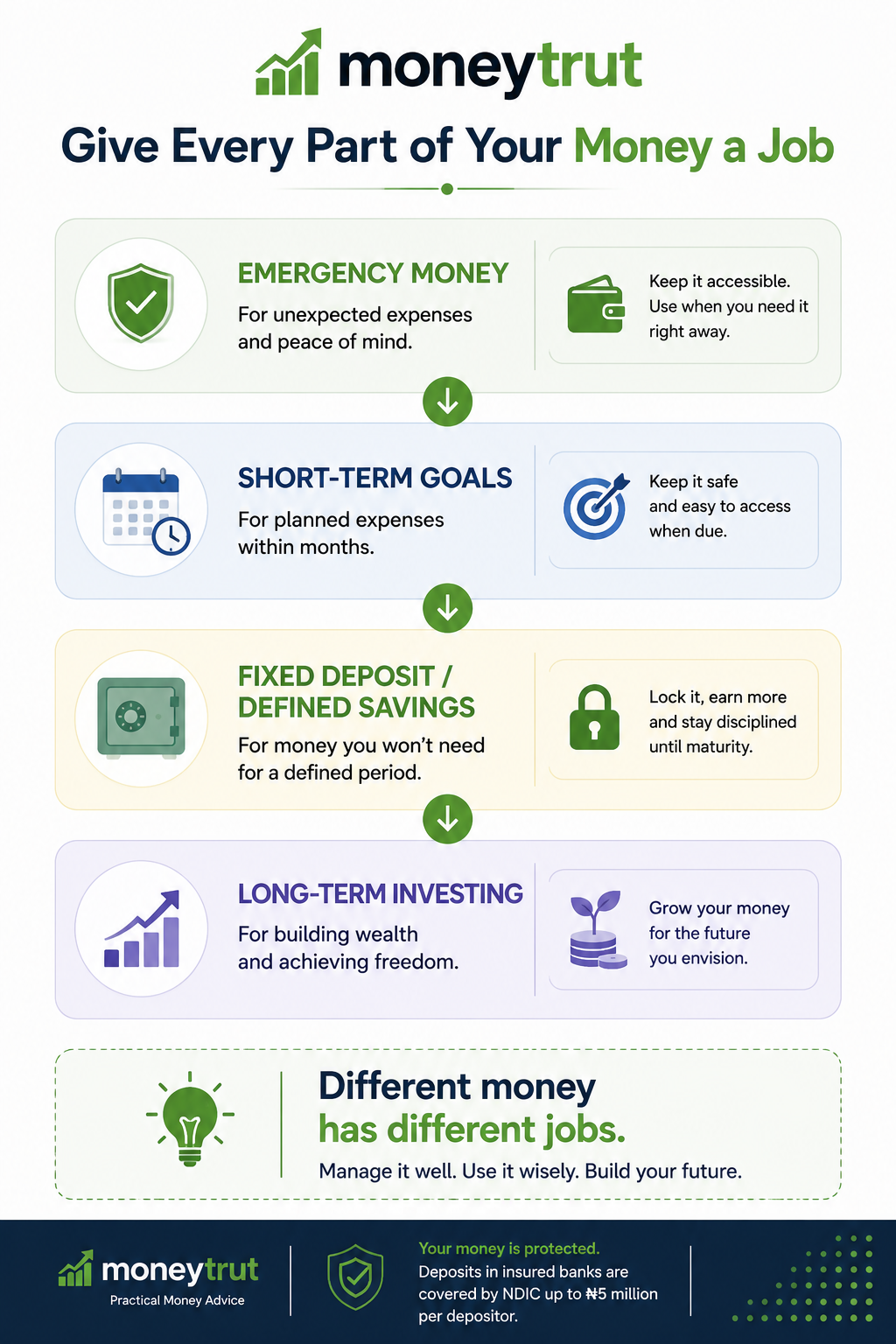
One useful way to think about savings is to divide your money according to its purpose.
Bucket 1: Money You May Need Immediately
This could include:
-
Emergency fund
-
Upcoming bills
-
Essential expenses
This money should generally prioritize accessibility.
Bucket 2: Money You Need Within Months
This might include:
-
School fees
-
Rent
-
Insurance
-
Planned repairs
-
Travel
-
A major purchase
The best place for this money depends on the timing and risk you can accept.
Bucket 3: Money You Don't Need for a Defined Period
This is where a fixed deposit may become more interesting.
If you know you won't need the money during the agreed term, you may be able to exchange some flexibility for a stated return.
Bucket 4: Long-Term Wealth
Money intended for long-term wealth building may belong in investments rather than simply sitting in a bank deposit.
MoneyTrut explains this further in:
How to Start Investing With Little Money
A fixed deposit and a long-term investment aren't the same thing.
Fixed Deposit vs Investment: Don't Confuse Them

A fixed deposit is still a deposit product.
An investment such as stocks or a fund involves different risks and potential returns.
A fixed deposit may provide a predetermined return according to its terms.
An investment's value can rise or fall.
That distinction matters.
If you have money you may need soon, putting it into a volatile investment can create a problem.
If you have money you won't need for many years, limiting yourself exclusively to bank deposits may also mean missing opportunities for long-term growth.
The correct choice depends on your objective.
What Happens If You Need Your Fixed Deposit Early?
This is one of the most important questions to ask before opening one.
Don't assume:
"I can always withdraw whenever I want."
You may be able to request early withdrawal, but the consequences depend on the product's terms.
You could potentially:
-
Lose some expected interest
-
Receive a lower return
-
Pay a charge
-
Need to give notice
-
Face other conditions
The specific terms should come from the bank offering the deposit.
Ask before you deposit.
What Questions Should You Ask the Bank?
Before placing money in a fixed deposit, ask:
1. What is the interest rate?
Don't rely on a verbal statement alone.
Ask for the applicable terms.
2. How long is the deposit?
Know the maturity date.
3. What happens if I withdraw early?
This is critical.
4. Is the interest paid at maturity or periodically?
Understand when and how you'll receive the return.
5. Are there any fees?
Ask about charges that could reduce your return.
6. Can the deposit be renewed automatically?
Some products may have automatic-renewal arrangements.
Know what happens when the deposit matures.
7. What happens to the principal?
Understand exactly what you'll receive at maturity.
8. Is the institution insured by NDIC?
Verify the status rather than assuming.
What Does NDIC Deposit Insurance Mean?
The Nigeria Deposit Insurance Corporation (NDIC) provides deposit insurance for eligible deposits held with insured deposit-taking institutions.
The current NDIC FAQ states that the maximum insured amount is ₦5 million per depositor in each insured Deposit Money Bank and Primary Mortgage Bank, and ₦2 million for depositors in Microfinance Banks, subject to the applicable rules.
This is important because people sometimes assume that splitting money between a savings account and fixed deposit at the same bank automatically gives them separate insurance coverage.
It does not.
NDIC states that deposits held by the same depositor in the same right and capacity at the same insured institution are aggregated for determining coverage. Different branches of the same bank are also treated as one institution.
So if someone has:
₦3 million in savings
and:
₦3 million in fixed deposit
at the same bank, simply having two different deposit products does not mean the entire ₦6 million receives a separate ₦5 million insurance limit.
The NDIC limit applies according to the applicable rules and ownership capacity.
This is one reason people with substantial deposits should understand deposit insurance rather than assuming every bank balance is fully protected.
What If You Have More Than the Insured Limit?
Deposit insurance isn't the same thing as saying:
"Every naira I put in a bank is guaranteed."
The current NDIC framework has defined limits.
If a failed insured institution owes a depositor more than the insured amount, amounts above the insured limit may be dealt with through the liquidation process and any available liquidation dividends, subject to the institution's assets and recovery of debts.
For people with substantial cash balances, this is worth considering when deciding where to keep large deposits.
Don't Choose a Fixed Deposit Just Because the Rate Looks High
Imagine Bank A offers a fixed deposit rate that appears attractive.
Bank B offers a slightly lower rate.
Before choosing Bank A, ask:
-
Is the institution properly licensed?
-
What are the terms?
-
What happens if I need my money early?
-
Are there charges?
-
When is interest paid?
-
Is the deposit insured?
-
Are there restrictions?
-
What happens at maturity?
A higher advertised rate isn't automatically a better deal.
Inflation Matters Too
There's another issue many savers overlook.
Suppose your money earns a return from a deposit.
That doesn't necessarily mean your money's purchasing power increased by the same amount.
If the prices of the things you buy rise faster than your return, your money may have grown in naira terms while losing purchasing power in real terms.
This is one reason you shouldn't look only at the interest rate.
Ask:
"What will this money realistically be worth in terms of what it can buy?"
Don't Put Your Entire Savings Into One Product
There is no requirement to choose one or the other.
You can have:
Savings account + fixed deposit + investments
if that structure fits your financial situation.
For example, someone might keep:
₦500,000 readily accessible
while placing:
₦300,000 into a fixed deposit for a known future need.
They might also invest a separate amount for long-term wealth building.
The important thing is that each portion of money has a purpose.
A Simple Example for a ₦500,000 Earner
Suppose someone earns:
₦500,000 monthly
and has:
₦1 million saved.
They don't necessarily need to put the entire ₦1 million into a fixed deposit.
A possible structure might be:
₦400,000 — accessible emergency savings
₦300,000 — short-term financial goals
₦300,000 — fixed deposit or another appropriate option
This is only an illustration.
Someone with dependants, unstable income or high debt might need a very different arrangement.
Someone with a larger emergency fund and stable income might choose differently.
A Simple Decision Rule
Before choosing, ask yourself:
Do I need this money soon?
Yes → prioritize accessibility.
Could an emergency require me to access it?
Yes → don't lock up all of it.
Do I already have an emergency fund?
No → building accessible savings may come first.
Do I have money I know I won't need during a defined period?
Yes → a fixed deposit may be worth considering.
Is this money for long-term wealth?
Yes → compare fixed deposits with appropriate investment options rather than automatically choosing a bank deposit.
Savings Account vs Fixed Deposit
| Feature | Savings Account | Fixed Deposit |
|---|---|---|
| Accessibility | Generally high | Generally lower during the agreed term |
| Purpose | Everyday savings and accessible cash | Money you can leave for a defined period |
| Interest | Usually lower, but varies | Often higher than ordinary savings, depending on the product |
| Term | Usually no fixed maturity | Has a defined term |
| Emergency fund | Generally more suitable | Usually not ideal for the entire emergency fund |
| Early withdrawal | Generally not an issue in the same way | Terms and consequences vary |
| Best for | Flexibility | Money you don't expect to need during the term |
The table is a general comparison. Individual bank products can have different terms.
The Best Strategy May Be to Use Both
The question doesn't have to be:
Savings account OR fixed deposit?
For many people, the better answer is:
Savings account AND fixed deposit.
Keep enough money accessible for emergencies and near-term obligations.
Then consider fixed deposits for money that has a defined purpose and doesn't need immediate access.
And for long-term wealth, consider appropriate investments based on your goals and risk tolerance.
That creates a more flexible financial system than putting everything into one place.
The Bottom Line
A savings account isn't automatically better than a fixed deposit, and a fixed deposit isn't automatically better than a savings account.
They solve different problems.
If you need easy access, a savings account may be more appropriate.
If you have money you don't expect to need for a defined period, a fixed deposit may be worth considering.
If you're still building an emergency fund, don't sacrifice accessibility simply because another product offers a higher return.
And if you're building long-term wealth, don't assume that keeping all your money in bank deposits is the same as investing.
The smartest approach is to give each portion of your money a job.
Emergency money should be accessible.
Short-term money should be protected from unnecessary risk.
Money you can leave untouched may be suitable for a fixed deposit.
Long-term wealth may require a broader investment strategy.
Your income doesn't determine the answer by itself.
Whether you earn ₦50,000, ₦100,000, ₦250,000, ₦500,000, ₦1 million or ₦2 million a month, the fundamental question remains the same:
What is this money for, and when will I need it?

You must be logged in to post a comment.