

Knowing how much to invest each month is only part of the investment decision.
The next question is:
Where should that money go?
Should you put most of it into stocks?
Should you focus on government securities?
Should you use mutual funds?
Should you keep some money in cash?
This is where asset allocation becomes important.
Asset allocation is the way you divide your investment portfolio among different types of assets.
For example, someone might decide to hold a combination of:
- Equities
- Fixed-income investments
- Government securities
- Mutual funds
- Cash or short-term savings
The exact combination depends on the investor.
There is no single asset allocation that is right for everyone.
The SEC's investor education resources emphasize matching investments with financial goals, risk considerations and informed decision-making.
What Is Asset Allocation?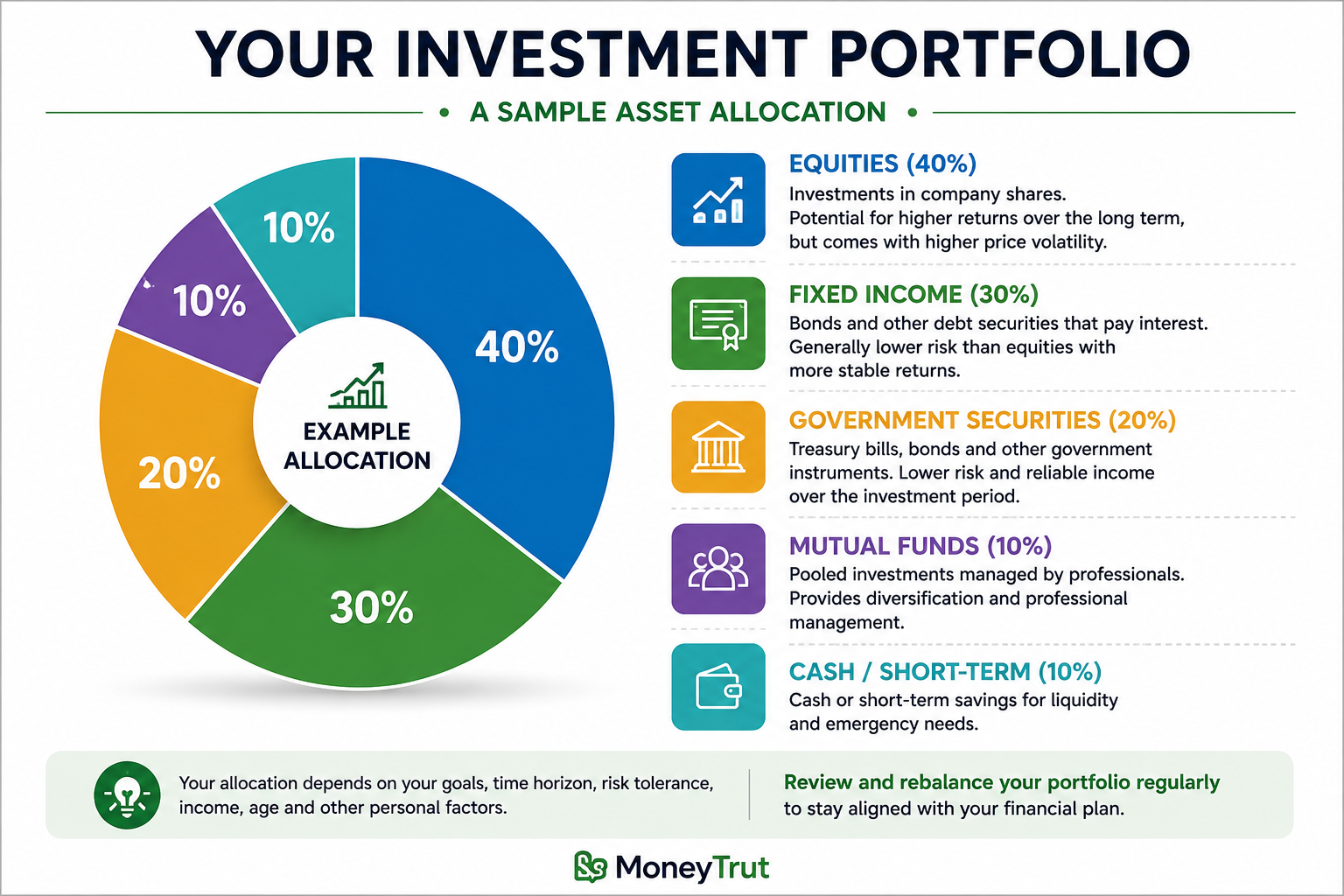
Asset allocation simply means deciding how much of your portfolio should be invested in different asset classes.
Imagine you have:
₦1 million
for long-term investing.
Instead of treating the entire ₦1 million as one pool of money, you could divide it according to your investment strategy.
For example, purely as an illustration:
50% equities
30% fixed income
20% other investments
That would mean:
₦500,000 → equities
₦300,000 → fixed income
₦200,000 → other investments
The numbers aren't a recommendation.
They're simply showing what asset allocation means.
Asset Allocation vs Diversification
These terms are often confused.
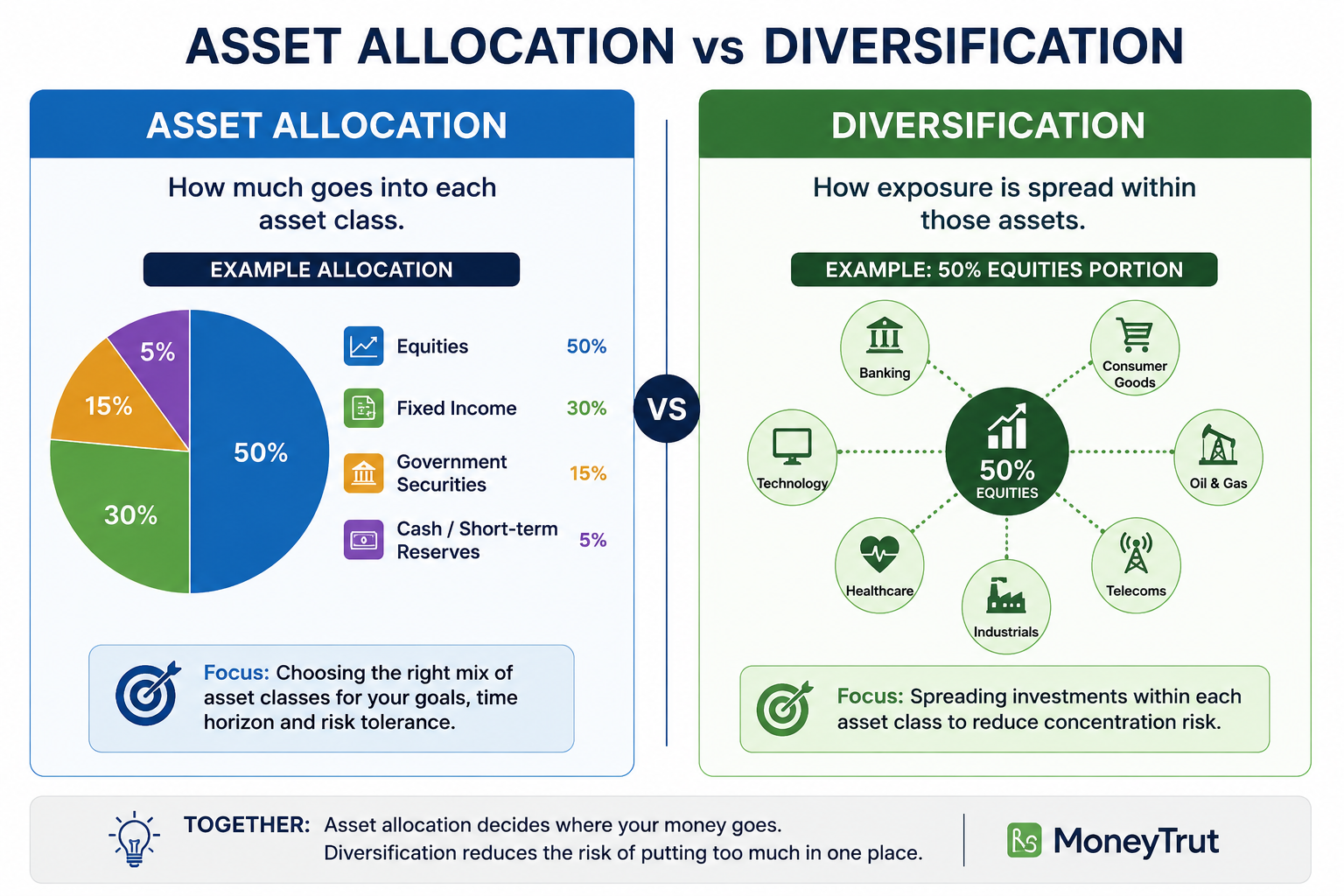
They're related, but they're not the same thing.
Asset allocation asks:
How much of my portfolio goes into each type of asset?
Diversification asks:
How do I spread my exposure within those investments?
For example, you might allocate:
60% to equities
and then diversify that 60% across different companies, industries or funds.
You might allocate:
40% to fixed income
and spread that exposure across appropriate securities with different characteristics.
MoneyTrut previously explained diversification in What Is Investment Diversification and How Does It Work?.
Why Does Asset Allocation Matter?
Different investments behave differently.
Stocks can experience significant price movements.
Fixed-income investments generally have different risk and return characteristics.
Cash and short-term savings can provide liquidity but may not provide the same long-term growth potential as riskier investments.
Your asset allocation therefore affects:
How much risk you take
How much your portfolio can fluctuate
How much growth you may potentially achieve
How accessible your money is
This is why choosing investments individually isn't enough.
You also need to consider how they work together.
There Is No Perfect Asset Allocation
You may find someone online recommending:
“80% stocks and 20% bonds.”
Another person might recommend:
“60% stocks and 40% fixed income.”
Another might tell you:
“Put everything into government securities.”
None of these automatically applies to everyone.
Your circumstances matter.
Consider two people.
Investor A
Age 25
Stable income
No major debt
Long-term goal
Strong emergency fund
Investor B
Age 55
Needs the money in five years
Unstable income
Large financial obligations
It would make little sense to assume both investors should have exactly the same portfolio.
Your Investment Goal Comes First
Before deciding your allocation, ask:
What am I investing for?
You might be investing for:
- Retirement
- A home
- Children's education
- Long-term wealth
- Financial independence
- A future business
- Another major long-term goal
The goal determines how much time you have.
And time affects how much investment risk you may be able to take.
Your Time Horizon Matters
Suppose you need the money in:
Six months.
That is very different from needing it in:
20 years.
Money required soon generally shouldn't be exposed to the same level of investment volatility as money intended for a distant goal.
This is one reason it's useful to separate your short-term money from your long-term investment portfolio.
Your Emergency Fund Is Not Your Investment Portfolio
Your emergency fund exists for unexpected expenses.
Your investment portfolio exists primarily for longer-term financial goals.
Mixing the two can create problems.
Imagine you have ₦500,000 invested in a volatile asset.
You suddenly lose your income.
If you don't have emergency savings, you may have to sell that investment when its value has fallen.
That's why MoneyTrut recommends treating emergency savings as an important part of your financial foundation.
See How Much Should You Have in an Emergency Fund?.
What Are the Main Asset Classes?
There isn't one universal list because financial markets classify investments differently.
For a beginner in Nigeria, however, it is useful to understand several broad categories.
Equities
Equities represent ownership in companies.
Stocks can provide potential capital growth and, where companies declare dividends, dividend income.
But stock prices can fluctuate significantly.
Fixed Income
Fixed-income investments generally involve lending money to an issuer in exchange for interest and repayment according to the terms.
Examples can include bonds and other debt securities.
Government Securities
Government securities can include instruments such as Treasury bills and government bonds.
The Central Bank of Nigeria provides information on government securities and their investment procedures.
Mutual Funds
Mutual funds pool money from investors and invest according to the fund's stated strategy.
They can make diversification more accessible, but investors still need to understand the fund's objectives, holdings, fees and risks.
Cash and Short-Term Savings
Cash and savings can provide liquidity.
They may be appropriate for emergency reserves and short-term needs, although keeping too much long-term wealth in cash can expose you to inflation risk.
Stocks Usually Come With More Price Volatility
Equities can offer substantial long-term growth potential.
But they can also fall sharply.
Imagine investing ₦1 million in stocks.
If the portfolio falls 20%, its market value becomes approximately:
₦800,000
You haven't necessarily permanently lost ₦200,000 unless you sell at that value, but the decline is real and can affect your financial position.
This is why stocks should be considered in relation to your risk tolerance and time horizon.
Fixed Income Can Play a Different Role
Fixed-income investments can provide income and stability characteristics that differ from equities.
But "fixed income" does not mean "risk-free."
Different fixed-income investments have different risks.
These can include:
- Interest-rate risk
- Credit risk
- Inflation risk
- Liquidity risk
- Reinvestment risk
You should understand the specific security before investing.
Government Securities Aren't Automatically the Answer
Some investors hear:
“Government securities are safer.”
and immediately conclude that they should put all their money there.
That may not fit every financial goal.
If your long-term objective requires growth, an extremely conservative portfolio may not provide the growth you need.
On the other hand, if you need stability and have a short time horizon, taking unnecessary equity risk may not make sense.
Asset allocation is about finding an appropriate balance.
What About Mutual Funds?
Mutual funds can be useful for investors who don't want to select every security themselves.
The SEC describes collective investment schemes as arrangements where investors' money is pooled and managed according to the scheme's investment objectives.
But don't choose a fund simply because its return looks attractive.
Look at:
- Investment objective
- Asset mix
- Historical performance
- Fees
- Risk
- Fund manager
- Liquidity
- Relevant regulatory information
MoneyTrut's How to Choose a Mutual Fund in Nigeria: 7 Things to Check Before Investing goes deeper into this.
A Simple Example of Asset Allocation
Suppose someone has:
₦2 million
available for long-term investing.
They might decide, purely for illustration, to use:
₦1 million → equities
₦600,000 → fixed income
₦400,000 → another appropriate investment
That's a:
50% / 30% / 20%
allocation.
If equities subsequently rise substantially, equities could become a larger percentage of the portfolio.
The investor may then need to review the allocation.
Your Portfolio Can Change Without You Buying Anything
This is one of the most important things to understand.
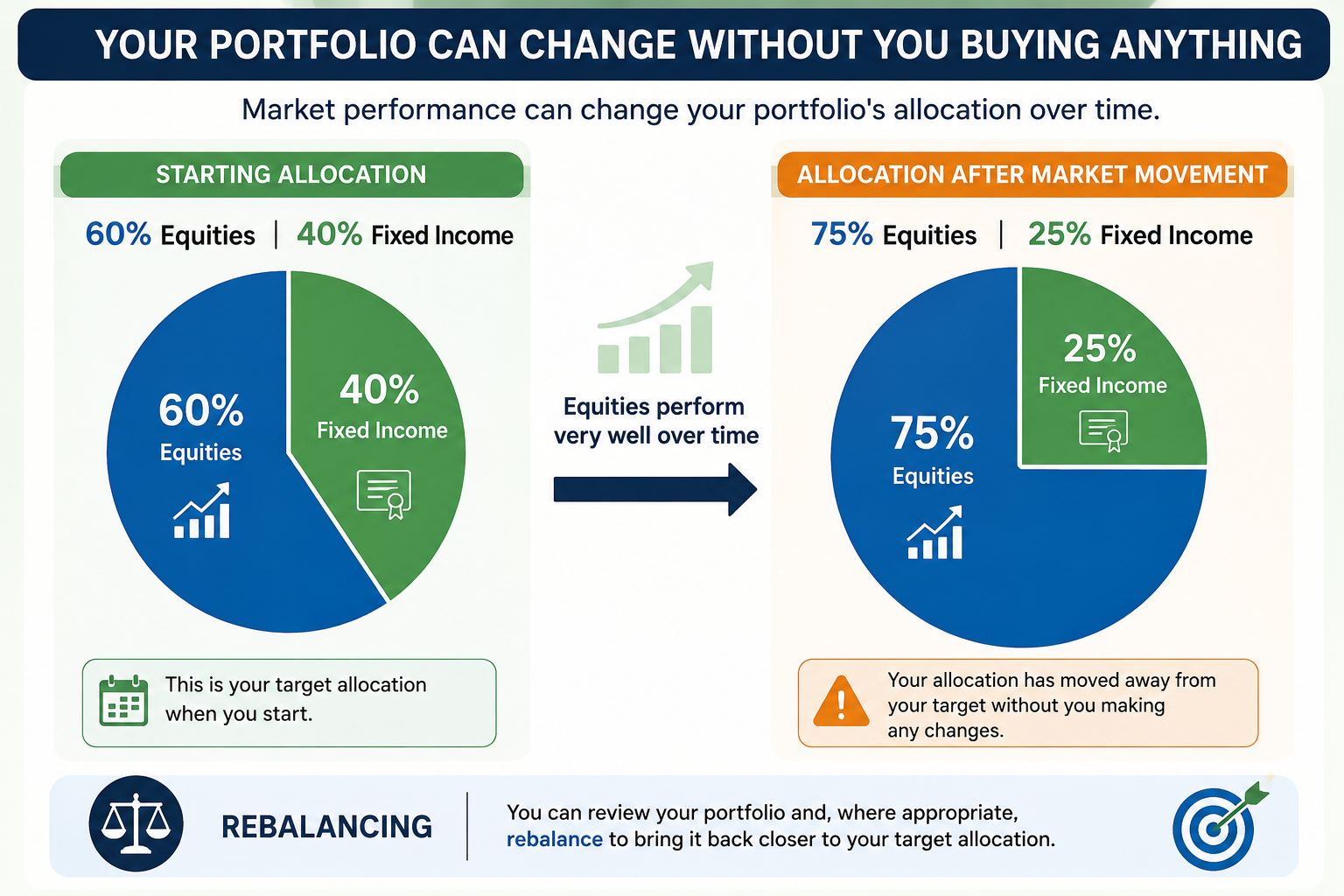
Suppose your starting portfolio is:
60% equities
40% fixed income
Then stocks perform extremely well.
Your portfolio might eventually become:
75% equities
25% fixed income
You didn't deliberately increase your equity allocation.
The market did it for you.
This can increase the risk of your portfolio.
That's where rebalancing comes in.
What Is Portfolio Rebalancing?
Rebalancing means adjusting your investments to bring your portfolio closer to your intended allocation.
Suppose your target is:
60% equities
40% fixed income
but your portfolio becomes:
75% equities
25% fixed income
You could review the portfolio and determine whether adjustments are appropriate.
This doesn't mean you should constantly buy and sell.
It means you periodically check whether your portfolio still matches your plan.
How Often Should You Rebalance?
There isn't one mandatory schedule for every investor.
Some investors review their allocation periodically.
Others use a threshold, such as rebalancing when an asset class moves significantly away from its target.
The important thing is to have a method rather than making emotional decisions whenever the market moves.
Don't Change Your Allocation Because of Every Market Headline
Markets will always produce headlines.
One day:
“Stocks are crashing.”
Another day:
“Stocks are reaching new highs.”
If you change your asset allocation every time you see a headline, your portfolio can quickly become a reflection of your emotions.
Your allocation should be connected to your financial plan.
How Age Can Influence Asset Allocation
Age can be a factor, but it shouldn't be the only factor.
A younger investor may have a longer time horizon.
An older investor may have a shorter period before needing the money.
But two people of the same age can have completely different:
- Income
- Expenses
- Goals
- Debt
- Risk capacity
- Emergency savings
- Investment experience
Therefore, age can inform an investment decision without determining it completely.
How Income Can Affect Your Allocation
Your income can also matter.
Someone earning:
₦100,000
may have little surplus after essential expenses.
Someone earning:
₦1 million
may have considerably more flexibility.
But income alone doesn't determine your allocation.
A ₦1 million earner with ₦950,000 in monthly obligations may have less investment capacity than a ₦300,000 earner with very low expenses.
MoneyTrut's How Much Should You Invest From Your Salary Each Month? explains how to determine a sustainable investment contribution.
Risk Tolerance Is Important
Ask yourself:
How would I react if my portfolio fell 20%?
Would you:
Stay invested because you understand your strategy?
Or would you:
Sell everything immediately?
If a temporary decline would cause you to panic and abandon your investment plan, your portfolio may contain more risk than you can comfortably handle.
But emotional comfort isn't the only consideration.
You also need to consider your financial ability to withstand losses.
Risk Capacity Is Different
Risk capacity is about what you can actually afford.
Imagine you have:
₦2 million
invested.
You are comfortable with volatility.
But you need the entire ₦2 million in six months for a major financial obligation.
Your ability to take investment risk is limited, regardless of how comfortable you feel about market fluctuations.
This is why goals and time horizon should come before choosing an allocation.
Don't Confuse High Returns With a Good Allocation
An investment may have performed extremely well recently.
That doesn't automatically mean you should increase your allocation to it.
Past performance doesn't guarantee future results.
A good portfolio is not necessarily the one with the highest return last year.
It's one that is appropriately structured for the investor's objectives and risk.
Diversification Still Matters
Suppose your equity allocation is:
60% of your portfolio.
You could still have concentration risk if most of that 60% is invested in one company or one sector.
That's why asset allocation and diversification work together.
Asset allocation: divide between broad asset classes.
Diversification: spread exposure within those classes.
You need to consider both.
What About International Investments?
Geographical diversification can provide another layer of diversification.
However, investing outside Nigeria introduces additional considerations such as:
- Currency movements
- Foreign-market risks
- Fees
- Tax implications
- Regulation
- Access
- Liquidity
International diversification can be useful for some investors, but it should be considered as part of an overall strategy rather than treated as automatically superior to Nigerian investments.
Keep Your Portfolio Simple
A beginner doesn't need a complicated spreadsheet containing dozens of investments.
You should be able to answer:
What do I own?
Why do I own it?
What percentage of my portfolio does it represent?
What risk does it carry?
When will I need the money?
If you can't answer these questions, adding more investments may make the situation worse rather than better.
Verify Investment Providers
Before sending money to an investment platform, verify the operator.
The SEC's current investor portal provides a Find a Registered Operator service and states that capital-market operators are required to register with the SEC before commencing operations.
This is especially important when an investment platform promises unusually high or guaranteed returns.
A good asset allocation cannot protect you from putting money into a fraudulent scheme.
Asset Allocation Can Change Over Your Lifetime
Your allocation doesn't have to remain the same forever.
At 25, you may have a long-term growth objective.
At 40, your responsibilities may be different.
At 55, you may be approaching retirement.
At 65, preserving and accessing your money may become more important.
Your portfolio can evolve with your financial life.
A Simple Process for Creating Your Allocation
You can start with these questions.
1. What is the goal?
Know what you're trying to accomplish.
2. When will you need the money?
Determine your time horizon.
3. Is your emergency fund adequate?
Don't use long-term investments as your emergency reserve.
4. Do you have expensive debt?
Consider debt alongside investment decisions.
5. How much loss can you financially withstand?
Think about risk capacity.
6. How much volatility can you tolerate?
Think about risk tolerance.
7. What investments do you understand?
Don't invest simply because someone recommended something.
8. How diversified is the portfolio?
Check for concentration.
9. What are the costs?
Fees reduce your investment returns.
10. When will you review the portfolio?
Have a plan for monitoring and rebalancing.
The Bottom Line
Asset allocation is about deciding how to divide your investment portfolio among different types of assets.
There is no universal percentage that every investor should use.
A young Nigerian investor with a 20-year goal may have a very different allocation from someone who needs their money in three years.
The important thing is to start with:
Goal → Time horizon → Risk capacity → Risk tolerance → Asset allocation → Diversification
Don't build a portfolio simply because someone online showed you theirs.
Build one that makes sense for your financial situation.
And remember:
A good portfolio isn't necessarily the one with the highest possible return. It's the one that gives you a sensible balance between growth, risk and your ability to stay invested long enough to achieve your goals.

You must be logged in to post a comment.