

If you've decided to start investing, there's a good chance you've encountered two options repeatedly:
Stocks and mutual funds.
Stocks let you buy ownership in individual companies.
Mutual funds pool money from many investors and use it to buy a portfolio of investments.
Both can be useful.
Neither is automatically better.
For a beginner, the more important question is:
Which option fits your goals, knowledge, risk tolerance, time horizon and ability to manage the investment?
That answer can be very different for someone earning ₦100,000 a month compared with someone earning ₦1 million.
The Short Answer
If you want to choose individual companies and are willing to research and accept the risk of concentrating money in particular businesses, individual stocks may be suitable for part of your portfolio.
If you prefer to spread your money across multiple investments and have a professional fund manager make investment decisions on behalf of the fund, a mutual fund may be more convenient.
For many beginners, diversification and simplicity can make a well-chosen mutual fund easier to manage than selecting individual stocks.
But that doesn't mean every mutual fund is automatically safer or better.
You still need to understand:
- What the fund invests in
- Its risk level
- Its fees
- Its investment objective
- Its performance history
- How you can buy and sell it
- Who manages it
- Whether the operator is properly regulated
The Securities and Exchange Commission (SEC) regulates collective investment schemes in Nigeria and provides investor-education resources to help people understand investment products and risks.
First, What Is a Stock?
When you buy shares in a publicly traded company, you are buying an ownership interest in that company.
For example, if you buy shares of a company listed on a stock exchange, your investment's value can rise or fall depending on the company's performance, market conditions and what investors are willing to pay for the shares.
Some companies also pay dividends.
But dividends aren't guaranteed.
And the share price can fall substantially.
If you put all your investment money into one company and that company performs badly, your portfolio can suffer significantly.
That's concentration risk.
What Is a Mutual Fund?
A mutual fund is a type of collective investment scheme in which money from multiple investors is pooled and invested according to the fund's stated strategy.
The SEC explains that unit trust schemes pool money from investors to invest in assets such as stocks, shares and money-market instruments, with professional fund managers managing the portfolio.
Instead of you deciding:
"I'll buy shares in Company A, Company B and Company C."
you may buy units in a fund that already owns a range of investments.
The fund's structure and strategy determine what it holds.
That's one reason mutual funds can be useful for people who don't want to select every individual investment themselves.
The Biggest Difference: Who Makes the Investment Decisions?
With individual stocks, you make the decisions.
You decide:
- Which company to buy
- How much to invest
- When to buy
- When to sell
- Whether to hold
- How to diversify
With a mutual fund, the fund manager manages the portfolio according to the fund's mandate.
You still decide whether to invest in the fund, but you generally aren't choosing each underlying security yourself.
That convenience comes at a cost: fees.
Stocks vs Mutual Funds at a Glance
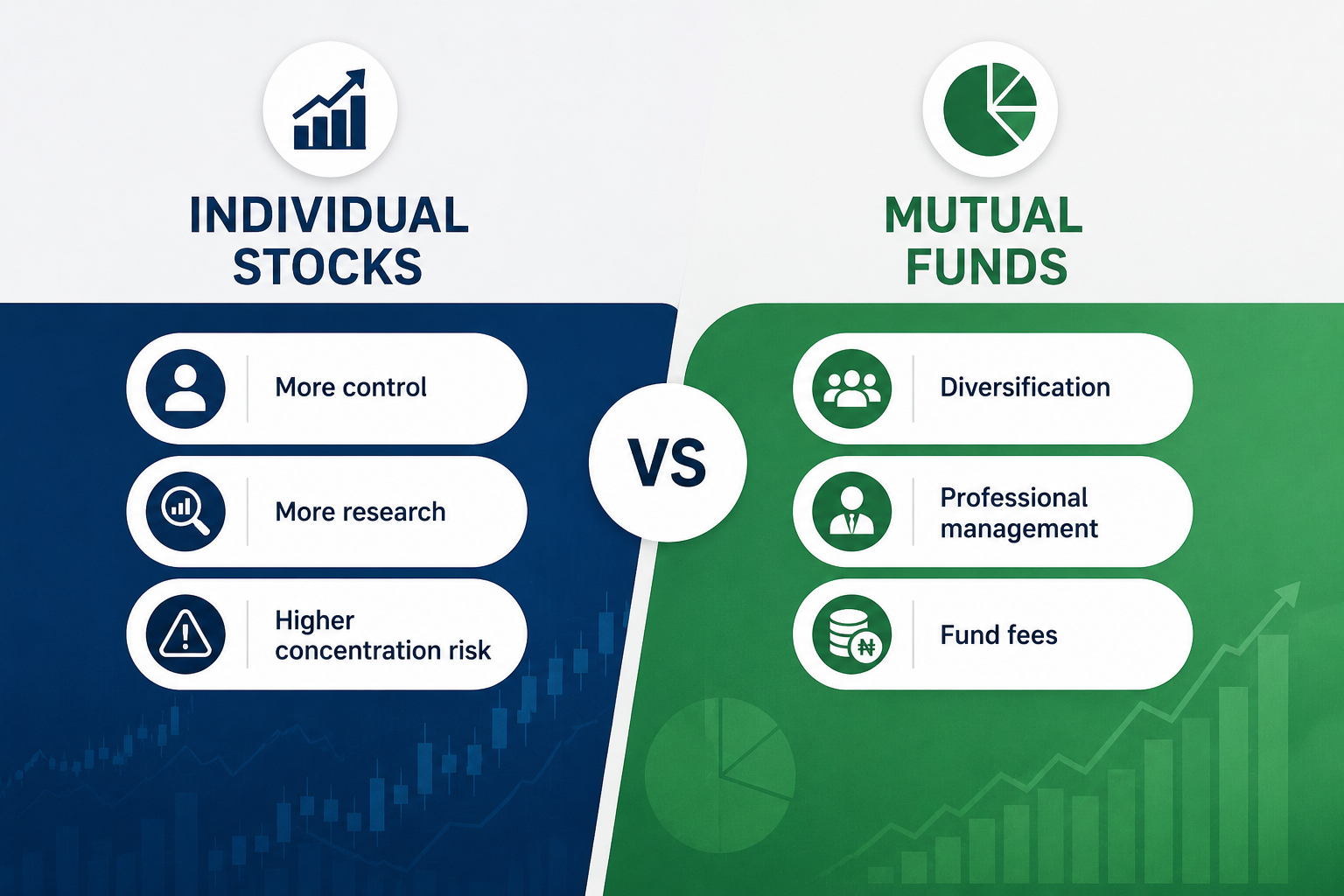
| Factor | Individual Stocks | Mutual Funds |
|---|---|---|
| What you buy | Shares in individual companies | Units in a pooled investment |
| Who chooses investments? | You | Fund manager |
| Diversification | You must create it | Often built into the fund |
| Research required | Higher | Generally lower for individual investors |
| Control | High | Lower |
| Fees | Trading/brokerage and other applicable costs | Fund management and other applicable expenses |
| Risk | Can be high if concentrated | Depends on what the fund owns |
| Suitable for beginners? | Possible, with education | Often simpler to diversify |
| Potential returns | Depends on individual holdings | Depends on underlying portfolio |
| Guaranteed return? | No | No |
This table is a starting point, not a recommendation.
Diversification Is a Major Advantage of Funds
Imagine you have:
₦100,000
and put all of it into one company.
If the company performs badly, your entire investment is exposed to that one company.
Now imagine another investor puts ₦100,000 into a diversified equity fund that owns shares across several companies.
One company performing badly may still hurt the fund.
But its effect could be smaller because other investments are also part of the portfolio.
That's the basic idea behind diversification.
The SEC describes diversification as one of the benefits of unit trust schemes.
Diversification doesn't eliminate losses.
A broad stock fund can still fall when the overall market falls.
But it can reduce the damage caused by relying on a single company.
Does Buying Five Stocks Mean You're Diversified?
Not necessarily.
Suppose you own five Nigerian bank stocks.
You own five companies, but they're all exposed to a similar sector.
If the banking sector experiences a major downturn, several of your holdings could fall at the same time.
True diversification requires thinking about the types of investments and risks you're exposed to, not simply counting the number of companies.
Mutual Funds Aren't All the Same
This is extremely important.
When someone says:
"Mutual funds are safer."
you should ask:
Which mutual fund?
A money-market fund isn't the same as an equity fund.
A fixed-income fund isn't the same as an equity fund.
A balanced fund isn't the same as either.
The SEC's materials distinguish several categories of collective investment schemes, including equity, money-market, fixed-income, mixed and other specialized funds.
So you shouldn't compare:
"stocks vs mutual funds"
as if mutual funds are one single type of investment.
The underlying assets matter.
Equity Mutual Funds
An equity fund generally invests substantially in shares or other equity securities.
That means it can still experience significant market volatility.
The SEC describes equity funds as being sensitive to market volatility and generally suited to longer investment horizons.
So buying an equity mutual fund doesn't mean you've escaped stock-market risk.
You've simply chosen to access equities through a pooled investment.
Money-Market Funds
Money-market funds are different.
They generally focus on short-term instruments and emphasize liquidity and income rather than long-term equity growth.
The SEC describes money-market funds as focusing on liquidity and income and investing primarily in short-term fixed-income instruments.
This means comparing:
An individual stock
with
a money-market fund
as though they're competing products isn't particularly useful.
They serve different purposes.
Fixed-Income Funds
Fixed-income funds can invest in government, corporate and other debt securities depending on their mandate.
The SEC describes fixed-income funds as potentially combining interest income, capital preservation and capital appreciation, with the actual risk depending on the fund's investments.
Again, the key is understanding what's inside the fund.
What About Fees?
This is one area where individual stocks and mutual funds differ significantly.
With stocks, you may encounter costs such as:
- Brokerage charges
- Exchange-related costs
- Taxes or levies where applicable
- Other transaction-related costs
With mutual funds, you may encounter:
- Management fees
- Administrative expenses
- Trustee or custody-related expenses
- Other fund expenses
- Performance or incentive fees where applicable
The actual costs depend on the product.
The SEC has rules and disclosure requirements around collective investment schemes, including fees and expenses.
Before investing, don't ask only:
"What return did this fund make?"
Also ask:
"How much does it cost me to own it?"
A Small Fee Can Matter Over Time
Imagine two investments have similar gross returns.
Investment A has relatively low costs.
Investment B has higher ongoing expenses.
The difference may look insignificant in one year.
Over many years, however, recurring costs can reduce the amount of money that remains invested and compounds.
This is why fees deserve attention when comparing funds.
You don't necessarily want the fund with the lowest fee.
You want to understand whether the fee is reasonable for what you're getting.
What About Returns?
This is where many beginners make mistakes.
They see:
Fund A: 25%
Fund B: 15%
and immediately choose Fund A.
But one year's return doesn't tell you everything.
Ask:
- What assets does it hold?
- How much risk does it take?
- What was the market environment?
- Was the return unusually high?
- What are the fees?
- How has it performed over different periods?
- What is its benchmark?
- What losses has it experienced?
The highest recent return is not automatically the best investment.
Individual Stocks Can Produce Very Different Results
Suppose you invest:
₦100,000
in Stock A.
If the stock rises 30%, ignoring costs and taxes:
₦100,000 → ₦130,000
If it falls 30%:
₦100,000 → ₦70,000
The same investment can move in either direction.
That's why you shouldn't invest money you cannot afford to leave exposed to market losses.
A Mutual Fund Can Also Lose Money
Don't make the mistake of thinking:
Mutual fund = guaranteed profit.
It isn't.
If a mutual fund owns assets whose values fall, the fund's value can fall as well.
For example, an equity fund invested in shares can decline when those shares decline.
The advantage of diversification is not that losses become impossible.
It's that your investment may be spread across multiple holdings rather than depending on one security.
Which Is Better for Someone Earning ₦50,000?
Suppose you earn:
₦50,000 per month.
If you can only set aside:
₦5,000
you shouldn't feel pressured to immediately choose between stocks and mutual funds.
Your first priority may be building financial stability.
MoneyTrut's articles on emergency savings and saving from different income levels are useful starting points:
How to Build an Emergency Fund With a Low Income
and
How Much Should You Save From Your Salary Every Month?
Once you have some financial protection, you can start investing small amounts while learning.
What About ₦100,000?
Suppose you earn:
₦100,000 monthly
and can consistently invest:
₦10,000.
You don't need to choose individual stocks just because you want to become an investor.
A diversified fund could potentially give you exposure to multiple investments without requiring you to research individual companies yourself.
Alternatively, you may eventually decide to learn how to select individual stocks.
The important thing is not the size of the first investment.
It's understanding what you're buying.
What About ₦250,000?
Suppose your income is:
₦250,000
and you can invest:
₦30,000 monthly.
You might decide to use a diversified fund as your core investment while learning more about individual stocks.
Or you might choose individual stocks if you have the time, knowledge and willingness to research companies.
There's no rule saying your entire monthly investment must go into one category.
What About ₦500,000?
At:
₦500,000 monthly income
you may have more flexibility.
You might decide to divide your investment contribution between:
- Cash or short-term savings
- Fixed-income investments
- Equity funds
- Individual stocks
The appropriate mix depends on your goals and risk tolerance.
The point is that higher income gives you more capacity to diversify.
It doesn't automatically make you a better investor.
What About ₦1 Million or ₦2 Million?
At higher income levels, the consequences of poor investment decisions become larger.
Suppose someone earning ₦2 million monthly accumulates:
₦10 million
in investable assets.
Putting the entire amount into one stock because someone on social media says it's "the next big thing" is very different from putting ₦10,000 into that same stock while learning.
As your portfolio grows, diversification and risk management become increasingly important.
When Individual Stocks May Make Sense
Individual stocks may appeal to you if:
- You enjoy researching companies
- You understand financial statements at a reasonable level
- You can tolerate price fluctuations
- You have a long-term investment horizon
- You understand diversification
- You don't need the money soon
- You can control emotional decisions
- You're willing to monitor your investments
But being interested in stocks isn't enough.
You need to understand what you're buying.
When Mutual Funds May Make More Sense
A mutual fund may be worth considering if:
- You want diversification
- You don't want to select individual securities
- You prefer professional management
- You have limited time for research
- You want to start with a relatively small amount
- You understand the fund's investment strategy
- You are comfortable paying the associated fees
The SEC notes that unit trust schemes can provide diversification and professional management.
What If You Want Both?
You don't necessarily have to choose one forever.
You could have:
A diversified fund as a core investment
and
a smaller allocation to individual stocks
if you have the knowledge and risk tolerance.
For example, someone might decide that most of their long-term equity exposure should be diversified while using a smaller portion to research individual companies.
The specific percentages should depend on the person's circumstances.
There's no universal formula that everyone should copy.
Don't Confuse a Mutual Fund With an ETF
This is another area where beginners can become confused.
Both mutual funds and exchange-traded funds can provide diversified exposure to multiple investments.
But their structures and trading mechanisms can differ.
An ETF generally trades on an exchange during market hours, much like a stock.
A traditional open-ended mutual fund generally issues and redeems units based on its net asset value under its rules.
The SEC explains that open-ended unit trust schemes continuously issue and redeem units, with pricing based on net asset value.
The distinction matters when you're deciding how you want to access an investment.
Don't Choose a Fund Based Only on Its Name
Suppose you see:
"Growth Fund"
or
"Balanced Fund."
The name alone isn't enough.
Read the fund's documents.
Find out:
- Investment objective
- Asset allocation
- Risk level
- Fees
- Minimum investment
- Redemption conditions
- Fund manager
- Trustee
- Custodian
- Historical performance
- Benchmark where applicable
The SEC describes the key parties involved in unit trust schemes, including fund managers, trustees, custodians and registrars.
You should know who is responsible for what.
Check That the Operator Is Legitimate
This is especially important when investing through apps and online platforms.
In May 2026, the SEC warned the public about unregistered online investment schemes promoted through social media and websites, including schemes promising unrealistic or guaranteed returns. It advised investors to verify the registration status of operators before investing.
That warning is highly relevant to beginners.
A polished website doesn't prove that an investment is legitimate.
Neither does a popular WhatsApp group.
Neither does a screenshot showing someone supposedly making millions.
Verify the operator.
Don't Let Someone Choose Your Investment Because They Promised a Return
Be especially careful with statements such as:
"Guaranteed 30%."
"No risk."
"Double your money."
"Fixed profit every month."
High returns can exist.
But the higher the promised return, the more important it becomes to understand exactly where that return comes from and what risks you're taking.
The SEC specifically warns investors against unregistered schemes promising unrealistic or guaranteed returns.
Stocks vs Mutual Funds: The Real Question
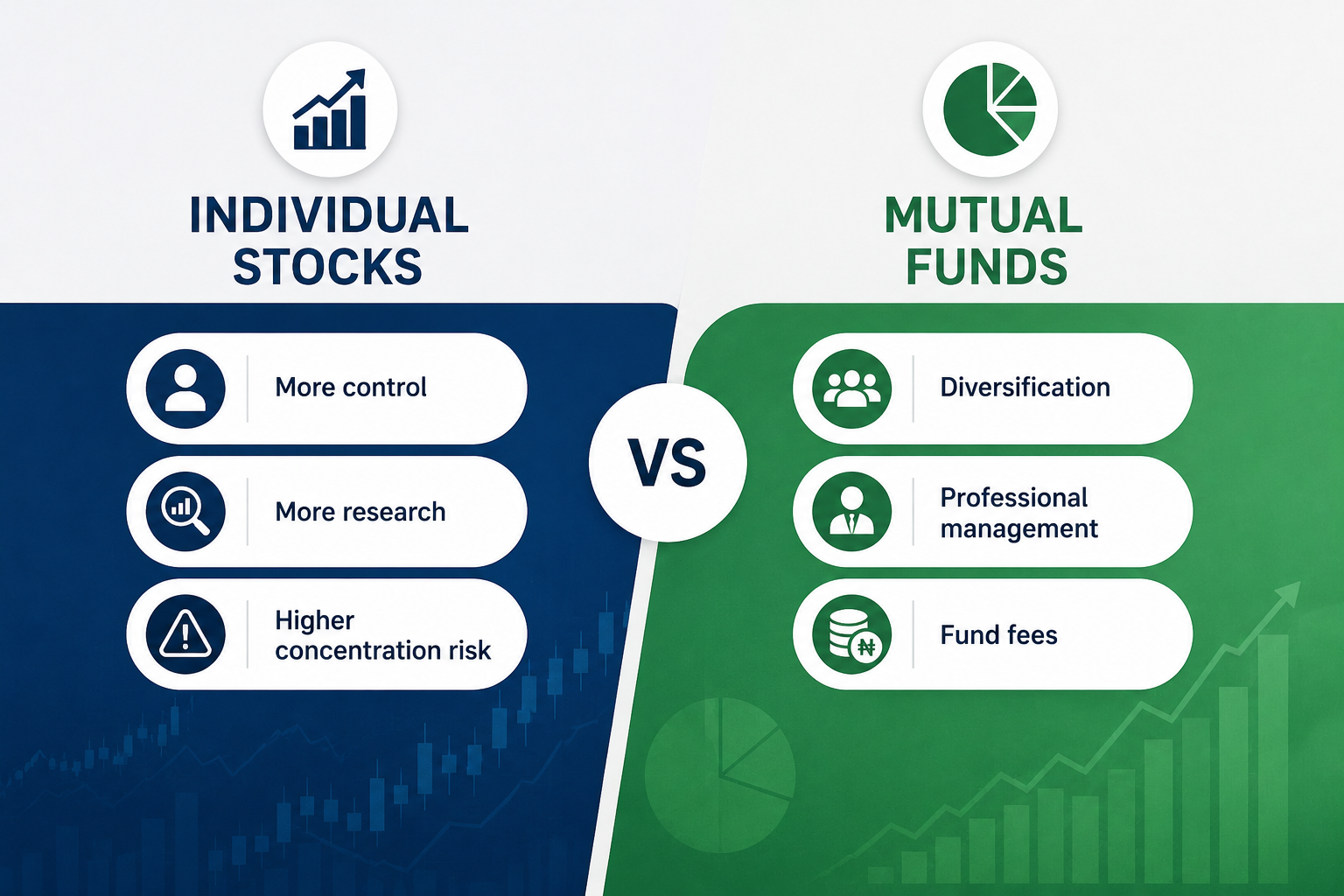
The question isn't:
"Which one is better?"
It's:
"Which one is better for my situation?"
If you enjoy analysing companies and can accept the risk, individual stocks may make sense.
If you prefer diversification and professional management, a suitable mutual fund may be more practical.
If you're still building your emergency fund, neither should take priority over basic financial stability.
And if you don't understand either product yet, the best investment you can make first may simply be learning.
A Simple Decision Framework
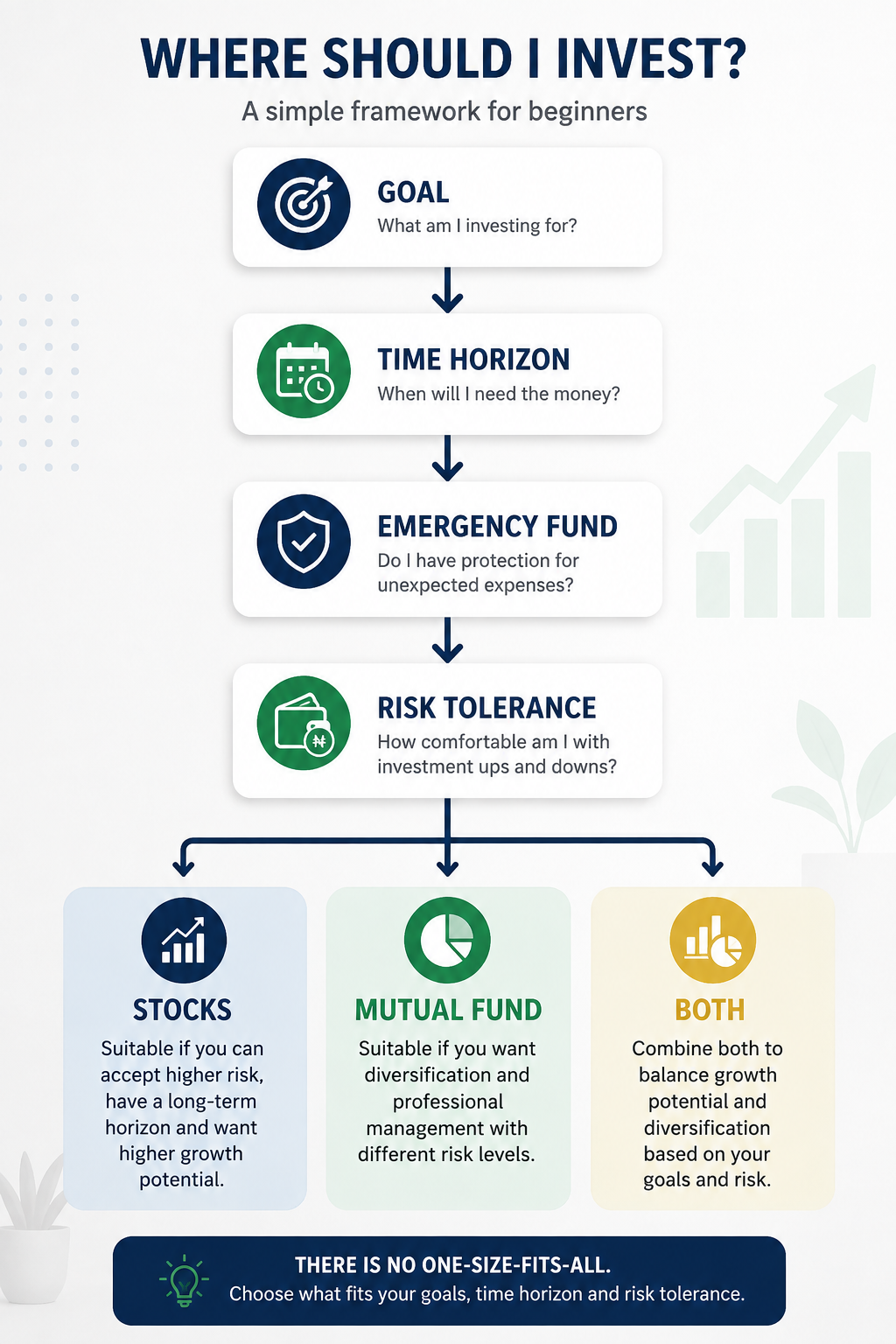
Ask yourself these questions:
1. Do I need this money soon?
If yes, be cautious about putting it into volatile investments.
2. Do I have an emergency fund?
If not, consider building one.
3. Do I have expensive debt?
If yes, consider how it affects your investment decision.
4. Do I understand individual companies?
If not, individual stocks may require more learning.
5. Do I want diversification without selecting every stock?
A suitable fund may be worth researching.
6. Can I tolerate seeing my investment fall?
If the answer is no, don't assume equities are appropriate simply because someone says they produce higher returns.
7. Do I understand the fees?
If you don't, stop and investigate.
8. Is the provider regulated?
Verify before sending money.
The Bottom Line
Stocks and mutual funds aren't competing answers where one is always right and the other is always wrong.
They are different ways of investing.
Individual stocks give you more control but require more responsibility.
Mutual funds can provide diversification and professional management but come with fund-specific fees and less control over individual holdings.
For a beginner, the choice should depend on your financial foundation, investment goal, time horizon, risk tolerance, knowledge and willingness to manage the investment.
And remember: a mutual fund can lose money, and a diversified fund is not automatically risk-free.
If you are still learning, don't rush because someone else appears to be making money.
Start with an amount you can afford, understand what you're buying, verify the provider and give your investment decision a reason beyond "everyone is doing it."
Your goal isn't to find the investment that looks most exciting.
Your goal is to build a portfolio you can understand, afford and stay invested in.

You must be logged in to post a comment.