
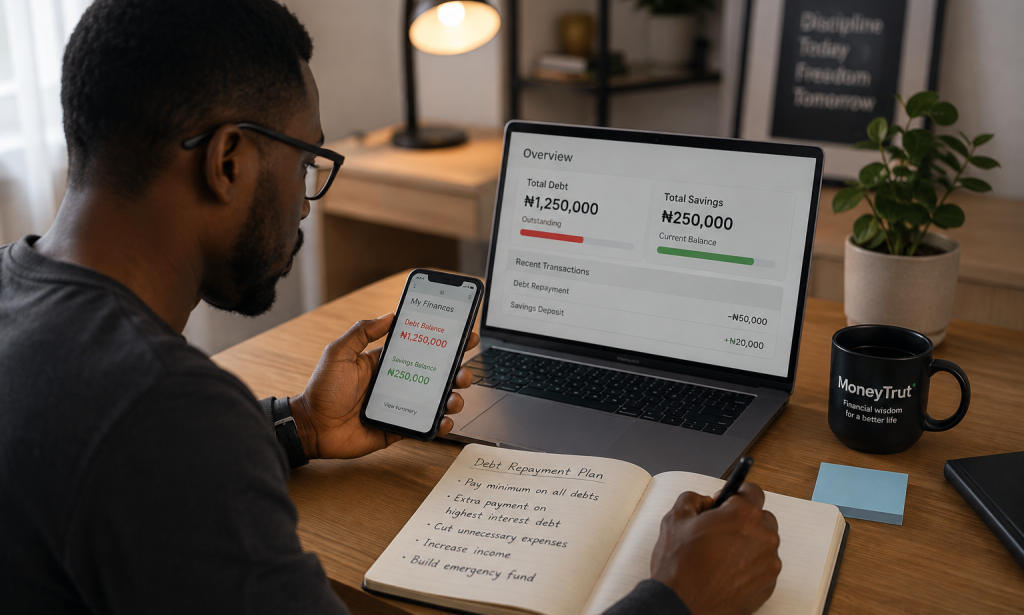
If you're in debt, it can feel like you're being pulled in two directions.
You want to pay what you owe as quickly as possible, but you also know that having no savings can leave you vulnerable when something goes wrong.
Then an unexpected medical bill, repair or loss of income happens—and you may end up borrowing again.
So should you stop saving until your debt is completely gone?
Not necessarily.
For many people, the better approach is to build a basic financial cushion while aggressively dealing with expensive debt.
The right balance depends on the type of debt you have, the interest you're paying, your income stability and how much you already have saved.
Should You Pay Debt or Save First?
There isn't one answer that applies to everyone.
A useful starting point is:
Build some emergency savings, make all required debt payments, then direct extra money toward expensive debt.
High-interest debt can grow quickly, while money sitting in savings may earn considerably less.
MoneyHelper's current guidance similarly recommends dealing with expensive debt and building an emergency fund before investing money that won't be needed for several years.
The important word is expensive.
A low-cost loan with manageable payments is different from a high-interest credit balance that keeps growing.
Why Saving While Paying Debt Makes Sense
Imagine you owe:
₦500,000
and have:
₦20,000
in savings.
You decide to put every available naira toward the debt.
Three months later, your car needs a ₦150,000 repair.
You have no savings.
You may now need to borrow another ₦150,000.
You successfully reduced one debt but created another financial problem.
An emergency fund exists partly to prevent an unexpected expense from immediately becoming new debt. The Consumer Financial Protection Bureau describes emergency savings as money specifically set aside for unplanned expenses and notes that even small amounts can provide some financial security.
That's why completely eliminating your savings cushion while paying debt isn't always the best strategy.
But Don't Use Saving as an Excuse to Ignore Expensive Debt
The opposite mistake is also common.
Someone has:
₦100,000 in savings
and:
₦500,000 of expensive debt
but keeps accumulating savings while making only the minimum debt payments.
If the debt is carrying a high interest cost, the numbers may work against them.
In general, the higher the borrowing cost, the more valuable it can be to reduce that debt.
MoneyHelper notes that people will rarely earn more on savings than they pay on expensive borrowing, making high-cost debt an important priority.
So the objective isn't:
Save everything.
or:
Pay debt at all costs.
It's:
Build enough financial protection while aggressively reducing costly debt.
Start by Knowing Exactly What You Owe
Before deciding how much to save and how much to pay toward debt, make a list.
For each debt, record:
| Debt | Balance | Interest/Cost | Minimum Payment |
|---|---|---|---|
| Loan A | ₦300,000 | 20% | ₦30,000 |
| Loan B | ₦150,000 | 10% | ₦20,000 |
| Credit balance | ₦100,000 | 30% | ₦15,000 |
The exact rates and terminology vary between financial products and countries, so check your actual loan agreement.
The important thing is knowing which debt is costing you the most.
The Highest-Interest Debt Usually Deserves Attention First
Suppose you have:
Debt A: ₦500,000 at 30%
Debt B: ₦500,000 at 10%
If you have extra money available, the 30% debt generally deserves priority because it is more expensive.
This is known as the debt avalanche method.
You continue making the required payments on all debts, while directing additional money toward the debt with the highest interest rate.
The CFPB describes the highest-interest-rate method as a strategy that can reduce costly debt first and potentially save money over time.
What Is the Debt Snowball Method?
Another approach is the debt snowball.
Instead of targeting the highest interest rate, you pay off the smallest balance first.
For example:
- ₦50,000 debt
- ₦150,000 debt
- ₦500,000 debt
You focus your extra money on the ₦50,000 debt first.
Once it's gone, the payment you were making toward it is added to the next debt.
The advantage is psychological.
You can see debts disappearing relatively quickly.
The disadvantage is that you may pay more interest overall if a larger debt carries a much higher rate.
The CFPB identifies both approaches and notes that the highest-interest method can save more money, while the snowball method can provide quicker visible progress.
Which Method Should You Choose?
If your main goal is:
Minimise interest → consider the avalanche method.
If your main problem is:
Staying motivated → the snowball method may work better.
A strategy you actually follow is better than a mathematically perfect strategy you abandon after two months.
Build a Starter Emergency Fund First
If you have no savings at all, consider building a small financial buffer before putting every available naira toward debt.
The amount depends on your situation.
For one person it might be:
₦50,000
For another:
₦100,000
For a household with higher essential expenses, it could be considerably more.
The goal at this stage isn't necessarily to complete your entire emergency fund.
It's to create enough breathing room that a relatively small unexpected expense doesn't immediately become another loan.
Once that starter cushion exists, you can focus more aggressively on expensive debt.
Your Emergency Fund Doesn't Have to Be Perfect Before You Attack Debt
Suppose your long-term emergency-fund target is:
₦1 million
You currently have:
₦100,000
and expensive debt of:
₦600,000.
You don't necessarily need to wait until you have the full ₦1 million before paying down the debt.
You could maintain the ₦100,000 emergency cushion while directing additional savings toward the expensive debt.
Once the debt falls, you can redirect the money that was going toward repayments into your emergency fund.
This is a practical way to handle the savings-debt trade-off.
Research from the CFPB also found that people commonly balance the two goals rather than completely sacrificing one for the other.
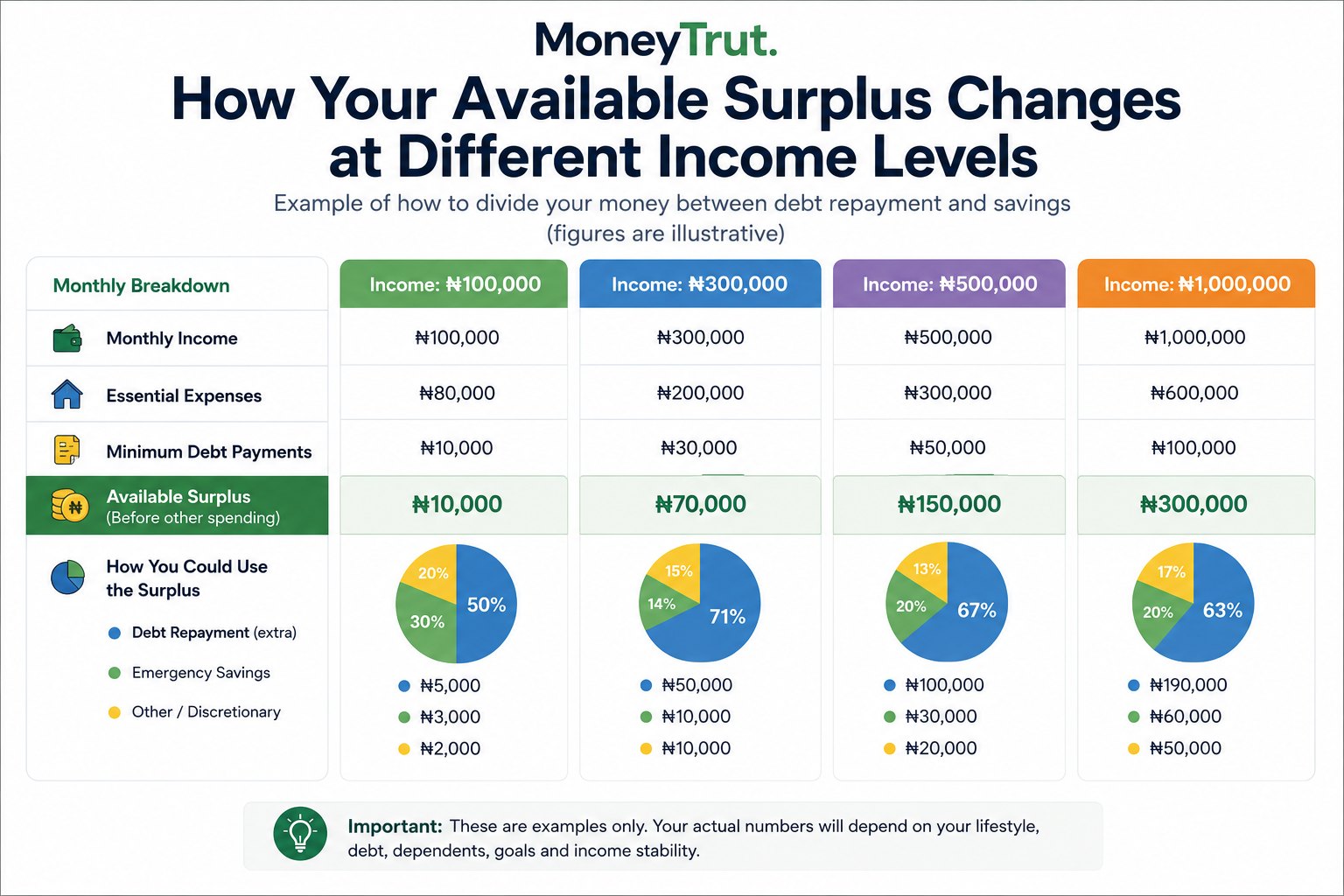
Example: Earning ₦100,000 a Month
Suppose you earn:
₦100,000
and your essential expenses are:
₦80,000.
That leaves:
₦20,000
before other discretionary expenses.
If you have expensive debt, putting the entire ₦20,000 toward debt may leave you vulnerable.
Instead, you could initially divide your available surplus.
For example:
₦5,000 → emergency savings
₦15,000 → debt repayment
The exact split isn't a universal rule.
The point is to maintain some savings while making meaningful progress against the debt.
Once you have a basic emergency cushion, you could potentially direct more toward debt.
Example: Earning ₦300,000
Suppose your monthly income is:
₦300,000
Essential expenses:
₦200,000
Debt minimum payments:
₦30,000
Available:
₦70,000
If the debt is expensive, you could allocate much of the ₦70,000 toward additional debt repayment while continuing a smaller savings contribution.
For example:
₦50,000 → additional debt repayment
₦20,000 → emergency savings
Again, this is an illustration, not a prescribed ratio.
Your actual allocation should reflect your debt costs, emergency needs and income stability.
Example: Earning ₦500,000
Suppose:
Income = ₦500,000
Essential expenses = ₦300,000
Minimum debt payments = ₦50,000
That leaves:
₦150,000
before other spending.
If you have high-interest debt, you may want to direct a significant portion of that surplus toward eliminating it.
For example:
₦100,000 → additional debt payment
₦30,000 → emergency savings
₦20,000 → discretionary spending
Once the expensive debt is gone, that ₦100,000 can be redirected toward savings and investing.
That's where the strategy starts to accelerate.
Example: Earning ₦1 Million
A higher income gives you more flexibility—but it doesn't automatically solve debt.
Suppose:
Income = ₦1,000,000
Essential expenses = ₦600,000
Debt minimum payments = ₦100,000
You have:
₦300,000
remaining before other spending.
If the debt is expensive, aggressively attacking it could save substantial money.
But don't allow the higher income to become an excuse for lifestyle inflation.
A person earning ₦1 million who spends ₦950,000 every month may have less financial flexibility than someone earning ₦500,000 who spends ₦350,000.
Don't Stop Making Minimum Payments
Regardless of which debt you target first, keep making the required payments on the others.
Missing payments can result in additional charges, penalties or other consequences depending on the agreement.
Your debt-repayment strategy should be built on top of your required payments, not instead of them.
What About Saving for Retirement While Paying Debt?
This depends heavily on the type and cost of the debt, your employer arrangements, tax considerations and your circumstances.
If you're carrying very expensive debt, aggressively investing while allowing that debt to accumulate may not make financial sense.
But completely abandoning long-term saving for many years can also create problems.
A sensible approach is to consider the cost of the debt, the value of any employer contributions or benefits available to you, your emergency savings and your long-term goals.
Don't treat "pay debt first" as a universal rule that means ignoring every other financial priority.
What About Investing While You Have Debt?
This is where the interest rate matters.
Suppose you have a debt costing you:
30%
and an investment that might earn:
10%
There is no guarantee the investment will earn 10%, but even before considering risk, the comparison should make you question why you're prioritising the investment over expensive borrowing.
The opposite situation is different.
If you have relatively low-cost debt and a long investment horizon, the decision becomes less straightforward.
MoneyHelper similarly recommends considering expensive debt and emergency savings before investing money that may be needed in the near term.
Don't Forget About Sinking Funds
Not every financial problem is an emergency.
Suppose you know your car insurance is due in six months.
Or school expenses are coming.
Or you expect annual property costs.
These expenses should ideally be planned for separately.
A sinking fund can help you save gradually for predictable expenses.
MoneyTrut explains this in:
What Is a Sinking Fund and How Does It Work?
Separating predictable expenses from emergencies can reduce the temptation to use your emergency fund for things you knew were coming.
Use Your Budget to Find Debt-Repayment Money
Before deciding that you don't have enough money to repay debt faster, look at your actual spending.
MoneyTrut's:
How to Create a Monthly Budget That Actually Works
can help you identify where your income is going.
You may discover:
- Unused subscriptions
- Excessive discretionary spending
- Frequent impulse purchases
- Avoidable fees
- Lifestyle expenses that have quietly increased
The objective isn't to eliminate every enjoyable expense.
It's to find money that can be redirected toward a more important goal.
Don't Make Your Budget So Extreme That You Quit
Suppose you earn ₦500,000.
You decide to spend almost nothing for six months.
For the first few weeks, you're extremely disciplined.
Then you become frustrated and start spending heavily again.
A slightly less aggressive plan that you can maintain for two years may produce a better result.
Debt repayment is a marathon.
Your plan has to be realistic enough to survive ordinary life.
What Should You Do With a Bonus?
Suppose you receive:
₦300,000
as a bonus.
You have:
₦500,000
of high-interest debt and:
₦100,000
in emergency savings.
You don't necessarily have to choose between using the entire bonus for debt or saving the entire amount.
You might decide to:
₦250,000 → debt
₦50,000 → emergency savings
The best split depends on your financial position.
But don't let unexpected income disappear without a plan.
The CFPB recommends making a plan for additional income and using it toward goals such as debt repayment and emergency savings.
What If You Get a Salary Increase?
Suppose your salary rises by:
₦100,000 per month.
A common mistake is allowing the entire increase to become additional spending.
Instead, you could decide beforehand:
₦70,000 → debt repayment
₦20,000 → savings
₦10,000 → lifestyle improvement
Once the debt is gone, the ₦70,000 doesn't disappear.
It becomes available for another financial goal.
That's how debt repayment can eventually turn into wealth building.
Don't Take New Debt While Paying Off Old Debt
This sounds obvious, but it is one of the biggest reasons debt repayment plans fail.
You pay:
₦100,000
toward an existing debt.
Then you borrow:
₦80,000
for new spending.
Your total debt may barely change.
Before aggressively repaying debt, ask:
Why did I get into the debt in the first place?
If the underlying problem remains, you may simply repay one balance and create another.
Be Careful With Debt Consolidation
Debt consolidation can sometimes simplify multiple debts into one payment.
But consolidation isn't automatically a saving.
Check:
- Interest rate
- Fees
- Repayment period
- Total amount repayable
- Early repayment conditions
- Whether the new payment is genuinely affordable
A lower monthly payment can sometimes result from extending the repayment period rather than actually reducing the total cost.
Look at the total cost, not just the monthly instalment.
What If Your Income Changes Every Month?
If your income is irregular, don't build your debt-repayment plan around your best month.
Use a conservative estimate of your normal income.
Then treat unusually high months as opportunities to accelerate your goals.
MoneyTrut's How to Budget When Your Income Changes Every Month goes deeper into managing variable income.
This approach reduces the risk of committing to a repayment amount you can't maintain during a weak month.
A Simple Order of Priorities
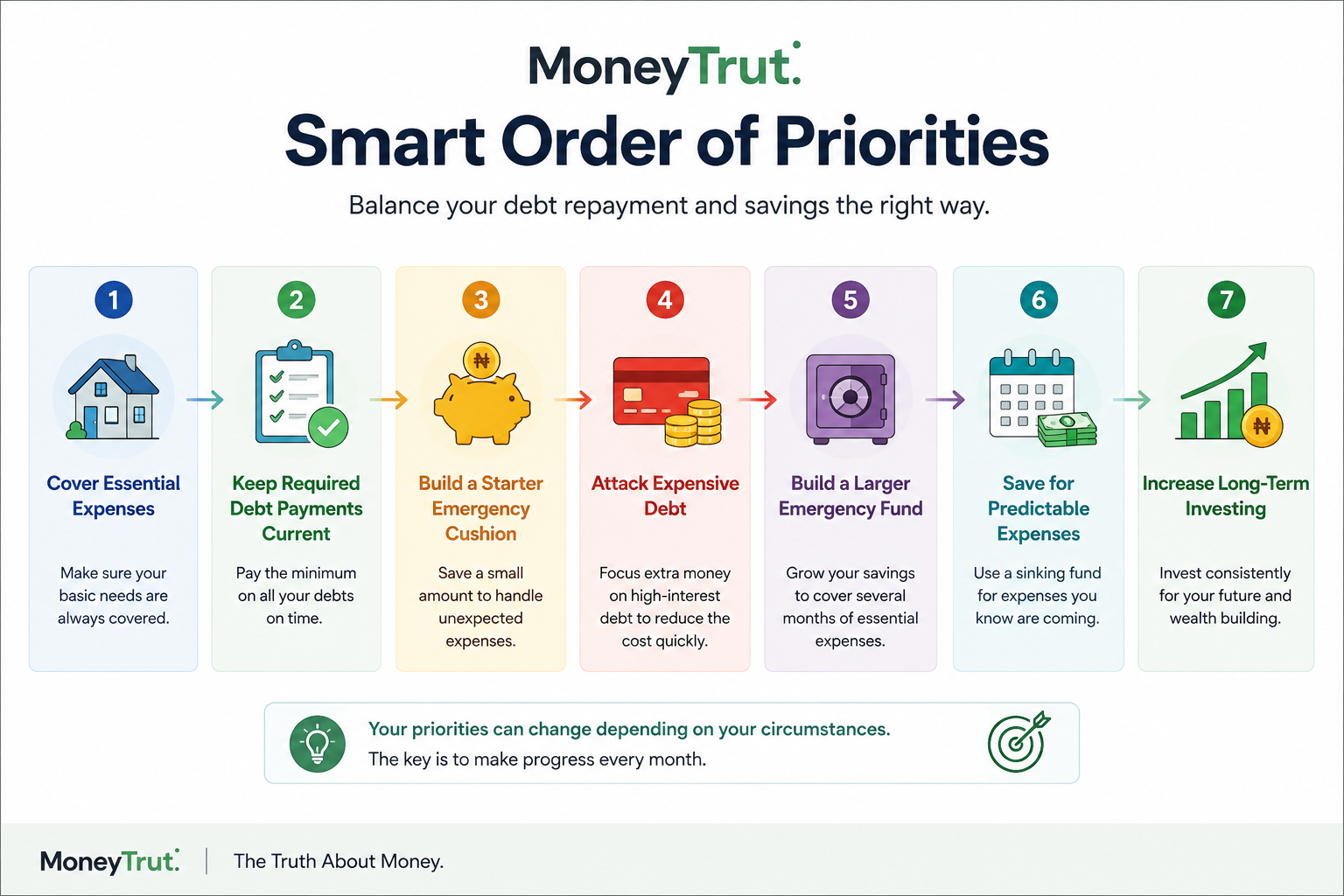
For many people dealing with both debt and savings, a practical framework can look like this:
1. Cover essential living expenses
Food, housing, utilities, transport and other necessities come first.
2. Keep required debt payments current
Avoid turning a manageable debt into a larger problem through missed payments and penalties.
3. Build a starter emergency cushion
Create some accessible savings.
4. Attack expensive debt
Direct additional money toward the highest-cost debt or use another strategy you can consistently follow.
5. Build a larger emergency fund
Once expensive debt is under control, strengthen your cash reserve.
6. Save for predictable expenses
Use sinking funds where appropriate.
7. Increase long-term investing
Once your financial foundation is stronger, direct more money toward long-term wealth-building goals.
This isn't a rigid sequence.
Your circumstances can change the order.
What If You Have No Savings and High-Interest Debt?
This is one of the hardest situations.
Suppose you have:
₦500,000 debt
₦0 savings
₦100,000 monthly income
The answer isn't necessarily to save ₦500,000 before touching the debt.
That could take too long.
Instead, you could build a small starter emergency cushion while directing most available surplus toward the expensive debt.
For example:
₦5,000 → emergency savings
₦15,000 → debt
If an emergency happens, you have at least something available.
If nothing happens, the debt continues falling.
Once the debt is under control, the savings rate can increase.
Your Emergency Fund Is There to Be Used When Necessary
Don't be afraid to use your emergency fund for a genuine emergency.
Some people become so protective of their savings that they borrow money instead of using money they specifically saved for emergencies.
That's backwards.
If your car breaks down and you need it for work, or you face an unexpected essential expense, using emergency savings may be exactly what the fund is designed for.
Then rebuild it afterward.
The CFPB similarly recommends using emergency savings when an actual financial shock occurs and rebuilding the fund afterward.
Don't Measure Progress Only by Your Savings Balance
Suppose you start with:
₦100,000 savings
and:
₦1 million debt.
Six months later:
₦150,000 savings
and:
₦600,000 debt.
Your savings increased by only ₦50,000.
But your overall financial position has improved substantially because your debt fell by ₦400,000.
That's why you should track both:
Savings
and
Debt balance
together.
Better still, track your net worth.
What Happens After the Debt Is Gone?
This is where the strategy becomes powerful.
Suppose you were paying:
₦100,000 per month
toward debt.
You finally become debt-free.
Don't immediately absorb the ₦100,000 into your lifestyle.
Redirect it.
For example:
₦60,000 → investing
₦30,000 → long-term savings
₦10,000 → lifestyle
You have now turned a debt repayment habit into a wealth-building habit.
That is one of the biggest benefits of becoming debt-free.
The Bottom Line
Paying debt and saving money don't always have to be competing goals.
For many people, the smarter approach is to maintain a basic emergency cushion while making aggressive progress against expensive debt.
Start by understanding exactly what you owe and how much each debt costs.
Keep required payments current.
Build some accessible emergency savings.
Then direct additional money toward high-interest debt, while using a repayment strategy you can realistically maintain.
Once the expensive debt is gone, redirect the money you were using for repayments toward emergency savings, investing and other long-term goals.
And remember that the goal isn't simply to become debt-free.
The bigger goal is to build a financial position where unexpected expenses no longer push you backward and your future income can increasingly be used to build wealth.

You must be logged in to post a comment.