

The internet has created more ways to make money than ever before.
You can freelance for clients in another country, sell products online, teach people remotely, create content, provide digital services or build an online business.
But there is another side to making money online in Nigeria.
Search social media for "how to make money online" and you will quickly find claims about making ₦50,000 every day, earning thousands of dollars with no skills, or doubling your money in a few days.
Some of these claims are misleading. Others are outright scams.
The reality is much less glamorous:
Legitimate online income usually comes from providing something valuable — a skill, service, product, content or audience — and getting paid for it.
This guide focuses on realistic ways Nigerians can make money online, what each method requires, how difficult it is to start and what you should realistically expect.mo
There is no single online money-making method that works for everyone.
For most beginners, the most practical starting point is to sell a skill or service online because you can start without putting large amounts of money at risk.
Other options include selling physical products, affiliate marketing, creating digital products, online tutoring, content creation and building an online business.
Some methods require little or no startup capital but take significant time to develop. Others require money but can potentially generate income more quickly.
The most important distinction is between earning money online and investing money online.
If someone asks you to deposit money before you can supposedly earn large guaranteed returns, be extremely careful. The SEC has warned Nigerians about unregistered online investment schemes promoted through platforms such as WhatsApp, Instagram, Telegram, Facebook and TikTok.
1. Freelancing
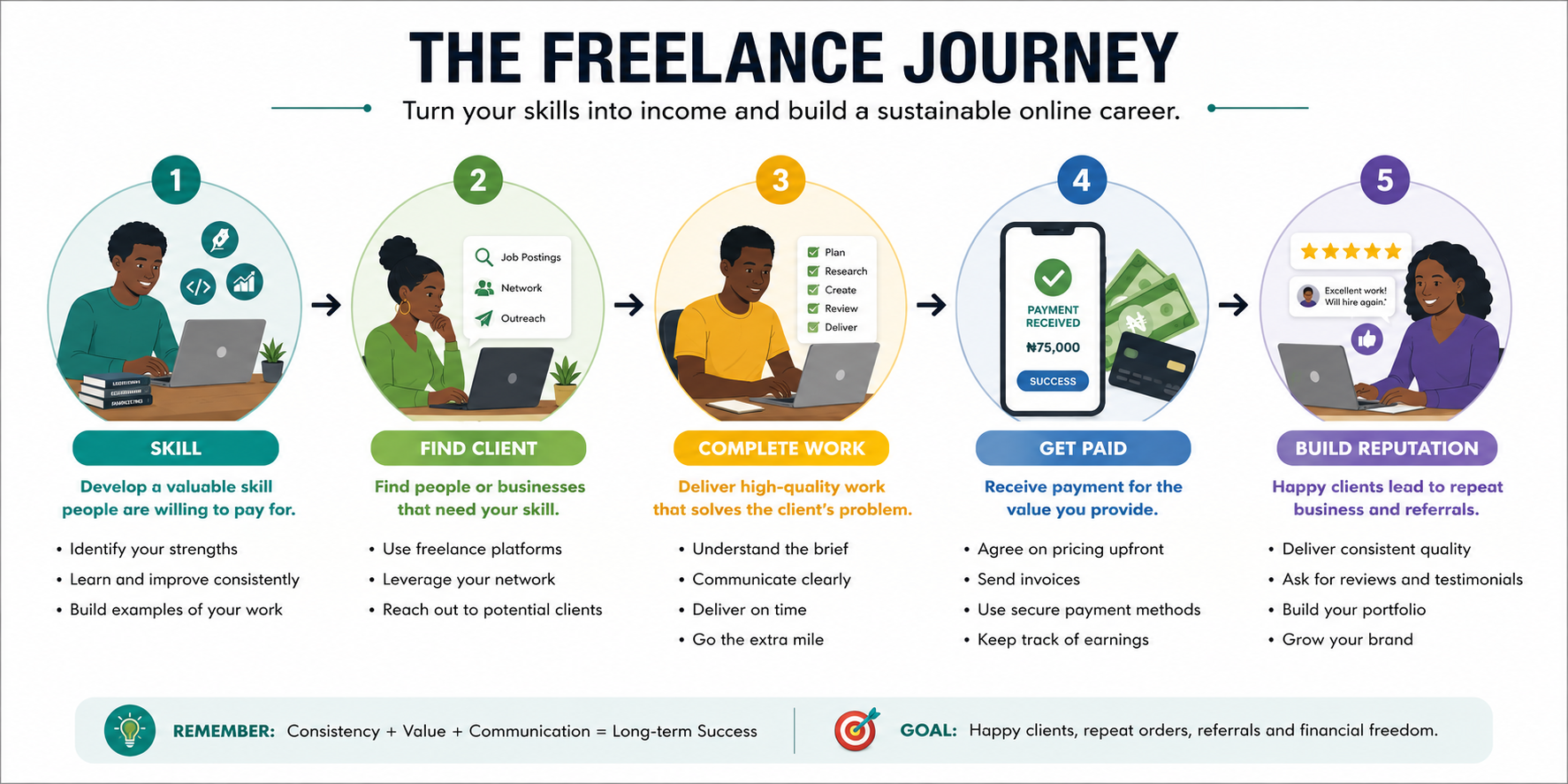
Freelancing is one of the most straightforward ways to make money online.
You have a skill.
Someone needs that skill.
You complete the work.
They pay you.
The skill could be:
- writing;
- graphic design;
- video editing;
- web development;
- programming;
- virtual assistance;
- social media management;
- bookkeeping;
- translation;
- data analysis;
- presentation design;
- customer support.
You can find clients through freelance marketplaces, professional networks, social media or direct outreach.
How it works
Imagine you know how to design social-media graphics.
Instead of waiting for a Nigerian employer to hire you permanently, you could offer graphic-design services to businesses.
You might charge:
₦15,000 per project
If you complete four projects in a month:
₦15,000 × 4 = ₦60,000
If your skill and reputation improve, you may eventually charge considerably more.
The important point is that the money comes from work delivered, not from depositing money into a platform.
What you need
Usually:
- a useful skill;
- internet access;
- a phone or computer, depending on the service;
- examples of your work;
- patience to find your first clients.
Difficulty
Medium
The hardest part for many beginners isn't creating an account on a freelance platform.
It is getting the first paying client.
2. Sell Digital Services Directly
You do not necessarily need to use a freelance marketplace.
You can sell services directly to businesses and individuals.
For example:
A small restaurant may need someone to manage its Instagram page.
A real-estate agent may need property videos edited.
A small business may need a simple website.
A professional may need their CV redesigned.
A company may need someone to create presentations.
Instead of waiting for clients to find you, you can contact businesses that could genuinely benefit from your service.
For example:
Service: Social-media management
Potential client: Local restaurant
Monthly fee: ₦50,000
If you eventually manage five clients:
₦50,000 × 5 = ₦250,000 per month
That is an illustration, not a promise of income.
Your actual price depends on your skill, the service, the client and the value you provide.
3. Start an Online Store
Another way to make money online is to sell physical products.
The internet can be used to find customers even if the actual product is delivered offline.
You could sell:
- clothing;
- footwear;
- beauty products;
- electronics accessories;
- home products;
- food;
- customized products;
- locally made products.
You could sell through social media, a website or an online marketplace.
The basic model is simple:
Buy or produce product → Find customer → Customer pays → Deliver product → Keep profit after costs
For example, suppose you buy an item for ₦8,000 and sell it for ₦11,000.
Your gross margin is:
₦11,000 − ₦8,000 = ₦3,000
But ₦3,000 is not necessarily your final profit.
You may still have:
- delivery costs;
- packaging;
- advertising;
- platform fees;
- returns;
- damaged goods;
- payment charges.
Your real profit is what remains after those costs.
This is why online business is not simply about selling something for more than you bought it.
4. Affiliate Marketing
Affiliate marketing involves promoting another company's product or service and receiving a commission when someone completes a qualifying purchase or action through your referral.
The basic process is:
You promote a product → Someone uses your referral → They buy/sign up → You receive a commission
You might promote products through:
- a website;
- YouTube;
- TikTok;
- Instagram;
- Facebook;
- email;
- other content channels.
The challenge is that affiliate marketing requires traffic and trust.
Simply obtaining an affiliate link does not mean people will buy.
If you have no audience, you may spend considerable time creating content before seeing meaningful results.
That is why claims such as "start affiliate marketing today and make ₦100,000 tomorrow" should be treated skeptically.
5. Create YouTube or Other Video Content
Content creation can eventually become an income source.
You could create content around:
- personal finance;
- technology;
- education;
- entertainment;
- cooking;
- sports;
- business;
- lifestyle;
- tutorials;
- news and commentary.
Revenue can potentially come from advertising, sponsorships, memberships, affiliate marketing, products or services.
But content creation is usually a long game.
You may spend months creating content before generating meaningful income.
The advantage is that one piece of useful content can potentially continue attracting viewers long after you publish it.
The disadvantage is that there is no guarantee that people will watch your content.
6. Online Tutoring
If you are good at a subject or have professional expertise, you can teach people online.
You could teach:
- mathematics;
- English;
- science;
- programming;
- music;
- exam preparation;
- professional skills;
- software;
- technical subjects.
You can find students through tutoring platforms, social media, referrals or your own website.
For example, suppose you charge:
₦5,000 per lesson
If you teach 10 lessons each week:
₦5,000 × 10 = ₦50,000 per week
That could be around ₦200,000 in four weeks before expenses.
Again, this is a mathematical illustration, not an expected income level.
Your actual earnings depend on your subject, experience, pricing and number of students.
7. Sell Digital Products
Digital products are another online business model.
Unlike physical products, you can potentially create a digital product once and sell copies repeatedly.
Examples include:
- ebooks;
- templates;
- spreadsheets;
- design assets;
- educational materials;
- online courses;
- checklists;
- business documents;
- calculators;
- software tools.
Suppose you create a budgeting template and sell it for ₦3,000.
If 50 people buy it:
₦3,000 × 50 = ₦150,000
But creating the product is only part of the job.
You also need to find people who want it.
This is where content marketing, social media, search traffic, email lists and existing audiences become valuable.
8. Become a Virtual Assistant
A virtual assistant helps businesses or individuals with administrative and digital tasks remotely.
Work could include:
- replying to emails;
- scheduling appointments;
- organizing files;
- research;
- customer support;
- social-media assistance;
- data entry;
- calendar management;
- basic administrative work.
This can be a good starting point for someone who is organized but does not yet have an advanced technical skill.
As you gain experience, you can specialize.
For example:
General virtual assistant → Executive assistant → Specialized operations assistant
Specialization can make it easier to charge more because you are no longer competing purely on basic administrative tasks.
9. Use Your Professional Skill Online
You do not necessarily need to learn an entirely new profession to make money online.
Your existing career skill may already have value online.
For example:
An accountant could provide bookkeeping services.
A designer could sell design services.
An engineer could provide technical consulting or create technical educational content.
A teacher could tutor students.
A lawyer may provide permitted professional services online within applicable rules.
A marketer could manage digital campaigns.
A programmer could build websites or software.
The internet simply changes where you find the customer.
This can be much more realistic than chasing a completely unfamiliar "side hustle."
10. Build a Small Online Business
The biggest opportunity may not be a particular website or app.
It may be building something you own.
For example:
Skill → Service → Clients → Reputation → Business
You might start by editing videos for clients.
Eventually you could:
- hire another editor;
- create packages;
- manage several clients;
- build a small agency;
- sell templates;
- teach video editing;
- create content around the skill.
This takes considerably more effort, but it gives you more control than depending entirely on one platform.
What About Online Surveys and "Watch Videos to Earn" Apps?
You will find plenty of websites and apps claiming you can make money by:
- watching videos;
- clicking advertisements;
- completing surveys;
- liking posts;
- installing apps;
- performing tiny tasks.
Some legitimate platforms may pay users for specific tasks.
But there is a major difference between earning a small amount for completing a task and building a meaningful income.
If an activity pays ₦100 for a task, you would need:
1,000 tasks = ₦100,000
That should immediately make you question whether the time involved is worthwhile.
Before spending hours on a platform, calculate:
Total earnings ÷ total hours worked = effective hourly income
The number matters more than the headline claim.
How Much Money Do You Need to Start?
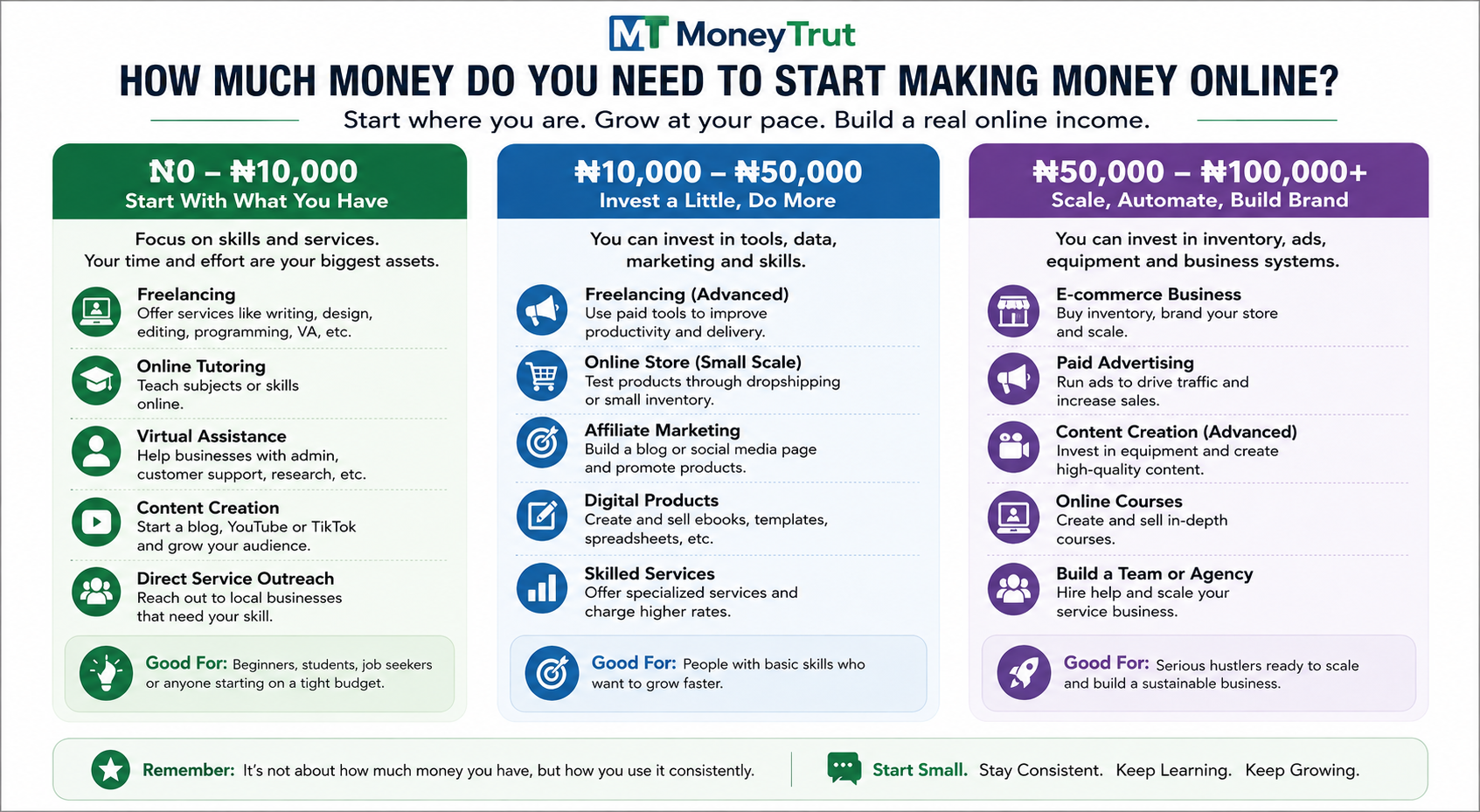
One of the biggest misconceptions about making money online is that you need a large amount of money to begin.
Some methods require almost no financial capital.
For example:
₦0–₦10,000
You could focus on:
- freelancing;
- tutoring;
- virtual assistance;
- content creation;
- direct service outreach.
Your main investment is your time and existing skill.
₦10,000–₦50,000
You may have more flexibility for:
- internet/data;
- basic software;
- marketing;
- creating samples;
- small-scale product testing.
₦50,000–₦100,000+
You could potentially test:
- small e-commerce inventory;
- product packaging;
- advertising;
- digital-product development;
- equipment needed for content creation.
But spending more money does not guarantee that you will make more money.
In many cases, learning the skill and finding customers is more important than buying expensive equipment.
What Is the Best Online Money-Making Method for Beginners?
There is no universal answer.
But if you are starting with little money, I would generally prioritize methods according to this logic:
1. Sell a skill you already have
Lowest need for financial capital.
2. Learn a marketable skill
This takes time but can increase your earning potential.
3. Sell the skill directly
Find businesses or individuals who need it.
4. Build a reputation
Good work can lead to referrals and repeat customers.
5. Turn the skill into a business
Eventually, you can add products, employees or other revenue streams.
This is generally more sustainable than searching for an app that supposedly pays you every day for doing nothing.
How to Spot an Online Money-Making Scam
Be especially careful when someone promises:
"Guaranteed ₦50,000 daily."
"Invest ₦20,000 and receive ₦100,000."
"No skills required."
"Guaranteed returns."
"Recruit three people and start earning."
"Pay a registration fee before you can withdraw."
These are major warning signs.
The SEC has specifically warned about unregistered online investment schemes that promise unrealistic or guaranteed returns. It advises investors to verify the registration status of platforms and entities before investing.
The SEC has also warned about schemes that use social media and online platforms to solicit money from Nigerians.
A legitimate business generally makes money because someone pays for a product or service that provides value.
A scheme that mainly depends on continuously bringing in new participants deserves much greater scrutiny.
Don't Confuse Making Money With Investing
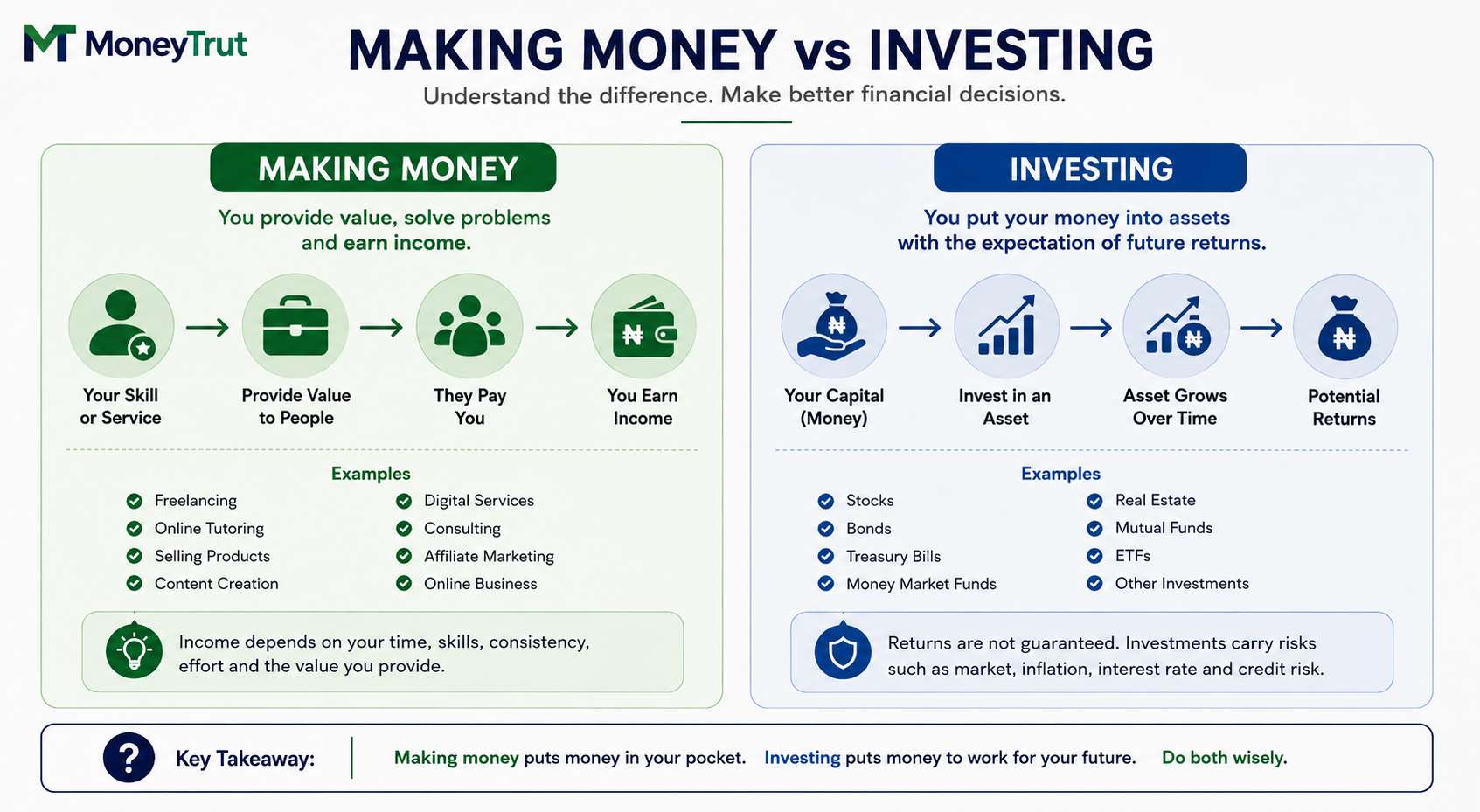
This distinction is extremely important.
Making money
You provide something valuable and receive income.
Examples:
- freelancing;
- selling products;
- tutoring;
- consulting;
- content creation.
Investing
You put existing money into an asset with the expectation that it will generate returns or appreciate.
Examples:
- stocks;
- bonds;
- Treasury bills;
- money market funds.
If you have ₦100,000, investing it is not the same thing as earning ₦100,000.
You already had the ₦100,000.
The investment is intended to potentially grow it.
If someone tells you to deposit ₦100,000 into a platform and promises to "make you money" every day, you should determine whether you are actually investing in a legitimate financial product or simply being asked to hand over money.
What If You Have a Salary?
You don't necessarily need to quit your job.
In fact, keeping your primary income while developing an online income stream can reduce financial pressure.
Suppose you earn:
₦300,000 salary
and eventually make:
₦70,000 online
Your total monthly income becomes:
₦370,000
You can then decide how much of the additional income should go toward:
- savings;
- investing;
- debt repayment;
- business reinvestment;
- personal spending.
This is similar to the approach we discussed in:
How to Make Extra Money Without Quitting Your Job
Don't Quit Your Job Too Early
An online side income can look impressive for one month and disappear the next.
For example:
January: ₦80,000
February: ₦120,000
March: ₦30,000
April: ₦0
That is very different from receiving a stable salary every month.
Before depending entirely on online income, consider:
- how consistent the income is;
- how many clients you have;
- whether one client provides most of your income;
- your emergency savings;
- your monthly expenses;
- whether you can replace your salary reliably.
Building additional income is useful.
But replacing stable employment should generally be a financial decision, not an emotional decision.
A Practical Starting Plan
If you have no idea where to begin, don't try ten methods simultaneously.
Start with one.
Week 1: Choose a skill
Identify something you can already do or can realistically learn.
Week 2: Create examples
Create three to five examples demonstrating what you can do.
Week 3: Find potential customers
Look for businesses or individuals who actually need your service.
Week 4: Start offering it
Contact potential clients, apply for suitable projects and improve your offer based on the responses you receive.
Your first goal should not necessarily be:
"Make ₦1 million."
A better first target might be:
Get the first paying customer.
Then:
Get the second customer.
Then:
Get repeat customers.
Then:
Increase your price as your skill and results improve.
That is how a small online income stream can become something more substantial.
The Bottom Line
Making money online in Nigeria is real, but it is not usually effortless.
The most sustainable opportunities tend to involve selling a useful skill, service, product or content to people who are willing to pay for it.
You can start with very little money, but you will usually need to invest something else:
time, skill, consistency and patience.
Don't let flashy screenshots of "₦100,000 daily" convince you that legitimate income is supposed to be instant.
If you have ₦0, start with a skill.
If you have a skill, find a customer.
If you have customers, improve the service.
If the income becomes consistent, build a business around it.
And whenever someone asks you to send money first in exchange for supposedly guaranteed profits, stop and investigate before paying.
Real online income is possible.
But the goal should not be to find the fastest way to make money.
The goal is to build a way of making money that can continue working after the excitement has disappeared.

You must be logged in to post a comment.