
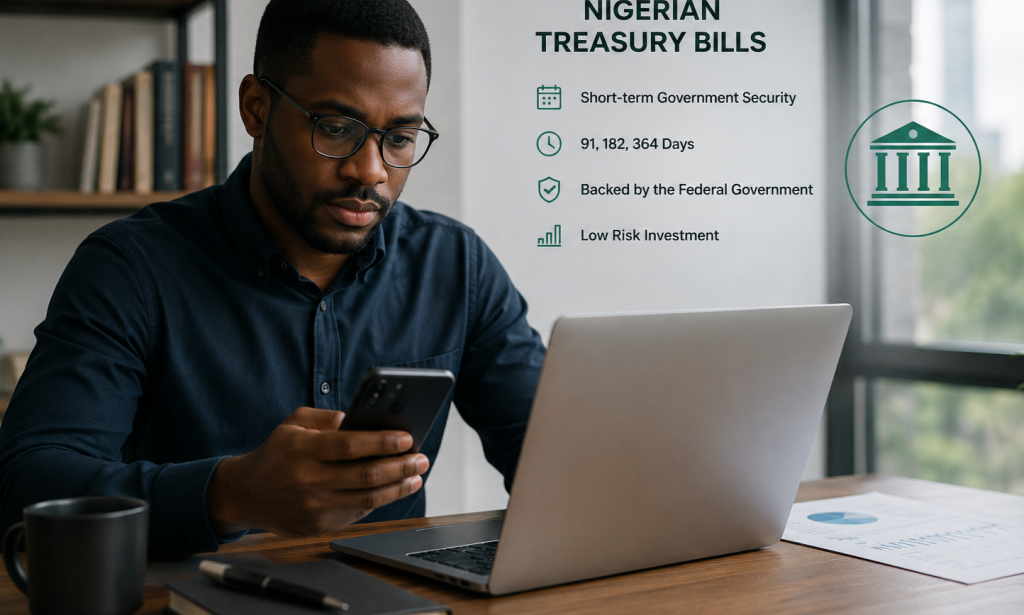
Unlike a normal savings account, a Treasury bill does not typically pay interest into your account every month. Instead, Treasury bills are generally issued at a discount and redeemed at their face value at maturity. The difference between what you pay and what you receive is your return.
This guide explains how Treasury bills work in Nigeria, how investors make money from them, what ₦100,000 or ₦1 million could look like, the risks involved, how to buy them, and what to consider before investing.
What Is a Treasury Bill?
A Treasury bill is a short-term debt instrument issued by the government.
When you buy one, you are effectively lending money to the government for a specified period.
In return, the government agrees to repay the bill at maturity according to its terms.
The key word is short-term.
Nigerian Treasury Bills are commonly issued with maturities such as:
- 91 days
- 182 days
- 364 days
The Central Bank of Nigeria's Treasury bill issuance records show these three tenors being used in the Nigerian market.
The Securities and Exchange Commission (SEC) Nigeria classifies government debt instruments separately from equities: debt represents a creditor relationship rather than ownership of the issuer.
That means buying a Treasury bill does not make you an owner of the Nigerian government.
You are investing in a government debt instrument.
How Do Treasury Bills Work?
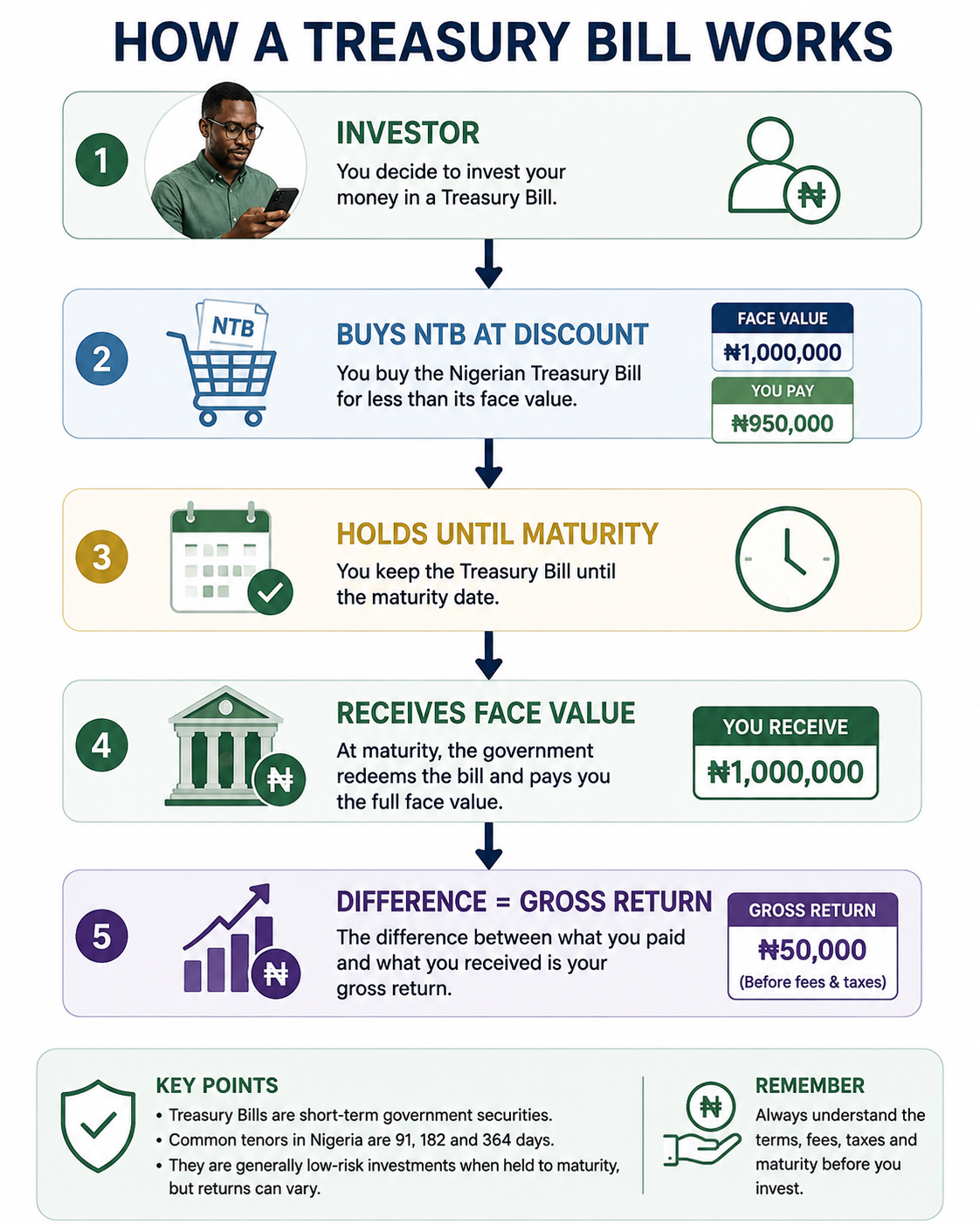
The easiest way to understand a Treasury bill is to think about a discount.
Suppose a Treasury bill has a face value of:
₦1,000,000
You may not pay the full ₦1 million when purchasing it.
Instead, you could buy it for less than its face value and receive the full face value when it matures.
For example, using a purely hypothetical figure:
Purchase price: ₦950,000
Amount received at maturity: ₦1,000,000
Your gross difference would be:
₦50,000
The actual price and return depend on the applicable auction or market conditions and the specific bill.
So don't assume that every Treasury bill will give you a particular percentage return.
Rates change.
Treasury Bills Are Not the Same as Savings Accounts
This distinction is important.
If you put ₦500,000 into a savings account, your bank may pay interest according to the account's terms.
A Treasury bill works differently.
You are purchasing a government security with a defined maturity.
For example:
Savings account
You deposit money → bank holds your deposit → interest may be paid according to the account terms → you can generally access the money subject to the account conditions.
Treasury bill
You purchase a government security → it has a defined maturity → it is redeemed according to its terms → your return comes from the difference between your purchase price and the amount received at maturity.
They serve different purposes.
Why Does the Government Issue Treasury Bills?
Governments need money to finance their activities and manage short-term funding requirements.
Treasury bills provide a way for the government to borrow for relatively short periods.
Investors, on the other hand, get an opportunity to invest in a government security.
It is therefore a relationship between:
Government needs funding
↓
Investor provides funds
↓
Government repays according to the security's terms
The CBN publishes information on Nigerian Treasury Bill issuance and government securities activity.
What Are the Different Treasury Bill Tenors?
The tenor is simply the length of time until the bill matures.
91-day Treasury Bill
This is a relatively short-term investment.
It may be useful for someone who wants exposure to a short-duration government security without committing money for a full year.
182-day Treasury Bill
This has a longer maturity than a 91-day bill.
It may suit an investor whose financial goal allows the money to remain invested for roughly six months.
364-day Treasury Bill
This is close to one year.
It may appeal to someone who has money they do not expect to need for approximately a year.
The important point is not to choose a tenor simply because its quoted rate looks attractive.
Ask yourself:
"When will I need this money?"
Your investment timeframe should come before chasing a particular rate.
How Do You Make Money From a Treasury Bill?
Treasury bills are generally issued at a discount.
Let's use a simple example.
Suppose you purchase a bill with:
Face value: ₦1,000,000
and your purchase price is:
₦940,000
At maturity, assuming all obligations are met according to the terms, you receive:
₦1,000,000
Your gross return would therefore be:
₦1,000,000 − ₦940,000 = ₦60,000
That's the basic idea.
However, don't confuse this simple example with an actual current Treasury bill rate.
Actual pricing depends on market conditions and the specific issuance.
What If You Invest ₦100,000?
Let's make the example smaller.
Suppose you invest ₦100,000 in a hypothetical Treasury bill and the applicable discount results in a purchase price of ₦96,000 for a ₦100,000 face-value bill.
At maturity:
You pay: ₦96,000
You receive: ₦100,000
Gross difference: ₦4,000
This is only an illustration.
Actual returns can be higher or lower depending on the prevailing rate, purchase price, tenor, fees and applicable taxes.
What If You Invest ₦1 Million?
Now suppose your face value is:
₦1,000,000
and your hypothetical purchase price is:
₦940,000
The gross difference is:
₦60,000
If you invested ₦10 million under exactly the same hypothetical pricing, the gross difference would be:
₦600,000
But this does not mean you should invest more simply because the naira amount of the return is larger.
The percentage return and the amount of capital at risk are both important.
Is the Return on a Treasury Bill Guaranteed?
This needs careful wording.
A Treasury bill is a government debt security, but investors should not interpret that to mean "there is no possible risk."
There are several things to consider.
There is:
- Issuer risk
- Inflation risk
- Reinvestment risk
- Liquidity considerations
- Interest-rate and market-price risk if you sell before maturity
- Tax and fee considerations
The SEC's investor-education materials specifically encourage investors to understand risks and make informed decisions rather than treating investments as automatically safe.
What Happens If You Need Your Money Before Maturity?
This is an important issue.
Suppose you buy a Treasury bill that matures in 364 days.
After 100 days, you suddenly need the money.
You may be able to sell the investment in the secondary market, depending on the product, market conditions and available counterparties.
But selling before maturity means the amount you receive may differ from what you originally paid.
This is different from simply waiting until maturity.
Therefore:
Don't invest emergency money in a Treasury bill just because the quoted return looks attractive.
Your emergency savings should remain accessible for emergencies.
MoneyTrut explains emergency-fund planning here:
How Much Should You Have in an Emergency Fund?
Treasury Bills vs Fixed Deposit
Treasury bills and fixed deposits can look similar because both may be used for money that you don't need immediately.
But they are different products.
| Feature | Treasury Bills | Fixed Deposit |
|---|---|---|
| What you are buying | Government security | Bank deposit |
| Main return | Discount between purchase price and face value | Interest according to bank terms |
| Maturity | Specific tenor | Specific agreed period |
| Issuer | Government | Bank |
| Deposit insurance | Not a bank deposit | Eligible deposits may be covered within NDIC limits |
| Early access | Depends on market/product arrangements | Depends on bank terms |
| Return | Depends on prevailing pricing | Depends on bank's offered rate |
The distinction matters because deposit insurance does not automatically apply to every financial investment product.
If your money is in a bank deposit, understand the applicable NDIC protection and limits.
If you are buying a Treasury bill, you are buying a government security—not a bank deposit.
Treasury Bills vs Savings Account
A savings account is generally designed for accessibility and everyday saving.
A Treasury bill is an investment with a defined maturity.
Consider someone who earns:
₦300,000 per month
and has ₦200,000 saved.
If that ₦200,000 is the person's entire emergency reserve, moving all of it into a Treasury bill could be a poor decision.
Why?
Because the person may need the money unexpectedly.
But if the person already has an adequate emergency reserve and has another ₦500,000 that will not be needed for several months, a short-term investment could potentially be considered.
The point is:
The right investment depends on what the money is for.
Treasury Bills vs Stocks
Treasury bills and stocks are very different.
When you buy shares, you become an owner of part of a company.
When you buy a Treasury bill, you are investing in government debt.
Stocks can experience significant price fluctuations and potentially produce substantial long-term growth.
Treasury bills generally have much shorter maturities and a different risk and return profile.
The SEC explains that equities represent ownership in a company, while debt instruments create a borrower-creditor relationship.
MoneyTrut explains the broader difference here:
Stocks vs Bonds: Which Is Better for Your Money?
Treasury Bills and Inflation
One of the biggest mistakes investors can make is looking only at the stated return.
Imagine your investment earns a return of 15%.
That sounds attractive until you consider what happens to the prices of the goods and services you buy.
If inflation is higher than your investment return, your money may still lose purchasing power in real terms.
This is called real return.
A simple way to think about it is:
Investment return − inflation ≈ real return
This is only a rough simplification, but it illustrates the point.
Your investment can increase in naira terms while your purchasing power still falls.
What Is the Difference Between the Interest Rate and Discount Rate?
Treasury bills can be confusing because people sometimes describe their return using different rate calculations.
The price of the bill is determined using a discount mechanism, while investors may also calculate the effective return based on the amount actually invested.
For example, if a bill has a face value of ₦1,000,000 and you pay ₦950,000, the ₦50,000 difference represents your gross gain.
The return relative to your ₦950,000 investment is:
₦50,000 ÷ ₦950,000 × 100 = 5.26%
That is different from calculating the ₦50,000 as a percentage of the ₦1 million face value:
₦50,000 ÷ ₦1,000,000 × 100 = 5%
The two numbers describe the same ₦50,000 difference but use different bases.
This is why you should look carefully at how a quoted Treasury bill rate has been calculated.
How Can You Buy Treasury Bills in Nigeria?
Investors should use legitimate channels and understand exactly what they are purchasing.
The process can involve banks, licensed investment firms, stockbrokers and other authorized market participants, depending on the route and type of transaction.
Before handing over your money, find out:
- Who is selling or arranging the investment?
- Is the operator authorized?
- What Treasury bill are you buying?
- What is the maturity date?
- What is the purchase price?
- What is the face value?
- What fees apply?
- What happens at maturity?
- What happens if you need to exit early?
The SEC provides an investor portal with resources including Find a Registered Operator, investor education and information about known investment scams.
Don't rely solely on an investment platform's social-media page or someone's WhatsApp recommendation.
Can You Buy Treasury Bills Through an Investment App?
Some financial platforms may provide access to government securities or fixed-income products.
But the important question is not whether an app makes the process convenient.
The important question is:
What exactly are you buying, and who is the regulated operator behind it?
Before investing, verify the product and the relevant operator.
A platform calling something a "Treasury bill investment" does not remove the need for due diligence.
The SEC maintains resources for investors to check regulated operators.
Can You Lose Money in Treasury Bills?
If you hold a Treasury bill to maturity and the issuer meets its obligations, the structure is designed for repayment of the face value according to the terms.
But there are still risks.
Inflation risk
Your return may not keep pace with rising prices.
Reinvestment risk
Suppose you buy a 91-day Treasury bill.
When it matures, you may want to reinvest the money.
But the rate available 91 days later could be lower.
You cannot assume today's rate will still be available.
Early-sale risk
If you need to sell before maturity, the price you receive may differ from what you paid.
Fraud risk
Someone could falsely claim to be selling Treasury bills while actually taking your money for an unrelated scheme.
That is why using legitimate channels and verifying operators matter.
What Is Reinvestment Risk?
This deserves more attention because it is easy to overlook.
Imagine you have:
₦2 million
You invest it in a Treasury bill for one year.
At maturity, you receive your principal and return.
You want to invest again.
But the available Treasury bill rate is now significantly lower.
Your next investment may therefore generate a smaller return.
This is called reinvestment risk.
It is one reason you should not build a financial plan on the assumption that today's investment rate will continue indefinitely.
Should You Put All Your Money in Treasury Bills?
Generally, you should not think about any single investment in isolation.
Treasury bills can have a role in a portfolio, but that does not mean they should automatically contain all of your savings or investments.
Your overall strategy could involve different purposes:
Emergency money
→ accessible savings
Short-term goals
→ suitable lower-volatility investments
Long-term growth
→ potentially stocks, funds and other long-term investments
Diversification
→ a combination of appropriate assets
MoneyTrut explains this broader concept in:
What Is Asset Allocation and How Should You Divide Your Investments?
Diversification is also discussed here:
What Is Investment Diversification and How Does It Work?
What About Someone Earning ₦100,000 a Month?
Suppose you earn ₦100,000 monthly.
You manage to save ₦15,000 each month.
It would be a mistake to assume that you must immediately put every naira into Treasury bills.
First consider your financial foundation.
Do you have:
- Emergency savings?
- High-interest debt?
- Upcoming expenses?
- Stable income?
- A specific investment goal?
If you have no emergency savings, building that reserve may be more important than chasing a Treasury bill return.
Once your financial foundation is stronger, you can decide how much of your surplus should be invested.
What About Someone Earning ₦500,000 a Month?
Now consider someone earning ₦500,000 monthly.
Suppose their essential expenses are ₦300,000 and they have ₦200,000 left before considering other financial goals.
They might divide their available money between:
- Emergency savings
- Debt repayment
- Long-term investments
- Short-term investments
- Other financial goals
There is no rule saying the entire ₦200,000 should go into Treasury bills.
Asset allocation should reflect the person's goals and risk capacity.
MoneyTrut previously explained how much someone might invest from their salary:
How Much Should You Invest From Your Salary Each Month?
Is a Treasury Bill a Good Investment?
It can be useful for some investors and some financial goals.
But "good investment" is not an absolute label.
A Treasury bill may be suitable for someone who:
- Wants exposure to short-term government debt
- Has money they don't need immediately
- Understands the maturity period
- Is comfortable with the expected return
- Has already considered emergency savings and other financial needs
It may be less suitable for someone who:
- Needs immediate access to the money
- Has no emergency savings
- Has expensive debt that needs attention
- Is investing for a very long-term growth objective
- Does not understand the product or its costs
The investment should serve your financial plan—not the other way around.
What Should You Check Before Buying?
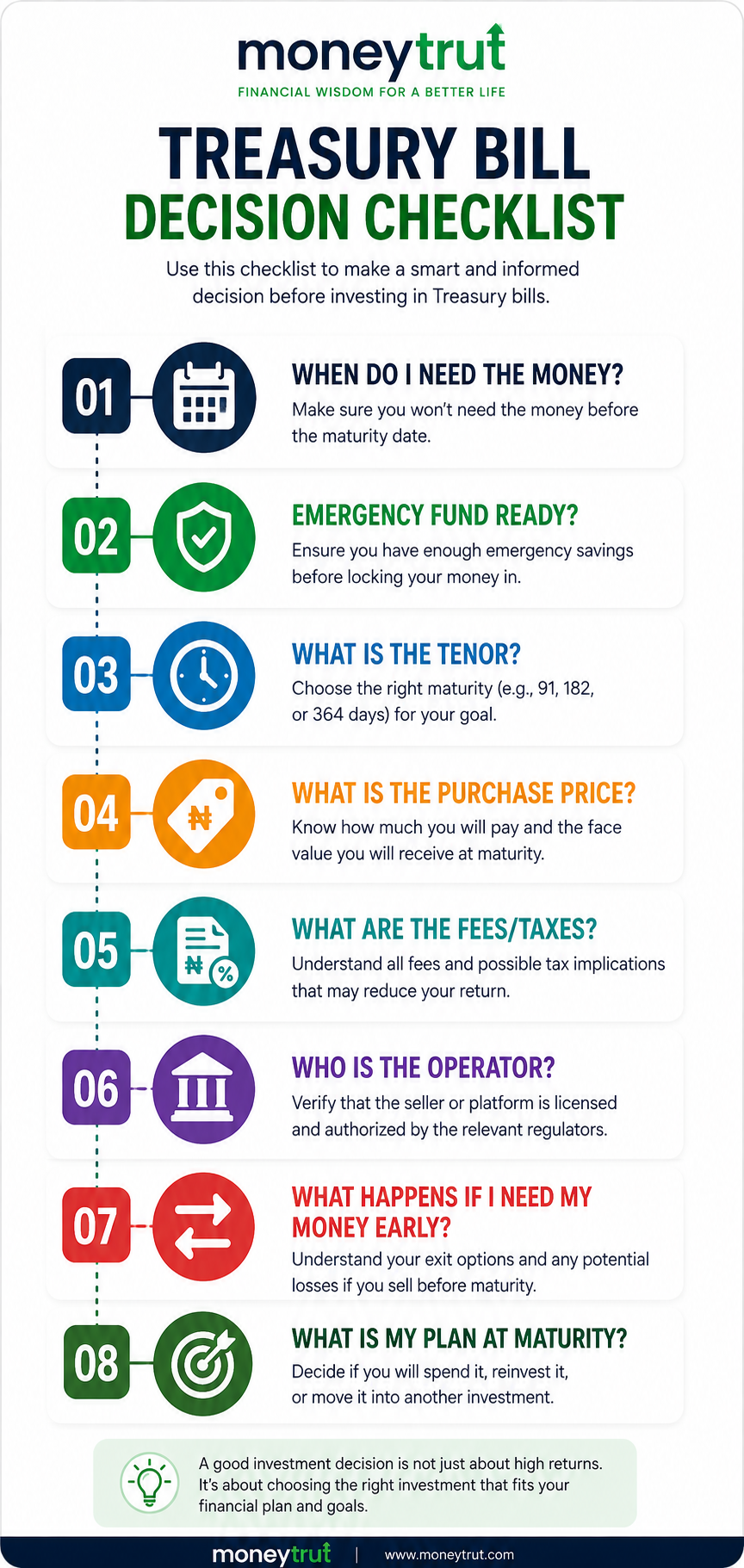
Before investing in a Treasury bill, ask these questions:
1. What is the maturity date?
Know exactly when the investment matures.
2. What is the purchase price?
Don't look only at a quoted percentage.
Understand how much money will actually leave your account.
3. What is the face value?
Know how much you are expected to receive at maturity.
4. What are the fees?
Fees reduce your actual return.
5. Are there tax implications?
Tax treatment can depend on the instrument, investor and applicable law.
Don't assume that every government security has the same tax treatment.
6. Who is the operator?
Verify the relevant financial institution or capital-market operator.
7. What happens if you need your money early?
Understand your exit options before investing.
8. What will you do when it matures?
Will you spend it, move it into another investment, or reinvest it?
Having an answer prevents you from making a rushed decision later.
Don't Chase the Highest Treasury Bill Rate
Suppose one opportunity appears to offer a much higher return than everything else.
That should make you ask more questions, not fewer.
Is it actually a Treasury bill?
Who is the issuer?
Who is offering it?
Is the operator authorized?
Are there hidden fees?
Is someone simply using the phrase "Treasury bill" to make another investment product sound safer?
The SEC provides investor-protection resources and encourages investors to make informed decisions and verify relevant operators.
Be especially cautious of anyone promising a guaranteed, unusually high return with no meaningful risk.
Bottom Line
A Treasury bill is a short-term government debt security that can provide investors with a way to invest money for a defined period.
In Nigeria, commonly issued NTB tenors include 91, 182 and 364 days.
Treasury bills are generally purchased at a discount and redeemed at face value at maturity, meaning the difference between your purchase price and the amount received represents your gross return.
But a Treasury bill is not simply a better version of a savings account.
Before investing, consider your emergency fund, financial goals, investment timeframe, inflation, fees, reinvestment risk and what you would do if you needed the money before maturity.
Most importantly, verify the investment and the operator through legitimate channels.
The best Treasury bill investment is not necessarily the one with the highest quoted rate. It is the one that fits your financial plan and whose terms and risks you fully understand.

You must be logged in to post a comment.