
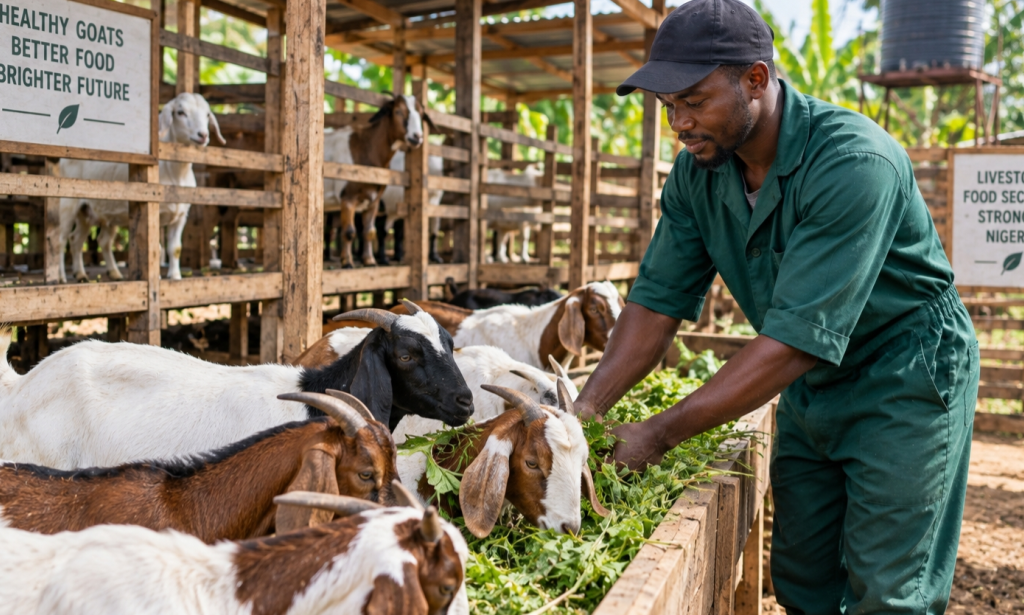
Goat farming can be started on a small scale in Nigeria, but buying a few goats and putting them in a pen is not enough to create a profitable farm. Your results depend on the breed you choose, housing, feed, water, breeding, animal health, mortality and how well you can sell the goats when they are ready. For a beginner, the most sensible approach is to start at a scale you can manage, keep accurate records and expand only after you understand the economics of your first production cycle.
Why Goat Farming Is Worth Considering in Nigeria
Goat farming is not a new business opportunity in Nigeria. It is already an important part of the country's livestock economy.
NAERLS's Agricultural Performance Survey for the 2024 wet season estimated Nigeria's goat population at approximately 114.3 million animals, with substantial goat populations across both northern and southern states.
The distribution is important because goats are adaptable to different production environments.
NAERLS identifies several commonly raised Nigerian goat breeds, including:
- West African Dwarf
- Red Sokoto
- Sahel
Their characteristics and environmental suitability differ, so choosing a breed should be based on your location and production objective rather than simply choosing the most expensive animal.
Goats can be raised for:
- Meat
- Breeding stock
- Milk
- Hides and skins
- Herd expansion
- Seasonal livestock sales
For most beginners interested in a straightforward commercial model, meat production and breeding are likely to be easier to understand than trying to build a specialised dairy operation from the beginning.
Is Goat Farming Profitable in Nigeria?
It can be, but there is no guaranteed profit.
A goat farmer can lose money through:
- Buying unhealthy animals
- Paying too much for breeding stock
- Poor nutrition
- High kid mortality
- Disease
- Poor housing
- Theft
- Expensive purchased feed
- Holding animals for too long
- Selling at the wrong time
- Poor record keeping
The basic business model is relatively simple:
Buy or breed goats → feed and manage them → maintain health → increase weight or herd size → sell at an appropriate market opportunity
But the time between those stages matters.
A goat is not inventory that you can necessarily turn into cash tomorrow.
Your working capital can remain tied up in the herd for months.
That means the first question should not be:
“How much can I make from 10 goats?”
It should be:
“What will it cost me to raise and maintain these goats until I can sell them?”
Choose Your Goat-Farming Model
NAERLS identifies several systems of goat rearing, including extensive, semi-intensive, intensive and backyard/household systems.
Your choice affects your capital requirement and daily workload.
1. Extensive System
Goats graze or browse over a relatively large area with limited supplementary feeding.
The advantage is that purchased feed costs can be lower where suitable vegetation is available.
The disadvantages include:
- Less control over nutrition
- Theft risk
- Exposure to disease
- Road accidents
- Predators
- Seasonal changes in feed availability
- Less control over breeding
NAERLS notes that extensive systems generally have lower input costs but can also have lower productivity and greater exposure to environmental risks.
2. Semi-Intensive System
Goats have access to grazing or browsing but are also housed and given supplementary feed.
This can provide a balance between cost and control.
FMLD highlighted semi-intensive production as a recommended approach for sheep and goat production during a January 2026 livestock training programme, noting the value of shelter, indoor feeding during unfavourable weather and grazing when conditions permit.
For many small and medium-scale farmers, this model is worth considering because it gives you more control without requiring a fully intensive system.
3. Intensive System
The goats remain largely confined and receive controlled feeding.
This can provide:
- Better monitoring
- More controlled breeding
- Better use of limited land
- More predictable feeding
- Easier individual observation
But it also requires more money, labour and management.
If hygiene is poor, keeping many goats together can also increase disease risks.
4. Backyard System
A small number of goats can be kept around a home where space and local conditions permit.
This can be an entry point for someone learning the basics.
But backyard farming still requires proper housing, waste management, security and consideration for neighbours.
Step 1: Decide What You Want to Produce
Before buying your first goat, decide what the farm is actually going to sell.
Meat goats
You buy or breed goats and raise them toward a suitable market size.
Your income comes mainly from selling live animals.
Breeding goats
You focus on healthy animals with desirable characteristics and sell breeding stock to other farmers.
This requires greater attention to:
- Genetics
- Reproductive performance
- Health
- Growth
- Pedigree or breeding history where relevant
Dairy goats
You produce milk.
This is a more specialised business because milk production requires appropriate breeds, nutrition, hygiene, milking practices and a market for the milk.
Do not enter dairy goat farming simply because milk sounds like an additional source of revenue.
You need a market and the appropriate production system.
Step 2: Choose the Right Breed for Your Location
Breed selection should be practical.
NAERLS identifies the following major Nigerian goat breeds:
West African Dwarf
The West African Dwarf goat is common in the humid forest zones of southern Nigeria.
NAERLS describes it as a relatively small breed adapted to humid and tsetse-prone environments, with early maturity and good reproductive characteristics.
For someone farming in southern Nigeria, this makes it a breed worth understanding rather than automatically looking for an expensive exotic breed.
Red Sokoto
The Red Sokoto is associated particularly with northwestern Nigeria.
It is valued for meat and its skin, and NAERLS notes that it is better suited to northern conditions than humid southern environments.
Sahel Goat
The Sahel goat is more commonly associated with northern Nigeria and dry environments.
NAERLS describes it as larger and adapted to arid conditions.
The lesson is simple:
The most expensive goat is not automatically the best goat for your farm.
Step 3: Visit Local Livestock Markets Before Buying
Before you buy, visit the market.
Observe:
- Goat sizes
- Breed types
- Prices
- Buyer behaviour
- Seasonal price changes
- Which goats appear healthy
- Which sellers are trusted
Speak to:
- Goat traders
- Farmers
- Butchers
- Restaurants
- Breeders
- Veterinary professionals
Ask what buyers in your area actually want.
If you are in Benin City, for example, the buying behaviour and prices you observe locally may not be identical to what a farmer in Kano or Sokoto experiences.
Your farm should respond to your market, not an online article's generic price list.
Step 4: Choose the Farm Location
Your location should provide:
- Access to water
- Access to feed or forage
- Good drainage
- Security
- Reasonable road access
- Adequate space
- Protection from flooding
- Distance from problematic neighbouring activities
If you are using an intensive or semi-intensive system, you do not necessarily need a huge piece of land.
But you need enough space for:
- Adult goats
- Kids
- Sick or isolated animals
- Feed storage
- Movement
- Waste management
Step 5: Build Suitable Goat Housing
Housing is not simply a roof over the animals.
A suitable goat house should protect the animals from:
- Rain
- Excessive heat
- Cold
- Predators
- Theft
- Excess moisture
NAERLS identifies traditional housing, elevated wooden platforms, semi-permanent concrete pens and modern intensive housing among the systems used in Nigeria.
In southern Nigeria, where rainfall and humidity can be significant, raised flooring can help reduce moisture around the animals.
NAERLS gives indicative floor-space requirements of approximately:
| Goat | Suggested floor space |
|---|---|
| Kids | 0.5–0.75 m² |
| Does | 1.0–1.5 m² |
| Bucks | About 2.0 m² |
| Lactating does | 1.5–2.0 m² |
These are useful planning figures, not a substitute for designing the housing around the actual breed, climate and management system.
Step 6: Make the Pen Dry and Well Ventilated
Goats do not do well in continuously wet, dirty conditions.
Your housing should have:
- Good airflow
- Dry bedding where used
- Effective drainage
- Easy cleaning
- Adequate shade
- Protection from rain
Remove accumulated droppings and wet bedding regularly.
NAERLS specifically recommends regular removal of droppings and urine, periodic disinfection and drainage that prevents water stagnation.
Step 7: Plan Your Feed Before Buying Goats
This is one of the most important financial decisions.
Goats can consume:
- Grasses
- Browse plants
- Leaves
- Legumes
- Crop residues
- Concentrates
- Mineral supplements
NAERLS recommends combining suitable forage with concentrates and minerals where required, and stresses the importance of clean water.
Your feeding strategy will depend on the production system.
A farmer with access to good pasture has a very different cost structure from someone buying most of the feed.
Think in terms of feed cost per goat
Suppose your feed-related expenses average:
₦2,500 per goat per month
If you keep 20 goats:
20 × ₦2,500 = ₦50,000 per month
That is:
₦600,000 per year
This is only an illustration.
Your actual figure could be much lower or higher depending on whether you produce your own forage, purchase concentrates and the nutritional needs of the animals.
The important lesson is that feed must be included in your business plan from day one.
Step 8: Provide Clean Water
Water is easy to underestimate because it may appear to cost less than feed.
But goats need reliable access to clean water.
NAERLS recommends constant access to clean, fresh water and regular cleaning of water troughs. Its guidance gives adult goats an indicative water intake of roughly 2–5 litres per day, with higher requirements possible during hot weather or lactation.
Water requirements vary with:
- Body size
- Temperature
- Diet
- Pregnancy
- Lactation
- Health
So treat those numbers as planning guidance rather than a rigid daily quota for every goat.
Step 9: Buy Healthy Goats
Do not buy goats simply because they look large.
When inspecting an animal, look for:
- Alert behaviour
- Normal movement
- Good body condition
- Clear eyes
- No obvious nasal discharge
- No severe coughing
- No visible wounds
- No severe diarrhoea
- Healthy-looking coat
- Normal appetite where observable
Ask the seller:
- How old is the goat?
- What breed is it?
- Where did it come from?
- Has it been vaccinated?
- Has it recently been sick?
- Is it being sold for breeding or meat?
- Has it recently been transported?
If you are investing significant money, professional veterinary inspection can be worthwhile.
Step 10: Quarantine New Animals
Do not automatically mix newly purchased goats with your existing herd.
A new animal may appear healthy but still introduce disease.
A quarantine period gives you an opportunity to:
- Observe the animal
- Check for illness
- Treat identified problems appropriately
- Monitor feeding
- Seek veterinary advice
- Reduce the risk of spreading disease
The exact quarantine protocol should be developed with a veterinarian or livestock-health professional familiar with your farm.
Step 11: Take PPR Seriously
Peste des Petits Ruminants (PPR) is a major disease concern for sheep and goats.
The Federal Ministry of Livestock Development stated in July 2026 that the Federal Government was working toward controlling and eradicating PPR in Nigeria by 2030.
This is one reason animal-health management should not be treated as an optional expense.
Vaccination programmes should follow current veterinary guidance and local disease-control programmes.
Do not buy veterinary drugs or design a vaccination programme solely from social-media recommendations.
Step 12: Manage Breeding Properly
Breeding is one of the major ways a goat farm can increase its herd.
But reproduction is not simply:
Buy goats → wait → get many goats
You need to manage:
- Breeding stock
- Male-to-female ratios
- Heat detection
- Pregnancy
- Nutrition
- Kid care
- Birth records
- Mortality
- Inbreeding
NAERLS recommends selecting breeding animals for characteristics such as good body condition, reproductive performance, health and absence of obvious defects. It also provides guidance on controlled breeding and avoiding close inbreeding.
How Many Goats Does One Buck Need?
NAERLS's goat-breeding guidance gives a general mating ratio of approximately one healthy, proven buck for 20–30 does, while cautioning against overworking young bucks.
That does not mean a beginner needs 20–30 does.
It means you should avoid buying multiple male goats unnecessarily if your production scale does not require them.
For a small farm, you may be able to arrange access to a suitable buck through another farmer rather than keeping a dedicated breeding male immediately, provided the arrangement is practical and animal-health considerations are properly managed.
Step 13: Keep Breeding Records
For each breeding female, record:
- Identification
- Date of mating
- Buck used
- Expected kidding period
- Actual kidding date
- Number of kids
- Kid survival
- Health problems
- Weaning information
Over time, this tells you which animals are actually contributing to the performance of the herd.
Without records, you may continue feeding animals that consistently perform poorly.
Step 14: Separate Kids and Vulnerable Animals Where Necessary
Young goats require different management from mature animals.
Your farm should have the ability to separate:
- Kids
- Pregnant does
- Lactating does
- Bucks
- Sick animals
- Newly purchased animals
This doesn't mean every small farmer needs a complicated commercial facility.
It means the housing should allow you to separate animals when management requires it.
Step 15: Calculate the Cost of Raising Each Goat
This is where goat farming becomes a business rather than simply livestock ownership.
Suppose you buy a young goat for:
₦35,000
Over the following months, you spend:
- Feed: ₦18,000
- Veterinary care: ₦4,000
- Transport: ₦3,000
- Housing allocation and other costs: ₦5,000
Your simplified cost becomes:
₦35,000 + ₦18,000 + ₦4,000 + ₦3,000 + ₦5,000 = ₦65,000
If you eventually sell the goat for ₦80,000:
₦80,000 − ₦65,000 = ₦15,000
That is an illustrative calculation, not a current market-price estimate.
If the goat dies, grows poorly or requires much more feed than expected, your economics change.
This is why you need actual farm records.
Step 16: Don't Ignore the Value of Your Own Labour
If you manage the goats yourself, you may be tempted to write:
Labour = ₦0
That can make the business look more profitable than it really is.
Your own labour has economic value.
You do not necessarily have to pay yourself a salary from day one, but keep track of the hours you spend feeding, cleaning, monitoring and marketing.
This becomes particularly important when deciding whether to scale.
A business that produces ₦100,000 of annual surplus but consumes hundreds of hours of your time is different from a business producing the same surplus with much less labour.
Step 17: Find Your Market Before Expanding
Potential goat buyers include:
- Livestock traders
- Butchers
- Restaurants
- Caterers
- Households
- Event suppliers
- Breeders
- Other farmers
Depending on your location and production model, demand may change around festive periods and other occasions.
But don't build your business around one seasonal price spike.
Ask buyers:
- What size goats do you prefer?
- How frequently do you buy?
- Do you buy live goats?
- Do you buy directly from farms?
- How many can you take at once?
- Do you negotiate by weight, size or animal?
- Who handles transportation?
The answers can help determine how you raise and sell the animals.
How Much Does It Cost to Start Goat Farming in Nigeria?
There is no single startup figure that applies to every farm.
Your cost depends on:
- Number of goats
- Breed
- Age of animals
- Housing
- Land
- Feed availability
- Water
- Veterinary care
- Labour
- Fencing
- Security
- Transport
- Working capital
Someone starting with three goats on existing family land has a completely different cost structure from someone establishing a 50-goat commercial farm.
Instead of asking:
“How much does goat farming cost?”
ask:
“How many goats can I realistically support with my available capital and resources?”
A Practical Budget Framework
Before purchasing your first goats, build a table like this:
| Cost | One-Time | Ongoing | Your Estimate |
|---|---|---|---|
| Goats | ✓ | ₦___ | |
| Housing | ✓ | ₦___ | |
| Fencing | ✓ | ₦___ | |
| Feed/forage | ✓ | ₦___ | |
| Water | ✓ | ✓ | ₦___ |
| Veterinary care | ✓ | ₦___ | |
| Vaccination | ✓ | ₦___ | |
| Labour | ✓ | ₦___ | |
| Transport | ✓ | ₦___ | |
| Security | ✓ | ₦___ | |
| Contingency | ✓ | ₦___ |
Then calculate:
Total startup requirement = One-time costs + initial livestock + working capital
Do not spend all your capital buying goats.
You need money left to maintain them.
Should You Start With 2, 5, 10 or 20 Goats?
There is no universal answer.
A better way to decide is to work backwards from your resources.
Suppose you have ₦300,000 available.
You should not automatically say:
“I will buy 10 goats because 10 × ₦30,000 = ₦300,000.”
That leaves nothing for:
- Housing
- Feed
- Water
- Veterinary care
- Transport
- Emergencies
A more sensible approach is to reserve money for operating costs first.
For example, if your complete setup and first-stage working capital require ₦120,000, only the remaining amount should be considered for livestock.
The exact allocation depends on your local prices and existing resources.
Goat Farming vs Poultry Farming
Goat farming and poultry farming have very different economics.
| Factor | Goat Farming | Poultry |
|---|---|---|
| Production cycle | Generally longer | Broilers can be relatively short |
| Space | Moderate | Varies by system |
| Feed system | Forage + supplements possible | Commercial feed often important |
| Reproduction | Can build herd | Eggs/hatching depending on model |
| Daily management | Regular | Often intensive |
| Cash turnover | Generally slower | Can be faster |
| Disease risk | Significant | Significant |
| Main advantage | Herd growth and livestock value | Faster turnover in some models |
MoneyTrut's guide to starting poultry farming in Nigeria goes into the economics of poultry production in more detail.
Neither business should be chosen simply because someone says it is more profitable.
Your capital, land, available feed, time and market should determine the model.
Goat Farming vs Snail Farming
Goat and snail farming can both be started on a relatively small scale, but their management requirements are very different.
Snail farming generally requires much less physical space, while goats require more room, fencing and animal-health management.
Goats also provide a more obvious live-animal market in many Nigerian communities, while snail farming can have a slower production cycle and a different customer base.
If you are considering both, compare:
- Space
- Capital
- Feed
- Production time
- Labour
- Market
- Your own experience
Our snail farming guide covers the alternative in more detail.
Common Goat-Farming Mistakes
Buying animals without inspecting them
A cheap sick goat is not a bargain.
Choosing a breed without considering your location
Breed suitability matters.
Building poor housing
Wet, overcrowded housing can create health problems.
Underestimating feed costs
Feed and forage need to be planned before the herd arrives.
Having no reliable water
Water should not become an emergency.
Keeping no breeding records
You won't know which animals are actually performing.
Mixing new animals into the herd immediately
This can increase disease risk.
Buying too many males
Your breeding ratio should match your herd size.
Spending all your capital on livestock
You need working capital after purchase.
Selling because you urgently need money
This can force you to sell at an unfavourable time.
Assuming every goat will reproduce successfully
Breeding involves health, nutrition, genetics and management.
How to Grow a Goat-Farming Business
Once your first herd is stable, growth can come through:
- Retaining good female offspring
- Improving breeding stock
- Adding suitable housing
- Expanding forage production
- Increasing the number of buyers
- Selling breeding stock
- Supplying traders directly
- Building relationships with restaurants
- Improving record keeping
But don't expand simply because you have more goats.
A larger herd means:
- More feed
- More water
- More labour
- More housing
- More disease-management requirements
- More capital tied up
Growth should follow the economics of the farm.
Should You Borrow Money to Start Goat Farming?
Be cautious.
A goat farm can have a longer cash cycle than a typical retail business.
If you borrow money to buy animals, you still need to feed and care for them while waiting for the appropriate sale opportunity.
Before taking a loan, calculate:
- Total loan amount
- Interest and fees
- Repayment schedule
- Expected holding period
- Feed costs
- Veterinary expenses
- Conservative selling price
- Emergency reserve
If the farm only works when every goat sells at your highest expected price, your plan is too optimistic.
A Simple Goat-Farming Business Plan
Before starting, write down:
- Production purpose
- Breed
- Starting herd size
- Location
- Housing system
- Feed source
- Water source
- Veterinary support
- Breeding plan
- Expected holding period
- Target customers
- Expected selling price
- Startup cost
- Working capital
- Expansion plan
Then calculate your expected cost per saleable animal.
You should be able to answer:
How much money will I spend before this goat is ready to sell?
That is a much more useful question than simply asking how much a goat sells for.
A Simple First-Year Approach
Months 1–2: Setup
- Choose your production model
- Prepare housing
- Secure water
- Identify feed sources
- Find a veterinary contact
- Research local markets
Months 2–3: Stock
- Buy healthy animals
- Record each animal
- Observe new animals carefully
- Begin your feeding and health programme
Months 3 onward: Manage
- Monitor weight and body condition
- Track feeding
- Maintain housing
- Monitor health
- Keep breeding records
- Record expenses
Before major sales: Market
- Contact buyers
- Check current prices
- Compare different buyers
- Determine transportation costs
- Decide whether to sell individually or in batches
After sales: Review
Calculate:
- Total revenue
- Total costs
- Cost per goat
- Mortality
- Weight gain where measured
- Breeding performance
- Labour
- Cash remaining
Then decide whether expansion makes sense.
When Should You Expand?
Expansion makes more sense when:
- Mortality is controlled
- Your animals are healthy
- Feed supply is reliable
- Housing is adequate
- You have regular buyers
- Your records show positive results
- You have sufficient working capital
If you struggle to manage five goats, buying 50 does not solve the underlying problem.
Fix the system first.
Ready to Start Your Goat Farming Business?
If goat farming is something you are seriously considering, don't rush out to buy goats yet. Start with the numbers.
Find out how much healthy goats cost in your area, estimate your housing and feeding expenses, identify where you will sell the goats, and calculate how much you can afford to lose if the business takes longer than expected to become profitable.
Then start at a scale you can manage. A small, well-recorded goat farm is a better starting point than a large herd you cannot properly feed, house or monitor.
Your next step: write down your available startup capital, target number of goats, estimated monthly expenses and expected selling price. If the numbers make sense, begin planning your first purchase.
If you found this guide useful, share it with someone considering livestock farming, and explore our other practical guides on starting and managing small businesses in Nigeria.
Bottom Line
Goat farming can be a practical agribusiness in Nigeria, but the business is not simply about buying goats and waiting for their prices to rise. The real work is in choosing appropriate animals, providing suitable housing, managing feed and water, preventing disease, controlling breeding and building a reliable market.
For a beginner, starting with a manageable herd can be more useful than trying to build a large farm immediately. Your first production cycle should teach you what each goat actually costs, how quickly your animals grow or reproduce, how much feed you use and what buyers in your area are willing to pay.
The goal is not to own the largest herd. It is to build a goat business where you understand the numbers behind every animal you raise.
Related Articles
- How to Start a Poultry Farming Business in Nigeria: A Beginner's Guide
- How to Start a Snail Farming Business in Nigeria: A Practical Beginner's Guide
- How to Start Fish Farming in Nigeria: A Practical Beginner's Guide
- How to Keep Business Records in Nigeria: A Simple System for Small Businesses
- How to Calculate the Break-Even Point for a Small Business in Nigeria
Sources & References
- National Agricultural Extension and Research Liaison Services (NAERLS) — goat breeds, rearing systems, housing, feeding and breeding guidance.
- NAERLS Agricultural Performance Survey 2024 — national goat population and state-level distribution.
- Federal Ministry of Livestock Development (FMLD), January 23, 2026 — sheep and goat production training, semi-intensive management, feeding, breeding, housing and animal-health practices.
- Federal Ministry of Livestock Development (FMLD), July 16, 2026 — current federal programme to control and eradicate PPR in sheep and goats by 2030.

You must be logged in to post a comment.