
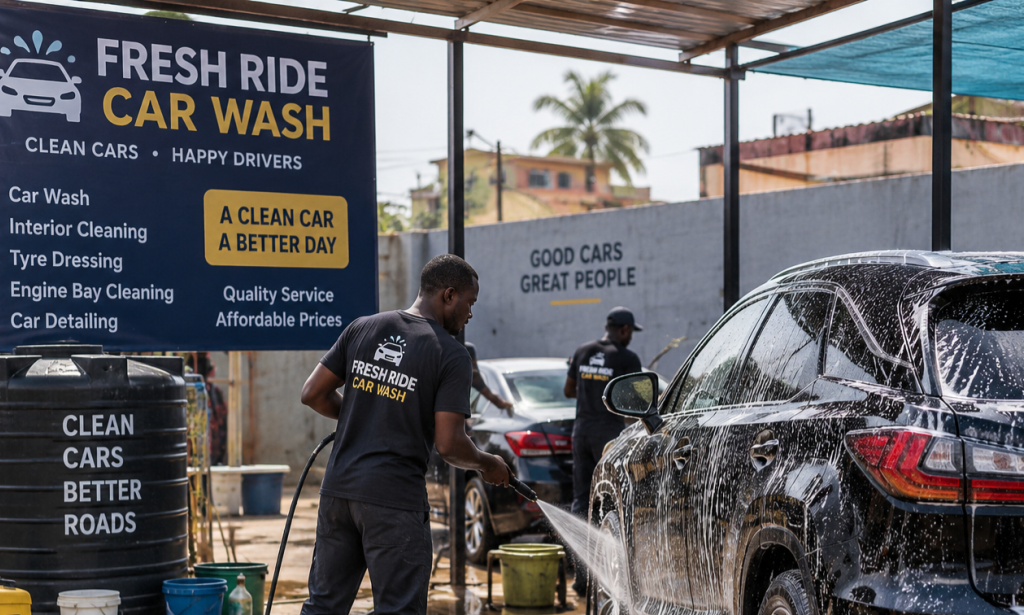
A car wash business in Nigeria can be started on a small scale and expanded as customer demand grows. The basic model is simple: provide vehicle-cleaning services and charge customers for the work, but profitability depends heavily on location, water, power, labour, equipment, pricing and the number of vehicles you can serve. Before spending money on a shop or expensive pressure washer, calculate what each wash will actually cost and how many customers you need to cover your expenses.
What Is a Car Wash Business?
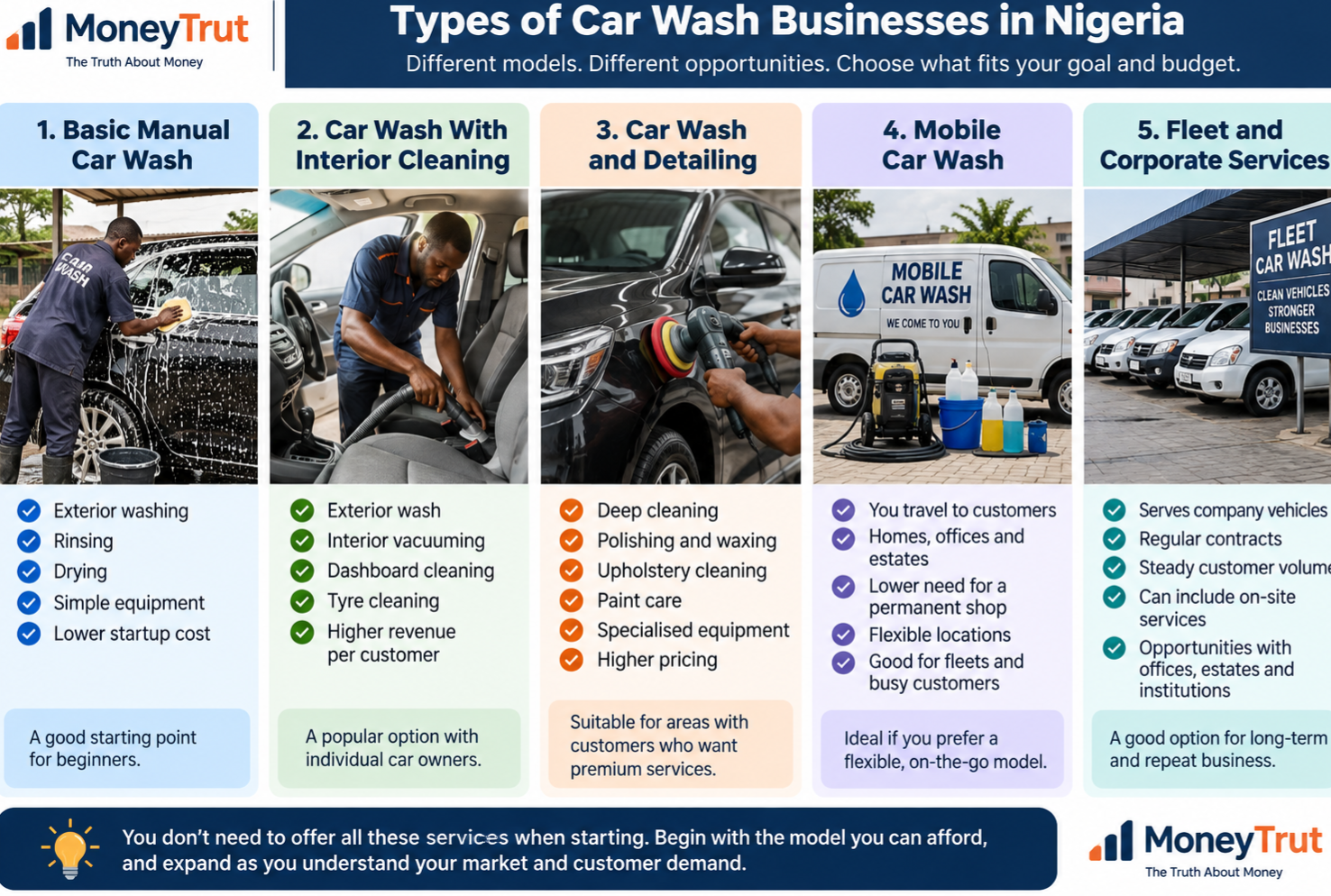
A car wash business provides cleaning services for vehicles.
The simplest version may involve:
- Exterior washing
- Rinsing
- Drying
- Interior cleaning
A more developed operation can offer:
- Vacuuming
- Dashboard cleaning
- Tyre cleaning
- Engine-bay cleaning where appropriate
- Waxing
- Polishing
- Interior detailing
- Upholstery cleaning
- Paint-care services
- Motorcycle washing
You do not need to offer all these services when starting.
A beginner can start with basic washing and interior cleaning, then introduce additional services after understanding what customers in the area actually want.
Is a Car Wash Business Profitable in Nigeria?
A car wash can generate profit, but the answer depends on your numbers.
Suppose you charge:
₦3,000 per vehicle
and wash:
20 vehicles per day
Your daily sales would be:
₦3,000 × 20 = ₦60,000
That sounds attractive.
But ₦60,000 is revenue, not profit.
You still have expenses such as:
- Water
- Electricity or fuel
- Labour
- Cleaning chemicals
- Rent
- Equipment maintenance
- Transportation
- Waste disposal
- Repairs
- Other operating costs
If your average direct cost per vehicle is ₦1,200:
₦3,000 − ₦1,200 = ₦1,800
Your contribution per vehicle would be ₦1,800 before fixed business expenses.
At 20 vehicles:
₦1,800 × 20 = ₦36,000
That is still not your final monthly profit because fixed expenses have to be deducted.
The lesson is simple:
Do not calculate a car wash business by multiplying your selling price by the number of cars.
Calculate the actual cost of serving each customer.
How Much Does It Cost to Start a Car Wash Business in Nigeria?
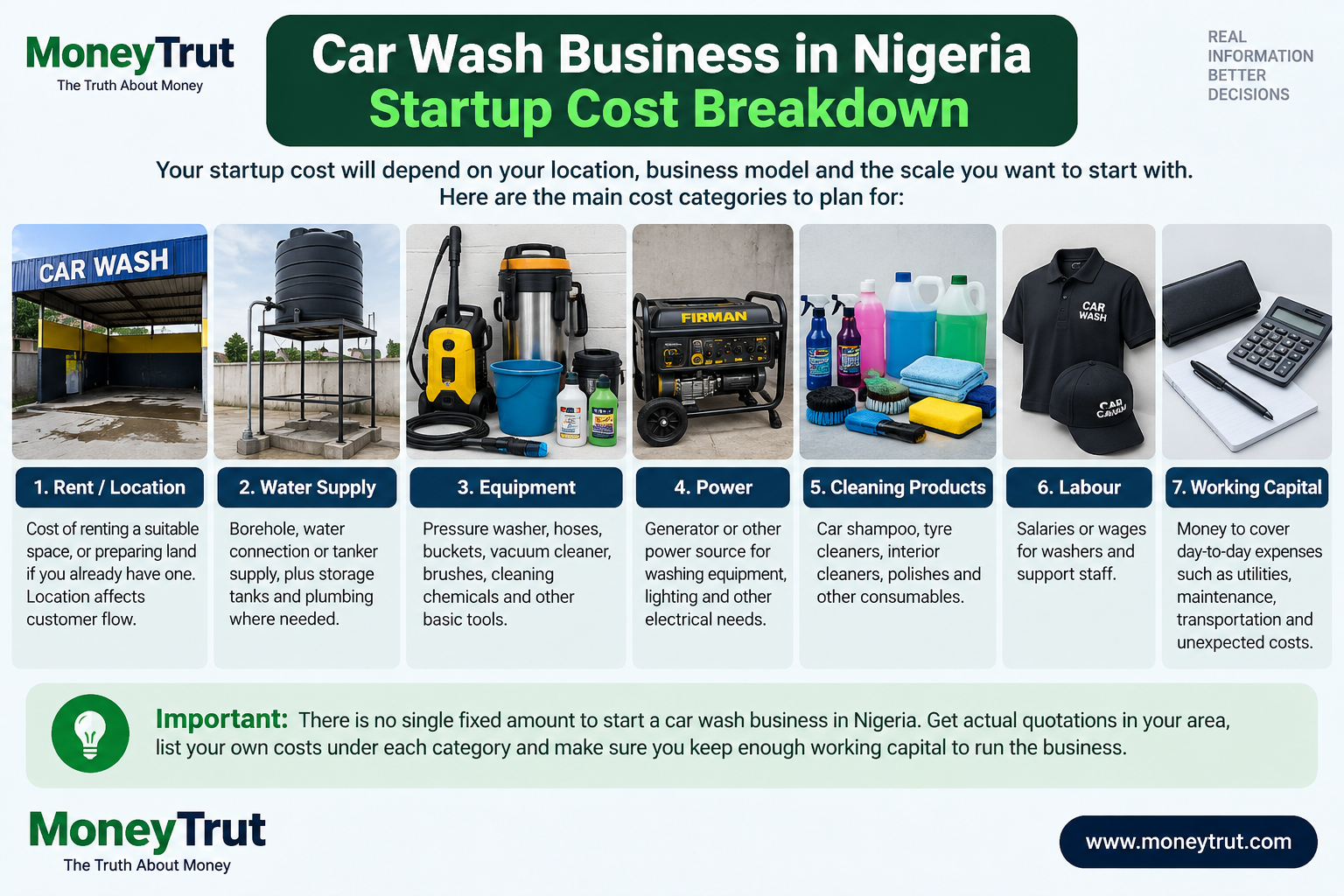
There is no single startup figure.
Your capital requirement depends on:
- Whether you already own the land
- Rent
- Location
- Water availability
- Drainage
- Pressure washer
- Generator or other power source
- Vacuum cleaner
- Water storage
- Shelter
- Signage
- Staff
- Cleaning products
- Working capital
Current Nigerian business guides show very different startup estimates because they are describing different scales of operation. One recent guide, for example, estimates a manual car-wash setup at substantially less than a larger operation requiring rent, drainage, water storage, power and higher-end equipment.
That is why a single headline such as “you need ₦2 million to start a car wash” can be misleading.
The better approach is to build your own startup budget.
Can You Start a Car Wash With ₦500,000?
Possibly, but the answer depends heavily on whether you already have access to suitable space, water and some equipment.
If you need to rent land, construct drainage, install water storage, buy a pressure washer, provide backup power and hire staff, ₦500,000 may not be enough for the model you have in mind.
If you already have suitable space and some basic equipment, the same amount could go much further.
For example, a small setup might allocate money toward:
- Basic washing equipment
- Hoses and brushes
- Cleaning products
- Water storage
- Basic shelter
- Signage
- Initial labour
- Working capital
These are planning categories, not fixed current prices.
Before spending anything, obtain actual quotations from suppliers in your area.
Step 1: Choose Your Car Wash Business Model
There are several ways to operate.
Basic Manual Car Wash
This is the simplest model.
Customers bring their vehicles, staff wash them manually and the vehicle is returned after cleaning.
The advantage is that you can begin with relatively simple equipment.
The disadvantage is that the business can become heavily dependent on labour and water availability.
Car Wash With Interior Cleaning
You add:
- Vacuuming
- Dashboard cleaning
- Interior wiping
- Mat cleaning
This can increase the amount customers are willing to pay.
Car Wash and Detailing
This is a more specialised model.
Services may include:
- Deep interior cleaning
- Paint correction
- Polishing
- Waxing
- Upholstery cleaning
- More detailed vehicle-care services
The equipment, skills and customer expectations are also higher.
Mobile Car Wash
Instead of customers coming to you, you travel to them.
You may serve:
- Homes
- Offices
- Estates
- Corporate customers
- Fleets
This model can reduce the need for a traditional roadside location, but transportation and logistics become more important.
Step 2: Choose the Right Location
Location can make or break a car wash.
You want an area where there is:
- A reasonable number of vehicle owners
- Convenient road access
- Sufficient space
- Reliable water access
- Suitable drainage
- Visibility
- Security
- Enough room for vehicles to enter and leave
A cheap location that nobody can conveniently access may not be a good bargain.
At the same time, the most expensive roadside location is not automatically the best.
Your objective is to find a location where the expected customer volume justifies the cost.
Step 3: Study Existing Car Washes
Before renting a location, visit other car washes in the area.
Observe:
- How many cars they wash
- Their busiest times
- Their prices
- Services offered
- Number of workers
- Waiting area
- Customer service
- Whether customers appear satisfied
- Whether they offer interior cleaning
- Whether they offer detailing
You can also speak with vehicle owners.
Ask:
- Where do you normally wash your car?
- How much do you usually pay?
- How often do you wash it?
- What do you dislike about existing car washes?
- Would you pay more for interior cleaning?
- Would you use a mobile service?
You are looking for a gap you can realistically fill.
Step 4: Check Water Supply Before Renting
Water is not a minor detail in a car wash.
Before signing a lease, determine:
- Where will your water come from?
- Is there a borehole?
- Is public water available?
- Will you buy water from tankers?
- How much storage capacity do you need?
- How much does water cost locally?
- What happens during shortages?
A car wash without reliable water can quickly become a business that cannot serve customers.
Water storage can also provide a buffer when supply is interrupted.
Step 5: Plan Your Drainage
Used water has to go somewhere.
Do not simply assume that you can wash vehicles on any piece of land and allow wastewater to run into the road.
Your site needs a practical drainage and wastewater-management arrangement appropriate to the location and applicable requirements.
Before committing to a property, investigate what local authorities or the property owner require.
Drainage can also become a major construction expense if the site is not already suitable.
Step 6: Choose the Equipment You Actually Need
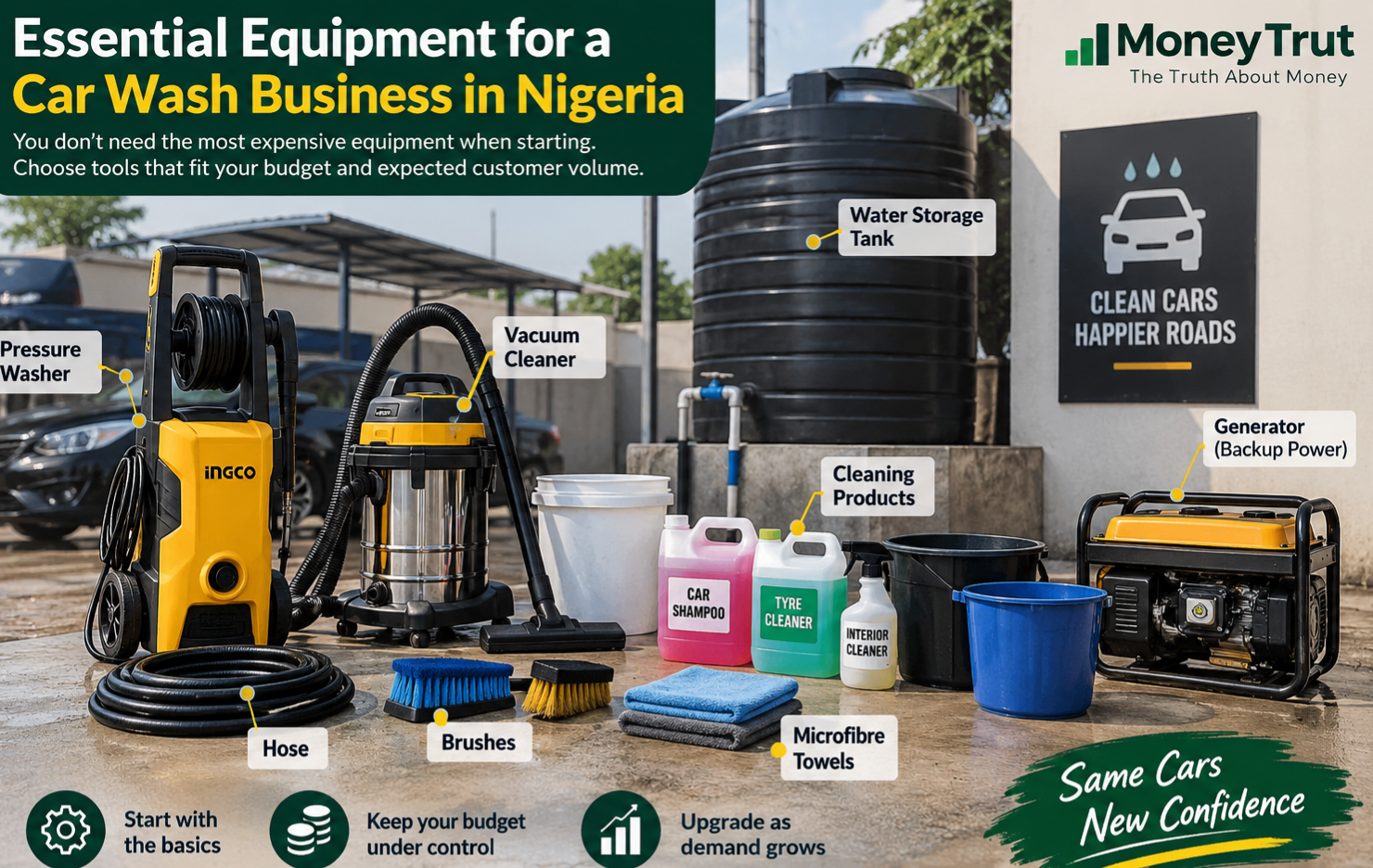
Basic equipment may include:
- Pressure washer
- Hoses
- Buckets
- Brushes
- Microfibre towels
- Car shampoo
- Wheel cleaner
- Tyre-cleaning products
- Interior-cleaning products
- Vacuum cleaner
- Water storage tank
- Generator or alternative power source
- Extension cables
- Drying equipment
A larger detailing operation may require additional specialised equipment.
Do not automatically buy the most powerful pressure washer available.
First determine:
- How many vehicles you expect to wash
- How many hours you will operate
- Water availability
- Power availability
- Maintenance requirements
- Cost of replacement parts
Your equipment should match your expected workload.
Step 7: Don't Spend Your Entire Capital on Equipment
Imagine you have ₦1 million.
You could spend ₦800,000 on equipment.
That may leave only ₦200,000 for everything else.
But the business still needs:
- Water
- Cleaning products
- Labour
- Transport
- Marketing
- Repairs
- Rent
- Unexpected expenses
A better startup budget leaves room for working capital.
The objective is not to own the most impressive equipment on day one.
It is to have enough equipment to deliver the service while keeping the business financially stable.
Step 8: Decide What to Charge
Your price should reflect:
- Water cost
- Cleaning chemicals
- Labour
- Electricity/fuel
- Equipment wear
- Rent allocation
- Time
- Desired margin
You should also consider local competition.
Suppose your direct cost of washing one vehicle is ₦1,200.
If you charge ₦3,000:
₦3,000 − ₦1,200 = ₦1,800
If you charge ₦2,000:
₦2,000 − ₦1,200 = ₦800
A lower price may attract more customers, but if the margin becomes too small, you may need an unrealistic number of vehicles every day just to cover your fixed expenses.
For broader guidance on pricing, see How to Price Your Products and Services in Nigeria Without Losing Money.
Step 9: Create Different Service Packages
You do not necessarily need one price for everything.
For example:
Basic Wash
- Exterior wash
- Rinse
- Dry
Standard Wash
- Exterior wash
- Tyre cleaning
- Interior vacuum
- Dashboard cleaning
Premium Cleaning
- Exterior wash
- Interior cleaning
- Detailed vacuuming
- Tyre treatment
- Additional detailing
The exact services and prices should be based on your market.
The benefit of packages is that customers can choose the level of service they want.
It also gives you an opportunity to increase your average revenue per customer without simply increasing the price of the basic wash.
Step 10: Track How Long Each Service Takes
Time is an important business cost.
Suppose a basic wash takes 30 minutes.
If your setup can process two cars per hour, your maximum theoretical capacity is very different from a setup that requires 60 minutes per vehicle.
Your capacity depends on:
- Number of workers
- Equipment
- Water supply
- Vehicle size
- Type of service
- Workflow
- Number of washing bays
Understanding capacity helps you avoid unrealistic revenue projections.
Step 11: Calculate Your Break-Even Point
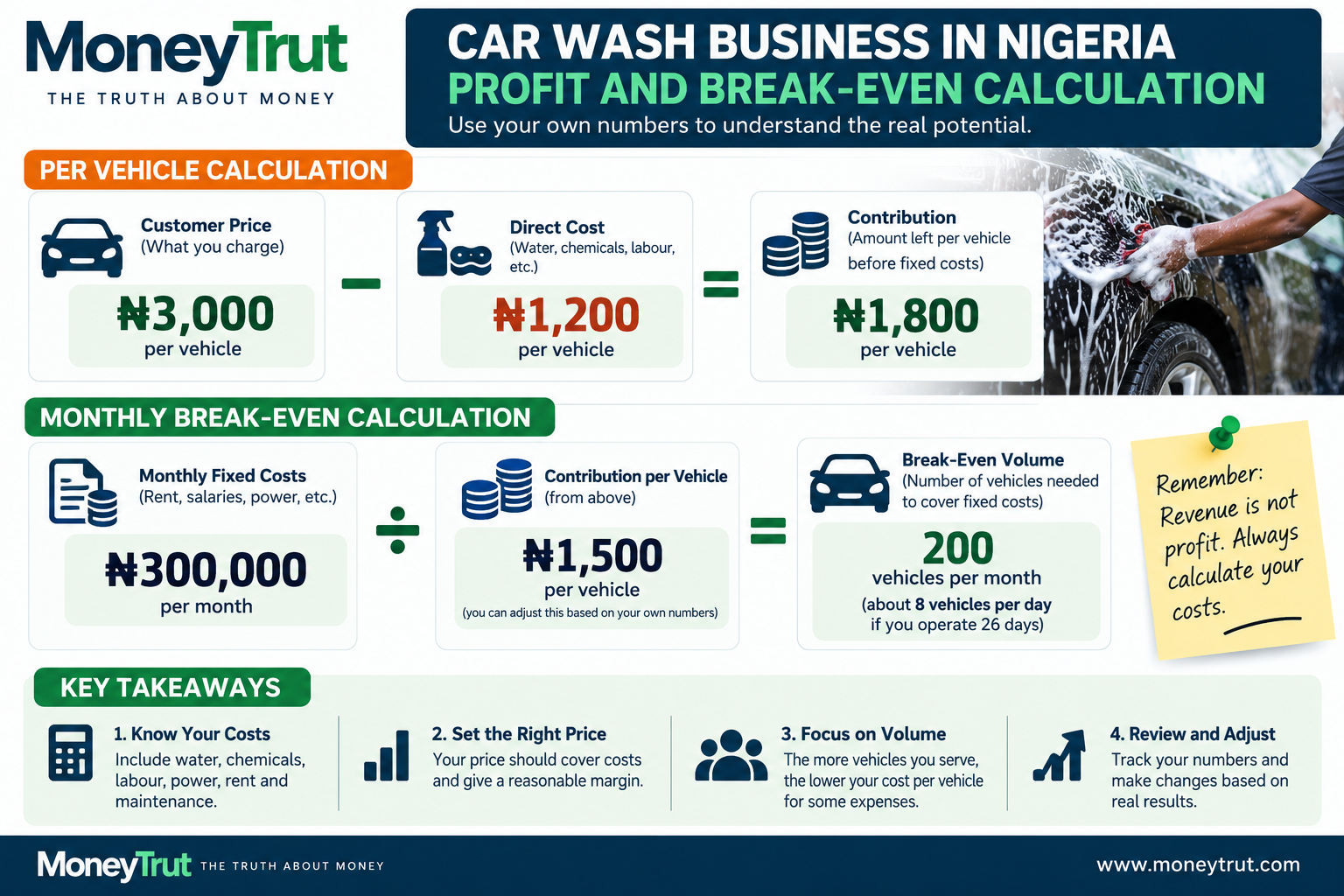
Suppose your monthly fixed costs are:
₦300,000
These could include:
- Rent allocation
- Staff salaries
- Security
- Basic utilities
- Other fixed costs
Suppose your average contribution after direct washing costs is:
₦1,500 per vehicle
Your simplified break-even volume would be:
₦300,000 ÷ ₦1,500 = 200 vehicles
If you operate 26 days per month:
200 ÷ 26 ≈ 7.7 vehicles per day
You therefore need roughly eight vehicles per day under these assumptions to cover the fixed costs.
This is much more useful than simply saying:
“A car wash can make ₦500,000 per month.”
You can change the assumptions and see how the business responds.
For more on break-even calculations, see How to Calculate the Break-Even Point for a Small Business in Nigeria.
Step 12: Find Your First Customers
You do not need hundreds of cars on the first day.
Start by building awareness in your immediate market.
Potential methods include:
- TikTok
- Google Business Profile
- Local flyers
- Referral offers
- Partnerships with estates
- Partnerships with offices
- Fleet operators
- Ride-hailing drivers
Your first customers may come from people who already know you.
Give them a good experience and ask satisfied customers to recommend your business.
Step 13: Target Regular Customers
A customer who washes once is useful.
A customer who returns every week or two weeks is more valuable.
Think about customer groups that may wash regularly:
- Private vehicle owners
- Ride-hailing drivers
- Corporate fleets
- Security companies
- Delivery businesses
- Car rental businesses
- Government or institutional fleets
- Businesses with company vehicles
You can create customer records and remind regular customers when they may be due for another service.
Step 14: Keep the Customer Experience Professional
Car washing is not only about water and soap.
Customers notice:
- How they are greeted
- How long they wait
- Whether staff are respectful
- Whether belongings are handled carefully
- Whether the vehicle is returned properly
- Whether prices are clear
- Whether staff damage anything
- Whether complaints are taken seriously
A customer who has to repeatedly check whether their belongings are still inside the vehicle may not return.
Train workers to treat every vehicle carefully.
Step 15: Be Careful With Customers' Vehicles
A car wash can create liability when property is damaged.
Before washing a vehicle, establish a simple inspection process.
Check for obvious:
- Existing scratches
- Broken mirrors
- Damaged lights
- Loose trim
- Other visible issues
You do not need to create unnecessary conflict with customers.
The purpose is simply to document obvious pre-existing conditions where appropriate.
If you offer more specialised services, make sure staff understand what they are doing.
Do not experiment with aggressive chemicals or equipment on a customer's vehicle.
Step 16: Keep Proper Business Records
Record:
- Date
- Vehicle/service
- Amount charged
- Payment method
- Cleaning products used
- Staff involved
- Discounts
- Additional services
- Customer complaints
At the end of each day, you should know:
How many cars did we wash?
How much money came in?
How much was spent?
What remains?
This helps prevent cash leakage and gives you information for future decisions.
For a simple small-business record system, see How to Keep Business Records in Nigeria: A Simple System for Small Businesses.
Step 17: Consider Business Registration
If you intend to build the operation into a serious business, you can consider registering the business with the Corporate Affairs Commission.
CAC's current business-name process involves checking name availability, completing the relevant pre-registration information, uploading required documents and paying the applicable filing fee through its Company Registration Portal. CAC also states that individual proprietors can register business names without using a lawyer, chartered accountant or chartered secretary.
Registration is only one part of formalising the business.
It does not guarantee customers or profitability.
You should also check any local requirements that may apply to your location, premises, drainage, environmental management or signage before opening.
Step 18: Think About Power Costs
Power can affect your costs significantly if your operation depends on:
- Pressure washers
- Vacuum cleaners
- Lighting
- Pumps
- Compressors
- Other electrical equipment
If you use a generator, include fuel and maintenance in your calculations.
For example, if you spend ₦5,000 on fuel in a day and wash only five vehicles, fuel alone represents:
₦5,000 ÷ 5 = ₦1,000 per vehicle
If you wash 20 vehicles:
₦5,000 ÷ 20 = ₦250 per vehicle
The same generator cost therefore has a very different effect depending on your customer volume.
This is why capacity and customer volume matter.
Step 19: Add Services Only When They Make Sense
Once the basic washing service is stable, you can consider additional services.
Examples include:
- Interior detailing
- Upholstery cleaning
- Carpet cleaning
- Waxing
- Polishing
- Headlight restoration
- Engine-bay cleaning where appropriate
- Motorcycle washing
But do not add services simply because competitors offer them.
Ask:
Will customers pay enough for this service to justify the equipment, labour and time?
A service that generates ₦10,000 in revenue but costs ₦9,000 to provide may not be as attractive as one generating ₦7,000 with ₦4,000 in contribution.
Common Car Wash Business Mistakes
1. Choosing a location because rent is cheap
Cheap rent does not compensate for poor customer access.
2. Ignoring water supply
A car wash cannot operate consistently without enough water.
3. Ignoring drainage
Wastewater needs to be managed properly.
4. Buying expensive equipment too early
Equipment should follow demand.
5. Underpricing
Low prices can produce high customer volume but weak margins.
6. Forgetting power and fuel costs
These can significantly affect operating expenses.
7. Mixing business money with personal money
This makes profitability difficult to measure.
8. Failing to track the number of cars washed
You need customer volume data to understand the business.
9. Damaging customer vehicles
Poor handling can destroy customer trust.
10. Expanding before the first location works
A second location should be based on evidence, not excitement.
How to Grow a Car Wash Business
Once the first operation becomes stable, you can grow by:
- Increasing service capacity
- Adding another washing bay
- Hiring and training more staff
- Introducing detailing
- Offering fleet packages
- Building corporate relationships
- Offering pickup or mobile services
- Extending operating hours
- Opening another location
Growth should follow demand.
If customers are regularly waiting because you cannot serve them quickly enough, additional capacity may make sense.
If your business has very few customers, buying another pressure washer probably will not solve the underlying problem.
A Simple 30-Day Launch Plan
Week 1: Research
Study your target location.
Visit competing car washes.
Check prices.
Talk to vehicle owners.
Investigate water, drainage and power.
Week 2: Budget
Get actual equipment quotations.
Calculate rent.
Estimate water costs.
Estimate power and fuel.
Calculate cleaning-product costs.
Set aside working capital.
Week 3: Setup
Prepare the site.
Install basic equipment.
Create your pricing.
Train staff if necessary.
Set up your payment and record-keeping system.
Week 4: Launch and Measure
Start serving customers.
Record every vehicle.
Track revenue.
Track direct costs.
Monitor customer feedback.
Identify your busiest times.
Then calculate whether your original assumptions were correct.
Bottom Line
A car wash business can be started on a small scale in Nigeria, but the business becomes much more complicated once you look beyond the bucket, hose and pressure washer.
Water, drainage, location, power, labour, equipment maintenance and customer volume all affect the economics.
Before opening, calculate how much it costs you to serve one vehicle and how many vehicles you need each day to cover your fixed expenses.
Start with the services you can deliver consistently. Keep your initial investment under control, protect customers' vehicles and build a reputation for reliable service.
If demand grows, you can gradually add equipment, staff and higher-value detailing services.
The goal is not simply to wash as many cars as possible.
The goal is to build a car wash that turns each customer into sustainable revenue while keeping the cost of serving them under control.
Related Articles
- How to Start a Small Business in Nigeria With Little Money
- How to Price Your Products and Services in Nigeria Without Losing Money
- How to Keep Business Records in Nigeria: A Simple System for Small Businesses
- How to Calculate the Break-Even Point for a Small Business in Nigeria
- How to Manage Cash Flow in a Small Business in Nigeria
- How to Get Repeat Customers for a Small Business in Nigeria

You must be logged in to post a comment.